Est. 1847 · National Register of Historic Places · Garden cemetery designed by John Notman · Burial place of Presidents Monroe and Tyler · Burial place of Jefferson Davis · Approximately 18,000 Confederate dead
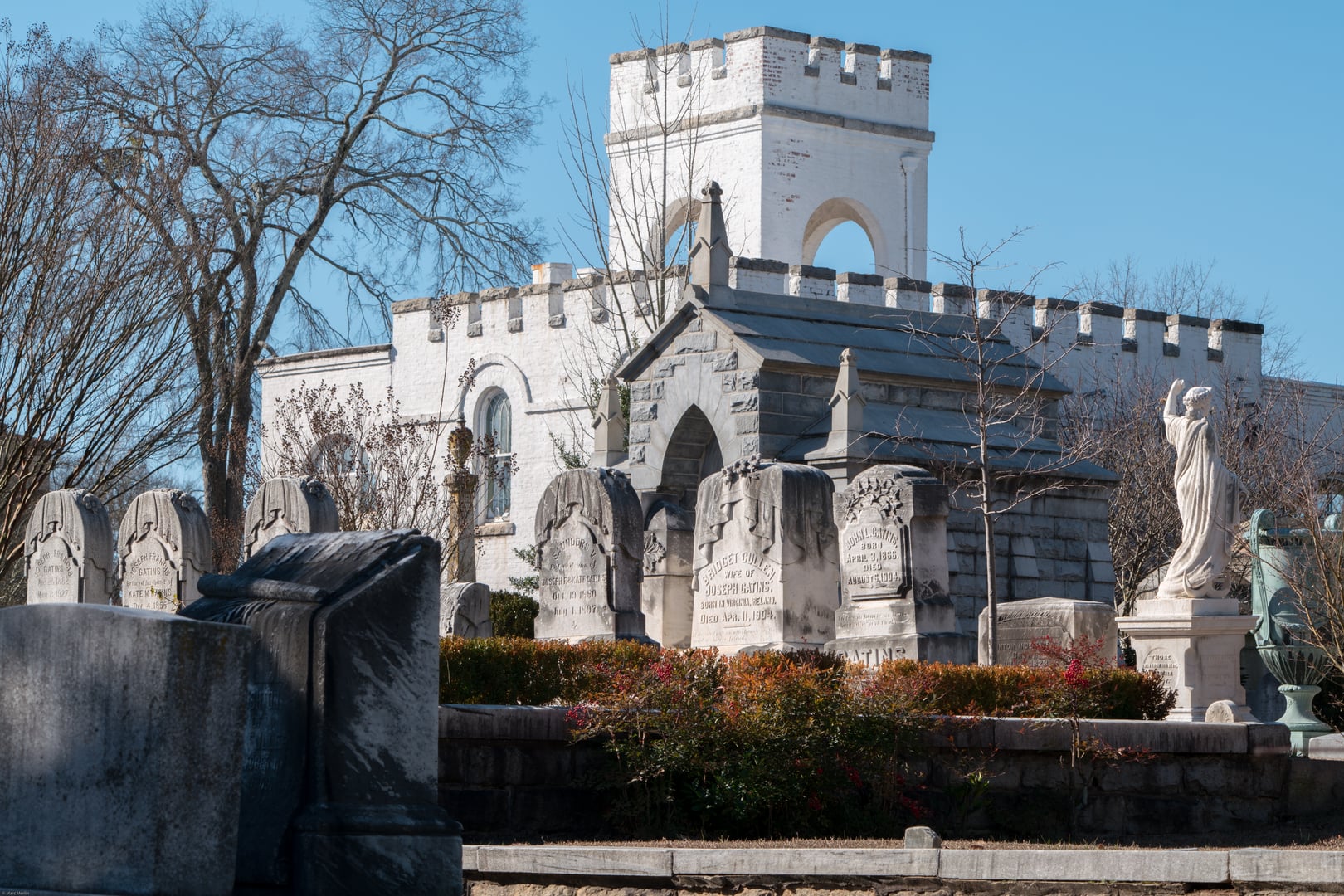
Hollywood Cemetery sits on a bluff above the James River on Richmond's western edge. It was incorporated in 1847 by William Haxall and Joshua Fry, who were inspired by Mount Auburn Cemetery near Boston — the first U.S. example of the rural garden cemetery movement, which sought to replace cramped urban churchyards with naturalistic burial parks. Haxall and Fry hired Philadelphia architect John Notman, then one of America's leading designers in the rural cemetery style, to lay out the grounds. The first interment took place in 1849.
The cemetery's burial register reads as a Richmond historical index. Presidents James Monroe (reinterred from New York in 1858) and John Tyler are buried in the President's Circle on the eastern bluff. Confederate President Jefferson Davis was reinterred there in 1893 alongside his wife Varina and their daughter Winnie. Confederate Generals J.E.B. Stuart, George Pickett, and Fitzhugh Lee are among the 25 Confederate generals interred at Hollywood.
The site also holds the remains of approximately 18,000 enlisted Confederate soldiers, many moved from battlefield burials at Gettysburg and elsewhere after the war. In 1869 a 90-foot granite pyramid designed by Charles H. Dimmock was erected as a memorial to these enlisted dead. The cemetery's significant Confederate burial history is inseparable from the Civil War's defense of slavery, and modern interpretation by the cemetery and outside historians has worked to contextualize rather than memorialize that aspect of the site.
The cemetery operates as a private, non-profit organization and is still in active use, with the Friends of Hollywood Cemetery running tours, restoration, and educational programming. It was added to the National Register of Historic Places in 1969 and now spans approximately 135 acres with roughly 65,000 burials.
Sources
- https://en.wikipedia.org/wiki/Hollywood_Cemetery_(Richmond,_Virginia)
- https://www.hollywoodcemetery.org/
- https://www.battlefields.org/visit/heritage-sites/hollywood-cemetery
- https://en.wikipedia.org/wiki/Richmond_Vampire
- https://en.wikipedia.org/wiki/Church_Hill_Tunnel
Vampire-like figure (Richmond Vampire legend)Spectral black dog near child's graveConfederate soldier apparitionsCold spots near Pool mausoleum
The cemetery's most enduring story is the Richmond Vampire, an urban legend documented in Wikipedia and traced in detail by writer David Castleton and the alt-weekly Style Weekly. The legend centers on the granite mausoleum of W.W. Pool, dated 1913, and a real industrial disaster: on October 2, 1925, the Church Hill Tunnel a few miles east of the cemetery collapsed onto a work train, killing several rail workers. Among those mortally injured was railroad fireman Benjamin F. Mosby, whose body was severely scalded by the locomotive's ruptured boiler; he died that same day at Grace Hospital, hours after the collapse.
In the years that followed, an oral legend grew that a horrific bloodied figure with broken teeth had been seen running from the tunnel mouth in the direction of Hollywood Cemetery and disappearing into the Pool mausoleum. Castleton notes that the two narratives — Pool's alleged vampirism and the Mosby tragedy — were not actually combined in print until around 2001 in online retellings, suggesting the modern 'Richmond Vampire' is a relatively recent composite folklore. Wikipedia's article on the Richmond Vampire treats the tale as urban legend, not history.
The Lineup and Richmond Ghosts also document a separate cluster of phenomena: a spectral black dog said to guard the grave of a young child whose iron-statue dog still stands over the plot, and recurring reports of Confederate soldier apparitions moving through the Confederate sections at dusk. These are consistently sourced to oral tradition and ghost-tour operators rather than primary documentation.
Notable Entities
The Richmond Vampire (W.W. Pool)Benjamin F. Mosby (1925 tunnel victim)Black dog guardian