Est. 1872 · 1838 Metairie Race Course Outline Preserved · Nine Louisiana Governors Buried · Three Confederate Generals · Josie Arlington Tomb · Garden Cemetery Movement
The site that became Metairie Cemetery began as a horse racing track in 1838, established by Colonel James Garrison and Richard Adams. The Metairie Race Course operated as one of the leading thoroughbred racetracks in the antebellum South. During the Civil War, racing was suspended and the grounds were used as a Confederate encampment until New Orleans fell to Admiral David Farragut's Union fleet in April 1862.
After the war, the track resumed operation briefly, but the Metairie Jockey Club went bankrupt in the late 1860s. According to durable New Orleans tradition, after wealthy real-estate developer Charles T. Howard was refused membership in the Metairie Jockey Club, he vowed that the racecourse would one day be a cemetery. In 1872 Howard and partners purchased the property and converted it. The 1838 oval was preserved as the cemetery's principal carriage drive, a feature still visible from aerial views today.
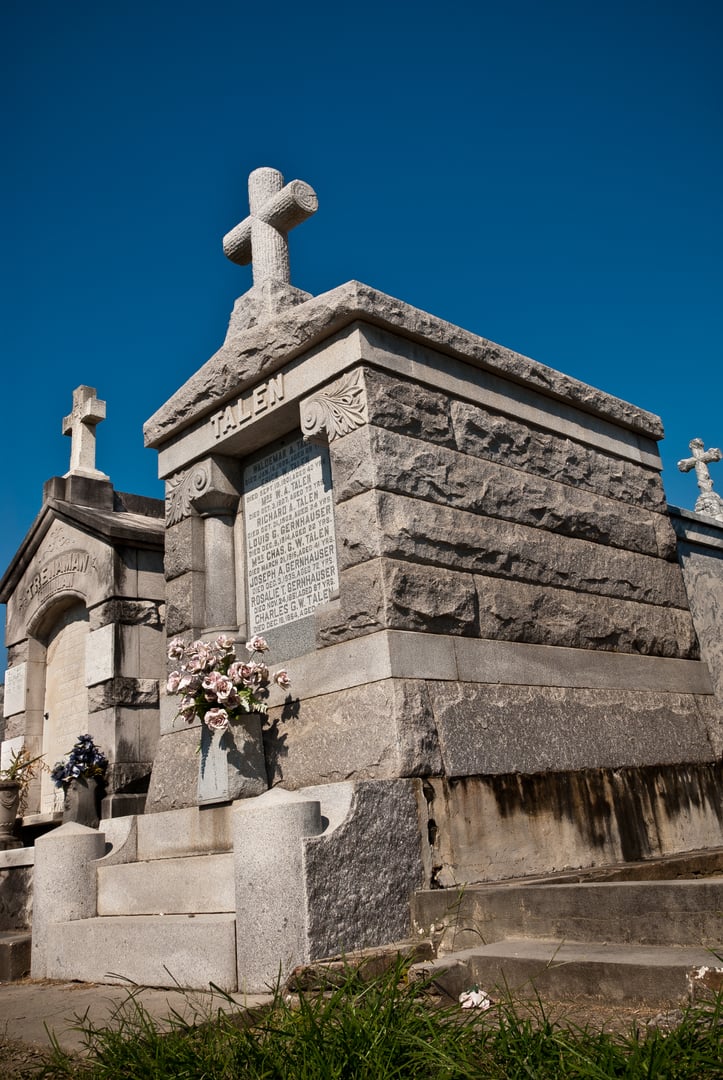
Metairie was designed in the rural garden cemetery tradition pioneered by Mount Auburn in Massachusetts and Laurel Hill in Pennsylvania, with curving drives, water features, and large family monuments. Across its 150 years of operation the cemetery has accumulated some of the most elaborate funerary architecture in the United States. Notable monuments include the Army of Tennessee, Louisiana Division tumulus, designed by sculptor Alexander Doyle, with an equestrian statue of General Albert Sidney Johnston who was killed at Shiloh in 1862; the 60-foot Moriarty obelisk built by Daniel Moriarty for his wife Mary Farrell; the Egyptian Revival Brunswig tomb; and the marble tomb of police chief David Hennessy, whose 1890 murder ignited one of the largest mass lynchings in American history.
The cemetery holds the burials of nine Louisiana governors, three Confederate generals, jazz musicians including Louis Prima, and Storyville madam Josie Arlington. The original tomb of Confederate President Jefferson Davis was located at Metairie before his remains were moved to Hollywood Cemetery in Richmond in 1893.
Sources
- https://en.wikipedia.org/wiki/Metairie_Cemetery
- https://www.atlasobscura.com/places/metairie-cemetery-new-orleans
- https://theclio.com/entry/31225
- https://prcno.org/historic-metairie-cemetery/
- https://www.battlefields.org/learn/articles/metairie-cemetery-new-orleans
Lights flickeringPhantom soundsApparitionsOrbs
Metairie Cemetery is a regular stop on New Orleans's elite cemetery and ghost tour circuit. Several of its monuments carry well-developed folklore.
The most-told story concerns the original tomb of Josie Arlington, born Mary Deubler, the most famous Storyville madam of the late 19th and early 20th centuries. Arlington commissioned a red Stony Creek granite mausoleum carved with a young woman approaching the bronze door with her arm raised — interpreted as either knocking to enter or being refused entry. After Arlington's burial in 1914, residents reported the tomb glowing with flickering red light at night. The glow was eventually traced to reflections of a nearby red streetlamp on the polished granite, but the story circulated widely and the tomb became a major attraction. Arlington's surviving family later sold the tomb to another family; her remains were moved elsewhere in the cemetery.
A second tradition concerns the Army of Tennessee tumulus and its equestrian statue of General Johnston. Visitors have reported the sound of distant cavalry hoofbeats near the monument at dusk and occasional figures in Confederate uniform observed near the tumulus entrance.
The Moriarty monument generates a third set of accounts. Daniel Moriarty's 60-foot obelisk is topped by four allegorical female figures representing Faith, Hope, Charity, and a fourth widely interpreted as 'Mrs. Moriarty.' Local lore holds that the fourth figure occasionally moves between visits; the claim has no documented basis in cemetery records.
The cemetery's main funeral home reports that the most-photographed nighttime paranormal phenomenon at Metairie is the appearance of unexplained orbs in flash photography, which a cemetery's spokesperson has consistently attributed to humidity and pollen common in the Louisiana climate.
Notable Entities
The Flaming Tomb of Josie ArlingtonThe Cavalry of Albert Sidney Johnston
Media Appearances
- The Moonlit Road podcast
- Multiple New Orleans cemetery tour features