Est. 1892 · Richardsonian Romanesque mansion designed by Harvey L. Page and William Winthrop Kent · Built 1888-1892 for tobacco magnate Lewis Ginter (1824-1897) · Inherited by Ginter's niece Grace Arents in 1897 · Richmond's first public library 1925-1930 · VCU Monroe Park administrative center for 40+ years · De-commemorated by VCU Board of Visitors in September 2020 · Contributing structure to the West Franklin Street Historic District
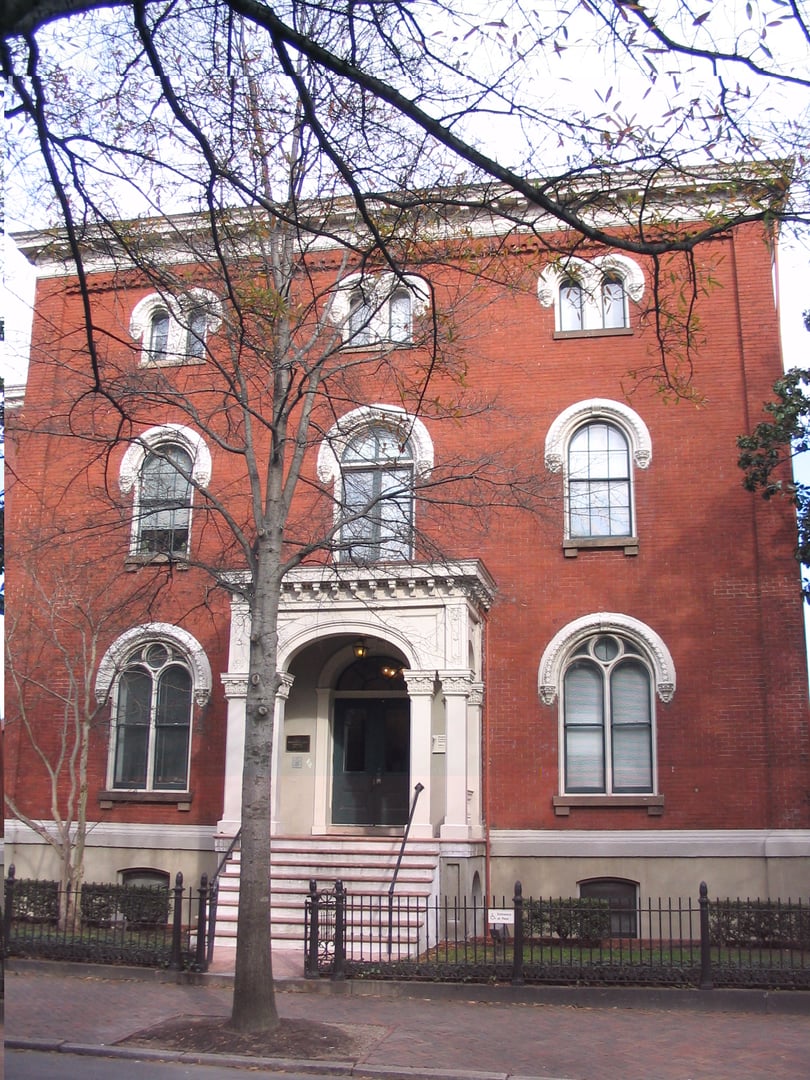
The Ginter House occupies the prominent corner of West Franklin and Shafer Streets in Richmond, on what is now VCU's Monroe Park campus. Designed in the Richardsonian Romanesque style by architects Harvey L. Page and William Winthrop Kent, the house was built between 1888 and 1892 as the city residence of Lewis Ginter — the Richmond tobacco magnate who co-founded Allen & Ginter (later folded into the American Tobacco Company), built The Jefferson Hotel, and shaped much of the city's late-19th-century development. The exterior features a three-and-a-half-story massing with a polygonal corner tower, brownstone base, patterned brick, carved stone panels, and a Spanish-tile roof; the interior retained decorative woodwork, ornate fireplaces, stained glass windows, and leather wallpaper for much of the 20th century.
Ginter never married. He lived in the house with his business associate and friend John Pope and his niece Grace Arents until Ginter died of complications from diabetes on October 2, 1897, at his country estate Westbrook, leaving the Franklin Street house and his fortune to Arents. Arents held the property until 1926. In 1925-1930 the building briefly served as Richmond's first public library and then was sold in 1930 to the Richmond School of Social Work and Public Health — a forerunner of VCU. It went on to serve as the primary administrative building on VCU's Monroe Park campus for more than forty years.
In September 2020 VCU's Board of Visitors voted to de-commemorate several campus buildings named for figures associated with the Confederacy — including the Lewis Ginter House. The building is now formally known as the Office of the Provost; the building itself, however, has not been renamed to honor anyone else and is still widely referred to as Ginter House.
The Ginter House was listed on the National Register of Historic Places as part of the West Franklin Street Historic District and is recognized as one of the finest surviving examples of Richardsonian Romanesque domestic architecture in Virginia.
Sources
- https://en.wikipedia.org/wiki/Ginter_House
- https://en.wikipedia.org/wiki/Lewis_Ginter
- https://theshockoeexaminer.blogspot.com/2015/09/ginter-house-architectural-history.html
- https://news.vcu.edu/article/Haunts_of_VCU
- https://www.lewisginter.org/where-did-lewis-ginters-money-go/
Restroom door handle violently rattling on an empty hallway (1999, VCU Police)Quick-moving shadow recurring in basement restroom (VCU Office of the Provost staff)Figure reported floating up the central staircase (ghost-tour lore)
The Ginter House is one of four VCU buildings featured in the university's own 'Haunts of VCU' article — an unusual public acknowledgment of ghost lore from a major research university. The earliest documented incident is from 1999: according to VCU News, a midnight-shift VCU Police officer was in a second-floor restroom of Ginter House when he heard a door handle on the same hallway violently rattle. When he stepped out to investigate, the hallway was empty and no one had entered or left the floor.
More recently, Kristen Luck of VCU's Office of the Provost told VCU News she has repeatedly seen 'something out of the corner of my eye…a shadow move by pretty quickly' in the basement restroom. A coworker suggested the shadow might be 'a woman…probably a worker in the Lewis Ginter House in the early 1900s' — a folk interpretation tying the phenomenon to a Gilded Age domestic servant rather than to Ginter or his family. No name or independent documentation has been attached to this figure; she is best understood as anonymous building-staff lore.
Richmond ghost-tour aggregators have also reported a figure 'floating up the central staircase' and stories of a previous owner who died in his upstairs bed. We note that the only documented owner death directly tied to the house is Grace Arents (post-1897), and Lewis Ginter himself died at his country estate Westbrook, not in the Franklin Street mansion. The 'upstairs deathbed' detail therefore lacks primary-source corroboration and is presented here only as ghost-tour folklore.
Notable Entities
Anonymous 'early-1900s house worker' figure (per coworker interpretation in VCU News)