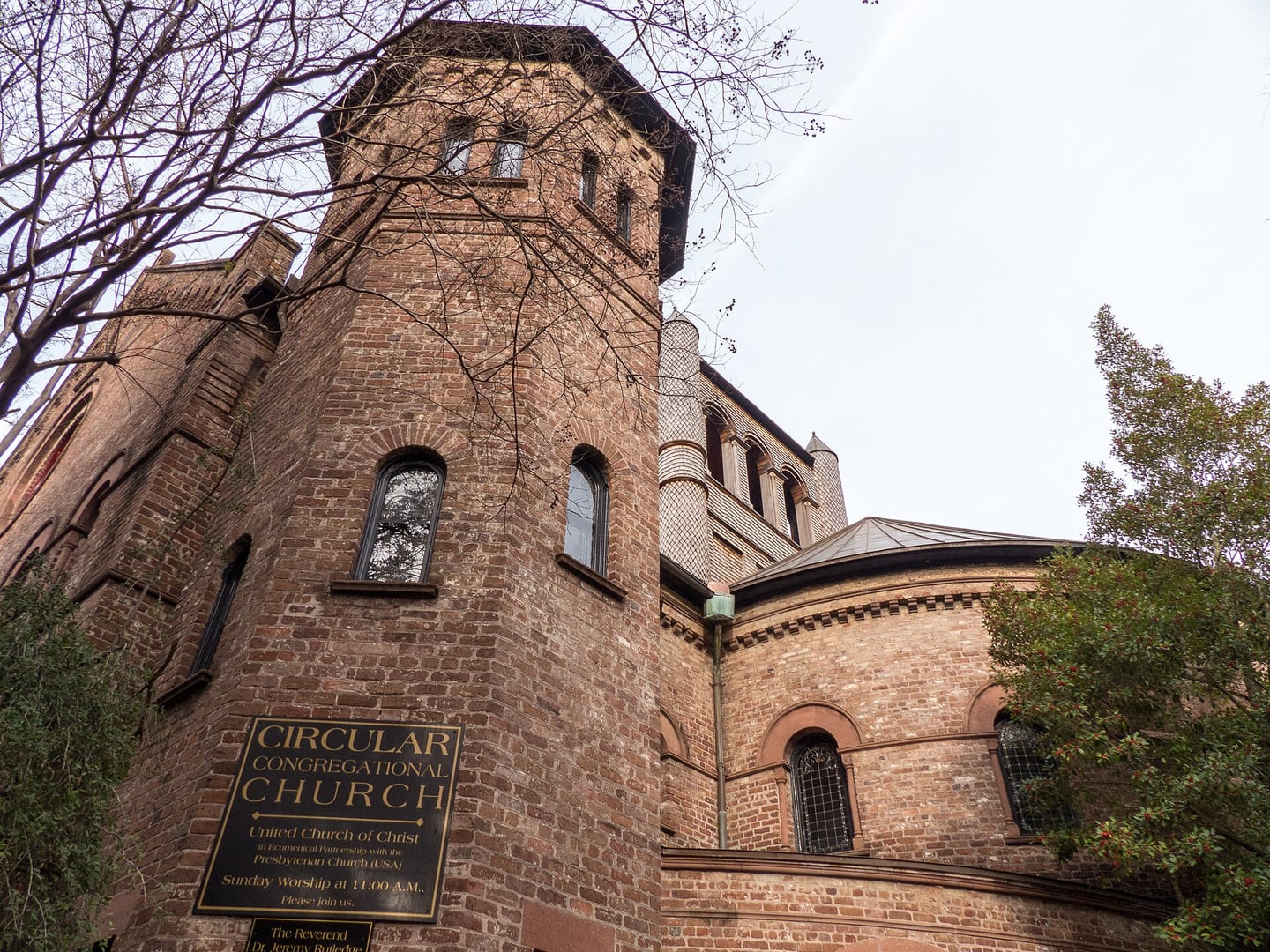
Oldest Unitarian church in the American South · Second-oldest church building in Charleston (after St. Michael's) · Second-oldest cemetery on the Charleston peninsula (1772) · Churchyard designed in 1831 by Caroline Gilman
The operator’s history gives conflicting origin dates: it says the church started in 1774, but also says the sanctuary was built by 1772. Construction, was halted by the Revolutionary War; British soldiers stabled horses inside the partially built church and Patriot forces also occupied it. After repairs, the church was consecrated in 1787.
The congregation formally adopted Unitarian theology in the 1810s under the ministry of Anthony Forster, becoming the first Unitarian church in the American South. The Reverend Samuel Gilman served as minister from 1819 until his death in 1858; he is best remembered nationally for writing the Harvard anthem 'Fair Harvard.' Francis Lee was commissioned in 1832 to redesign the church in perpendicular Gothic style, patterned after King’s College Chapel, Cambridge. The fan-traceried ceiling was copied from that church, and the original brick walls were retained under stucco.
The cemetery adjoining the church was established with the congregation in 1772 and is among the oldest burial grounds on the Charleston peninsula. Caroline Gilman designed the churchyard in 1831. The churchyard's intentionally 'wild' character, with naturalized grasses, flowering plants, and slow-decaying stones, remains its defining feature today.
The Unitarian Church and its churchyard are contributing structures to the Charleston Historic District National Historic Landmark.
Sources
- https://en.wikipedia.org/wiki/Unitarian_Church_in_Charleston
- https://www.nps.gov/places/unitarian-church.htm
- https://www.scpictureproject.org/charleston-county/unitarian-church-in-charleston.html
- https://www.atlasobscura.com/places/unitarian-church-cemetery
- https://beastofbladenboro.com/the-haunted-unitarian-church-cemetery-of-charleston/
- https://alexandracharitan.com/blog//2017/02/charleston-unitarian-church-st-johns.html
- https://ghostlandia.media/2023/03/16/the-spirit-of-annabel-lee-at-the-unitarian-church-cemetery-in-charleston/
Lady in White apparition gliding between gravestonesCold spots in the back of the cemeteryFleeting figures in peripheral visionSense of being watched
The Unitarian Church Cemetery is one of Charleston's most-cited haunted spots, with the central legend involving a 'Lady in White' said to wander among the gravestones and wildflowers. Live 5 News' 'Haunted Charleston' coverage and Atlas Obscura both note the recurring reports of a female figure in a long white dress, often described as appearing to glide rather than walk between the stones.
The most popular folk-explanation connects the apparition to one 'Anna Ravenel,' said to have been the daughter of Charleston physician Dr. Edmund Ravenel and the lover of a young soldier — sometimes identified with Edgar Allan Poe during his 1827-1828 enlisted service at Fort Moultrie on Sullivan's Island. The legend further holds that Anna's family forbade the romance, that she died young, and that her ghost continues to seek him in the churchyard. Tour-operator copy frequently goes a step further and claims she was the inspiration for Poe's 1849 poem 'Annabel Lee.'
Charleston historians and the church itself note that this story is folklore. Dr. Edmund Ravenel was a real Charleston physician and naturalist, but no documentary evidence located in this research indicates he had a daughter named Anna. Poe did serve at Fort Moultrie under the name Edgar A. Perry from late 1827 to December 1828 — that part of the legend is historically grounded — but the connection between Poe, the supposed Anna, and 'Annabel Lee' (written more than two decades later) rests on storytelling tradition rather than primary sources.
Additional phenomena reported by tour guides and visitors include cold spots in the back of the cemetery, fleeting figures in peripheral vision, and the sense of being watched while reading the older stones. The intentionally unkempt landscape — moving grasses, dappled shadows under live oaks, the gentle uneveness of the ground — creates conditions conducive to the kind of subjective experiences that fuel cemetery ghost reports.
Notable Entities
'Anna Ravenel' (folkloric — no documentary evidence Dr. Edmund Ravenel had a daughter Anna)Edgar Allan Poe associations (Poe's 1827-1828 Fort Moultrie service is documented; the cemetery connection is folklore)
Media Appearances
- Live 5 News 'Haunted Charleston' (2018)
- Atlas Obscura entry