Eighteenth-century Spanish/French Catholic Campo Santo cemetery · 1819 partial relocation to Church Street Graveyard · 1890s accidental grave-unearthings along Conti Street · 1979 building demolition created the current public park · Faces the 1850s Cathedral Basilica of the Immaculate Conception
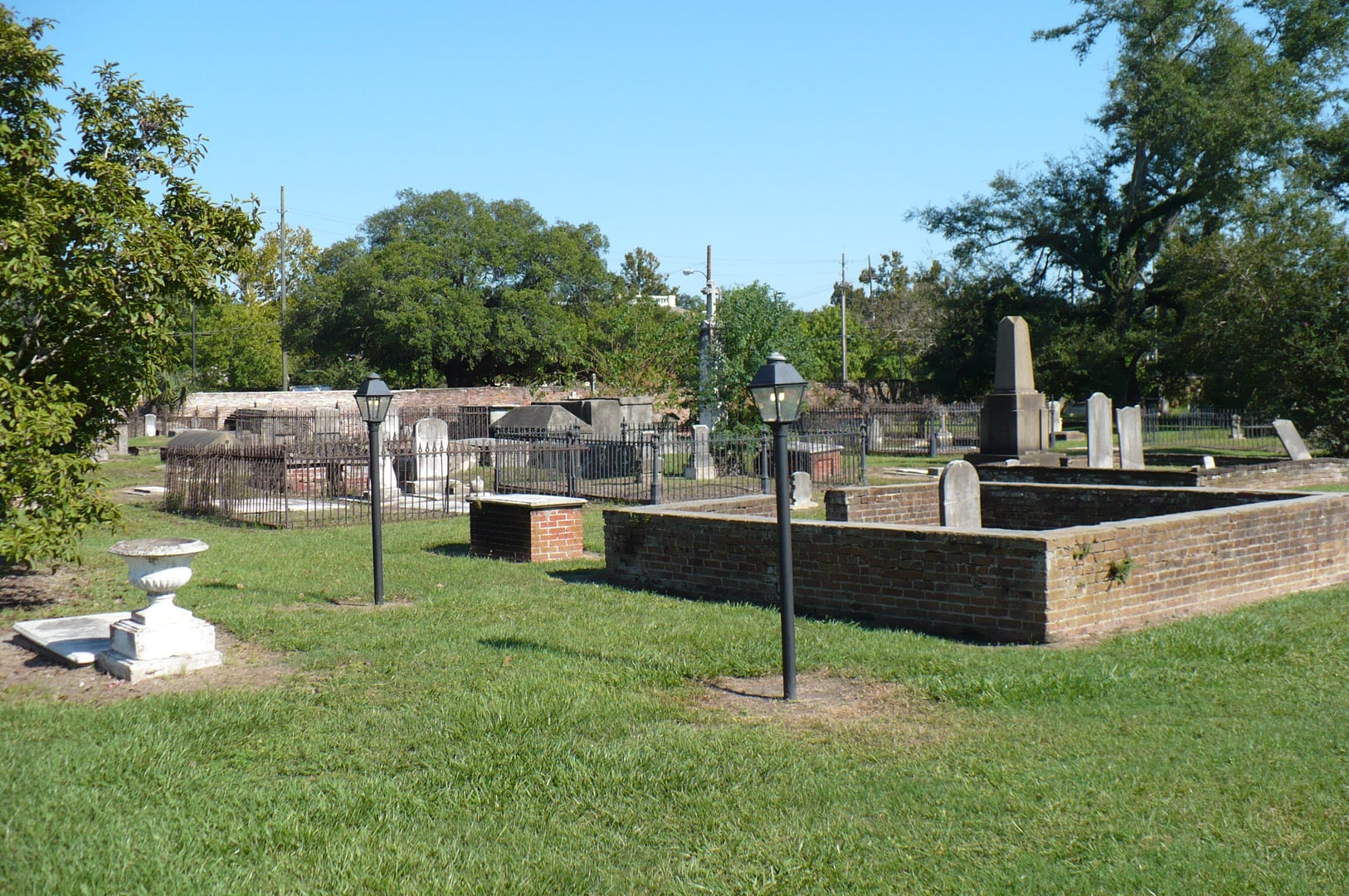
The Campo Santo was the eighteenth-century Catholic cemetery serving Mobile's Spanish-colonial, French-colonial, and early American populations. The burial ground measured roughly 400 feet long by 300 feet wide and filled portions of what are now several city blocks between Joachim, Dauphin, Franklin, and Conti Streets in downtown Mobile. It served as the primary Catholic burial site for over a century, with interments spanning the city's colonial-era and early-statehood populations.
In 1819, as Mobile's boundaries expanded and the increasingly American population objected to interments so close to the booming commercial district, most of the burials were relocated to the newly-established Church Street Graveyard a short distance away. The relocation was substantial but not complete. Mobile city records and contemporaneous newspaper accounts document that additional graves continued to be accidentally unearthed along Conti Street during utility-construction and building-foundation work as late as the 1890s, indicating that a significant number of remains were never disinterred.
The area that is now Cathedral Square was filled with commercial buildings through most of the nineteenth and twentieth centuries. In 1979 these buildings were demolished to create the public park facing the 1850s Cathedral Basilica of the Immaculate Conception. The park has since been maintained by the Downtown Parks Conservancy and hosts farmers' markets, festivals, and Mardi Gras programming.
The Cathedral Basilica itself, completed in the 1850s, sits on part of the old graveyard footprint and could legitimately be considered part of the same Campo-Santo historical site. The Find a Grave entry for the Campo Santo notes that the cemetery 'is buried beneath what is now Cathedral Square Park' and is recognized as a historic cemetery site.
Sources
- https://en.wikipedia.org/wiki/Cathedral_Square,_Mobile,_Alabama
- https://en.wikipedia.org/wiki/Cathedral_Basilica_of_the_Immaculate_Conception_(Mobile,_Alabama)
- https://encyclopediaofalabama.org/article/church-street-graveyard/
- https://www.findagrave.com/cemetery/2572875/campo-santo
- https://usghostadventures.com/mobile-ghost-tour/cathedral-square/
- https://bienvillebitesfoodtour.com/blog/12-haunted-places-in-mobile-alabama/
Whispered voices at duskSensation of being watchedShadow figures near the cathedral stepsAtmospheric cold in still-air conditions
Cathedral Square's lore is anchored in the documented historical fact that many Campo Santo burials were never moved during the 1819 relocation, with additional graves still being accidentally unearthed along Conti Street into the 1890s. The US Ghost Adventures Mobile Ghost Tour write-up for the square frames this as the central paranormal premise: that the public-park lawns and benches sit directly above un-relocated remains.
Reported phenomena are atmospheric rather than apparitional. Visitors and ghost-tour participants describe whispered voices heard while crossing the square at dusk, a strong sensation of being watched while seated on benches near the cathedral side, and occasional shadow figures glimpsed near the cathedral steps before disappearing. The Bienville Bites Food Tour series and Mobile's official tourism haunted-history coverage both repeat this general pattern.
The square's haunted reputation is consistently framed in the published lore as a sense-of-presence experience rather than a discrete-entity haunting. No named historical figure is associated with the Cathedral Square reports; the activity is treated as collective and ambient, an effect of the un-relocated colonial-era dead beneath the modern park.
The historical record's documented 1890s accidental grave-unearthings give the lore an unusual evidentiary foundation: the central claim — that bodies remain beneath the square — is not folklore but documented urban-archaeology fact. The paranormal interpretation built on top of that fact remains untestable, but the underlying premise is well-anchored.
Media Appearances
- US Ghost Adventures Mobile Ghost Tour dedicated stop
- Bienville Bites Food Tour 12 Haunted Places coverage