Congregation founded around 1681 (English Congregational, Scots Presbyterian, French Huguenot union) · Charleston’s oldest burial ground; one surviving 17th-century monument · British cannonball burst in graveyard during Sunday service, 1780 siege of Charleston · Current Romanesque Revival sanctuary (circa 1892) built using bricks from the earlier Robert Mills-designed structure
The Circular Congregational Church congregation traces its founding to around 1681. The original congregation united English Congregationalists, Scots Presbyterians, and French Huguenots — a deliberately ecumenical 'Independent' congregation that reflected the diverse Protestant population of the early colony.
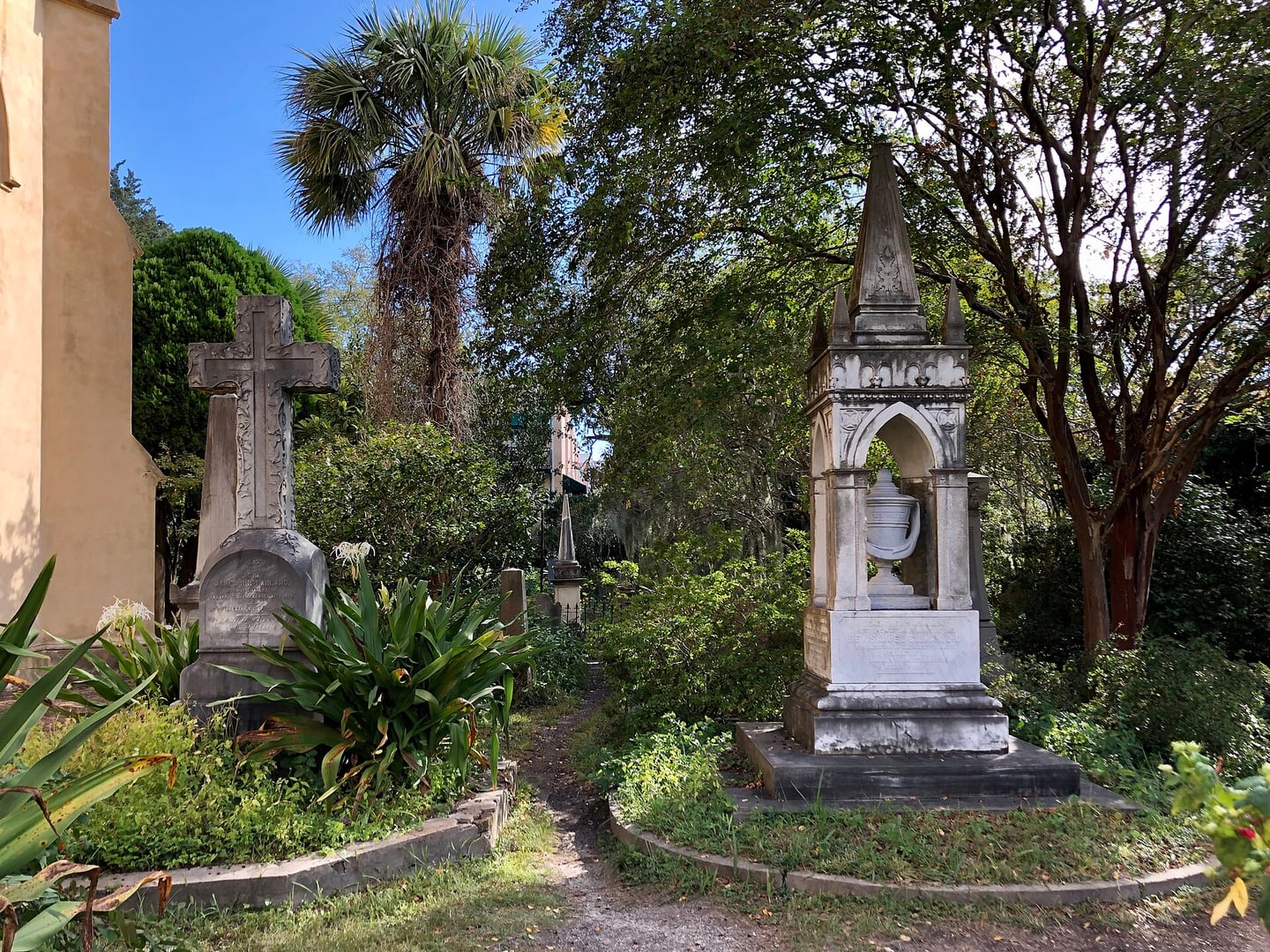
The adjoining graveyard is Charleston’s oldest burial ground, with one surviving 17th-century monument. More than 500 gravestones are still in place and approximately 730 individuals are identified by name; the burying ground holds Revolutionary War soldiers, Confederate officers, ministers, and Charlestonians from across three centuries.
A particularly remembered event occurred during the British siege of Charleston in 1780, when a British cannonball burst inside the graveyard during a Sunday service — a story preserved in church tradition. After Charleston fell to the British in May 1780, 38 heads of congregational families were exiled to St. Augustine and later to Philadelphia, a measure of the congregation's prominence in the Patriot cause.
The present 'Circular' church building is the third on the site. The first church building was erected before 1695, and a second meeting house was built in 1732. A circular structure designed by Robert Mills replaced it in 1804 to 1806 and burned in 1861. The present Romanesque Revival building, designed by Stevenson and Green, was constructed circa 1892 using bricks salvaged from the earlier structure. The graveyard has been carefully conserved in partnership with the Historic Charleston Foundation.
The church and graveyard are contributing structures to the Charleston Historic District National Historic Landmark.
Sources
- https://en.wikipedia.org/wiki/Circular_Congregational_Church
- https://www.circularchurch.org/history
- https://discoversouthcarolina.com/articles/hallowed-ground-circular-congregational-church-charleston
- https://theclio.com/entry/127139
Revolutionary War-era soldier apparitions among monumentsShadow figures between gravestonesCold spots near the back wallUnexplained touches reported by tour groupsOrbs in photographs (often dust/humidity artifacts)Disembodied conversational voices
The Circular Graveyard is one of Charleston's most-visited paranormal-tourism stops. Ghost City Tours, US Ghost Adventures, and Charleston Terrors all describe a similar cluster of phenomena anchored to the burying ground's three-century span of mortality.
The most-reported apparitions are figures in Revolutionary War-era military dress, sometimes seen briefly between the older monuments before disappearing. Given that the graveyard contains documented Revolutionary War burials and was struck by a British cannonball during the 1780 siege of Charleston, the historical resonance supplies the lore even where individual sightings are unverified.
Shadow figures glimpsed in peripheral vision among the older stones are also commonly described — often near the back wall of the graveyard, which adjoins other historic-district properties. Cold spots and a sense of being touched are reported, particularly by tour group members on evening visits.
Orbs in photographs are routinely highlighted by ghost-tour guides as evidence of paranormal activity. The graveyard's environment — moist coastal air, abundant pollen, dappled light through live oaks, and many tourists carrying flash photography — produces conditions in which orb-like artifacts are predictable photographic outcomes; tour-operator framing typically does not engage these alternative explanations.
Additional reports collected by tour operators include disembodied voices (described as conversational rather than threatening) and occasional appearances of a man in colonial-era clothing near the church entrance. As with most Charleston cemetery sites, the reported phenomena are largely subjective experiences rather than independently corroborated events.
Notable Entities
Anonymous Revolutionary War soldiers (folkloric)Anonymous colonial-era figure near church entrance