Est. 1774 · National Historic Landmark (1960) · William Buckland's final and most celebrated design · House museum since 1938 · Considered one of the finest Palladian-plan colonial houses in North America · Built with the wealth of enslaved labor
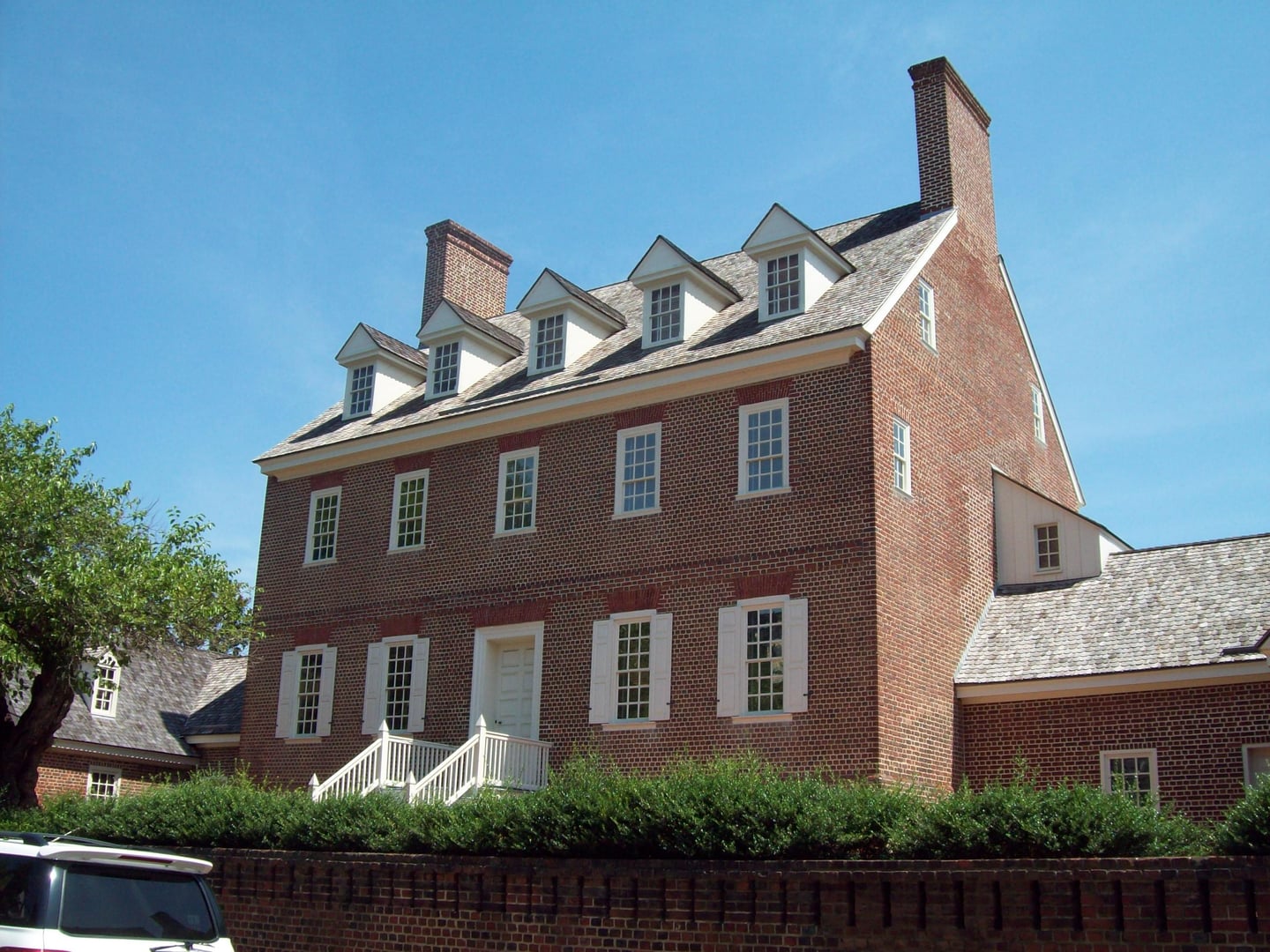
Construction of the Hammond-Harwood House began in 1774 to a design by William Buckland, an English-born architect who had previously worked on the Chase-Lloyd House across Maryland Avenue. The house is one of the most thoroughly Palladian colonial mansions in North America, with a central block flanked by two hyphens and two wings — the five-part plan articulated in Andrea Palladio's I Quattro Libri dell'Architettura. The carving and joinery of the entrance doorway are considered Buckland's finest work and are widely studied as a high point of American colonial design.
The house was commissioned by Matthias Hammond, a wealthy Annapolis lawyer who owned 54 tobacco plantations and 63 enslaved people. Buckland died in 1774, before the house was finished, and Hammond himself never moved in; he left Annapolis in 1776. The reasons for his sudden departure are debated by historians and are entangled with the local fiancee legend.
In 1811 the house was purchased by William Harwood, Buckland's grandson, whose family retained it through the 19th century — giving the building its hyphenated name. After several subsequent owners, the property was acquired by St. John's College for use as a decorative-arts study collection in 1926 and opened as a house museum in 1938 under the Hammond-Harwood House Association.
The house was designated a National Historic Landmark in 1960 and is jointly managed by the Hammond-Harwood House Association as a museum of colonial decorative arts. The collection includes period furniture, paintings by Charles Willson Peale, and architectural drawings associated with Buckland.
Sources
- https://en.wikipedia.org/wiki/Hammond%E2%80%93Harwood_House
- https://www.historic-structures.com/md/annapolis/hammond_harwood_house.php
- https://hammondharwoodhouse.org/
- https://msa.maryland.gov/megafile/msa/speccol/sc3500/sc3520/013600/013623/html/hammond-harwoodhouse.html
- https://apps.mht.maryland.gov/nr/NRDetail.aspx?NRID=3
Apparition at upstairs windowObject movementPhantom footstepsReported figure standing on canopy bed
The principal Hammond-Harwood ghost story is the 'jilted fiancee' tradition recorded by Annapolis Ghosts, the Wikipedia article, and the local Annapolis press. The story holds that Matthias Hammond commissioned the house for his fiancee in 1774, but became so absorbed in its construction that he neglected her, prompting her to break off the engagement. According to one version of the story, the couple later resumed a relationship — though she never married Hammond and never lived in the house in life. After her death, she is said to have taken up residence as the resident apparition.
The most cited paranormal incident is a 1991 report — repeated by Annapolis Ghosts and Creative Travel Guide — describing a police officer who was inside the house at night observing a female figure standing on a bed in an upstairs room, with her head 'floating above the canopy.' This account is reproduced in tour material; Hauntbound has not located the original police report or news source and treats it as ghost-tour tradition.
The second figure regularly reported is a woman in colonial dress at an upstairs window. Staff describe objects moving on their own and footsteps in unoccupied rooms during after-hours work. The Hammond-Harwood garden is a regular stop on Watermark's Special Historic Hauntings tour, which includes a 20-minute presentation by guides during the October program.
Notable Entities
Matthias Hammond's fiancee (unnamed in tradition)
Media Appearances
- Watermark Annapolis Tours: Special Historic Hauntings (annual October program)