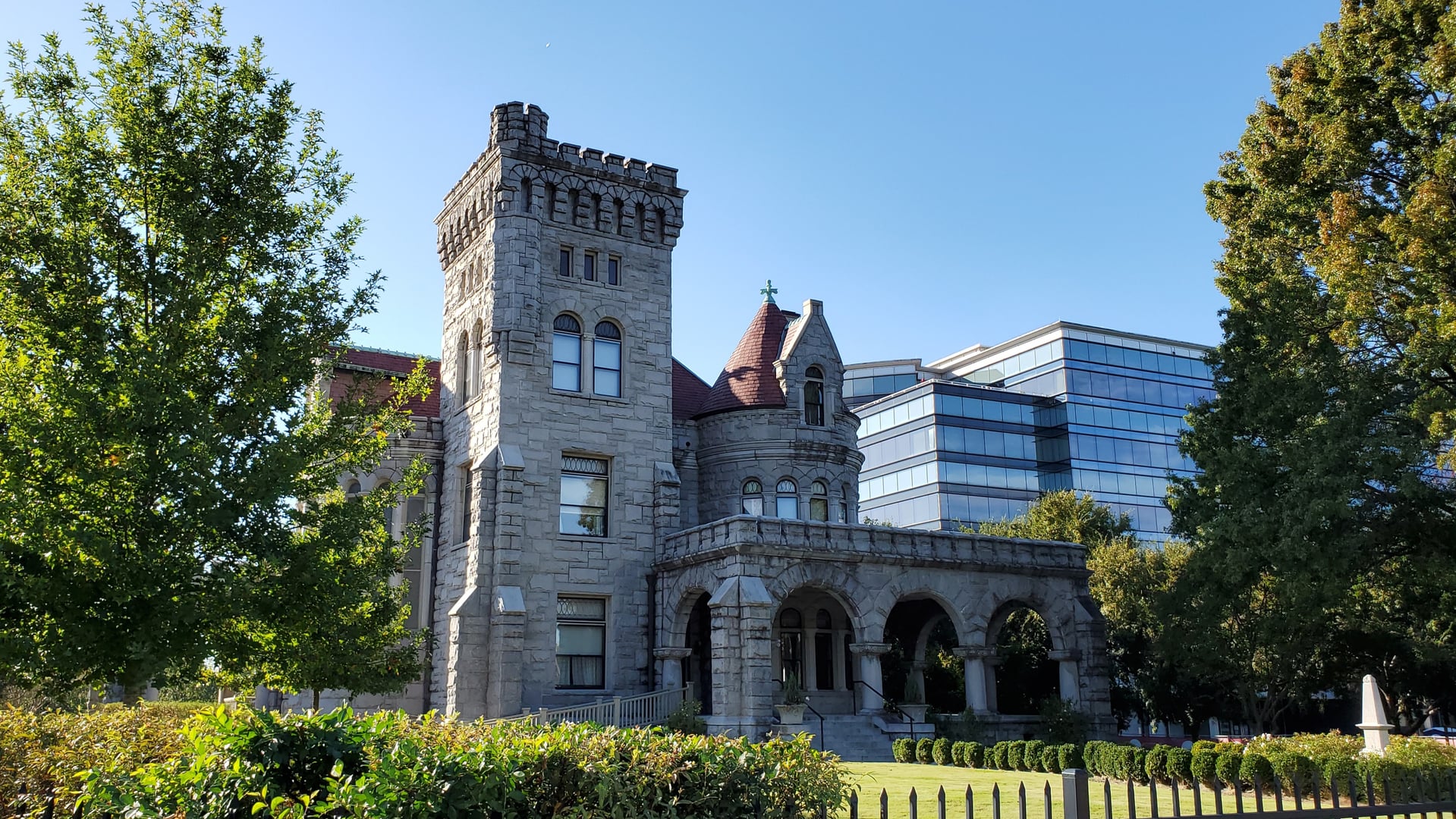
Est. 1855 · National Historic Landmark · National Register of Historic Places · Designed by T. Thomas and Son, New York architects · Italian Renaissance Revival architecture · Operated by The Georgia Trust for Historic Preservation
Construction began in 1855 under the New York architectural firm T. Thomas and Son and was completed in 1859. The commission was financed by William Butler Johnston, a Macon merchant, banker, and railroad investor, at a reported cost of $100,000 — an extraordinary sum for the era in middle Georgia. The result was a four-story structure with 24 rooms, a three-story cupola, elaborate plasterwork, and one of the earliest residential indoor plumbing systems in the South.
During the Civil War, the house remained in Johnston hands, and Macon itself avoided the destruction Sherman inflicted on nearby Milledgeville in November 1864; his march to the sea bypassed the city entirely. In 1896, following Mrs. Johnston's death, the house passed to her daughter Mary Ellen and son-in-law Judge William Felton, who held it until 1926.
The Hay family purchased the property in 1926 and gave it its current popular name. Parks Lee Hay and his wife Maude occupied it for decades. In 1977, the family donated the house and its contents to The Georgia Trust for Historic Preservation, which operates it as a house museum. The house was designated a National Historic Landmark in 1974 and is listed on the National Register of Historic Places.
Sources
- https://en.wikipedia.org/wiki/Johnston%E2%80%93Felton%E2%80%93Hay_House
- https://www.hayhousemacon.org/
- https://www.13wmaz.com/article/news/local/hay-houses-haunted-history-ghost-tour/93-f9dffd56-8ade-4da4-ae70-5dc3539e833d
ApparitionsObject movementUnexplained soundsDoors slammingLights flickering
The paranormal reputation at Hay House rests primarily on staff testimony rather than visitor reports — unusual for a house museum. A board member with over thirty years of involvement at the property told local media that in all that time there had never been a stretch when staff, contractors, or guests did not experience something they could not explain.
The most specific account involves a figure in period dress rummaging through a chest of drawers, identified by the witness as Mary Ellen Felton, daughter of the house's original owners William and Anne Johnston, who lived in the home into the early twentieth century. The apparition has also been reported independently, described as a woman in 1800s clothing moving through the halls without appearing aware of observers.
Additional reports cluster around physical events: doors slamming in rooms confirmed empty, objects — particularly contractor tools — found moved or displaced from where they were left, and lights cycling without electrical malfunction. Staff reported hearing moaning in the master bedroom.
A paranormal investigation conducted in 2010 reportedly documented full-bodied apparitions. The house's annual 'Haunts and History on the Hill' walking tour, offered in October through The Georgia Trust, incorporates these accounts as part of a broader neighborhood ghost walk through the College Hill Corridor.
Notable Entities
Mary Ellen Felton
Where this legend is told