Est. 1884 · Mission established by Charles Wesley in 1736 — one of the oldest Anglican/Episcopal sites in North America · Second oldest Episcopal parish in Georgia (1808) · Cemetery contains graves dating to 1803 · 1884 church built as memorial by Anson Greene Phelps Dodge Jr. · Home parish of Anna Alexander, first Black deaconess in the Episcopal Church (canonized 1998)
On February 15, 1736, General James Oglethorpe founded the town and fort of Frederica on the western shore of St. Simons Island, bringing with him the first English colonists to settle this part of Georgia. Accompanying the expedition was the Reverend Charles Wesley — brother of John Wesley and co-founder of what would become the Methodist movement — who served as Oglethorpe's chaplain and secretary for Indian affairs. Wesley held religious services in a tabby structure on the island until departing in July 1736.
The formal Episcopal parish was organized in 1807 and incorporated by act of the Georgia State Legislature on December 22, 1808, as 'the Episcopal Church in the town of Frederica called Christ Church.' In 1823, Christ Church Frederica joined Christ Church Savannah and St. Paul's Augusta to form the first Episcopal Diocese in Georgia. The first permanent church building was constructed in 1820, built by the island's planter families on land from the former Fort Frederica grant.
During the Civil War, the 1820 church was destroyed — deliberately or accidentally — as Union troops occupied the barrier islands. The ruins stood for nearly two decades until Anson Greene Phelps Dodge Jr., a New York merchant and philanthropist who had joined the parish, undertook a complete reconstruction in 1884. Dodge built the current Gothic Revival structure as a memorial to his wife, Ellen, who was buried in the churchyard. He spent years rebuilding and serving the congregation; the building was completed in 1885 and consecrated on December 2, 1886.
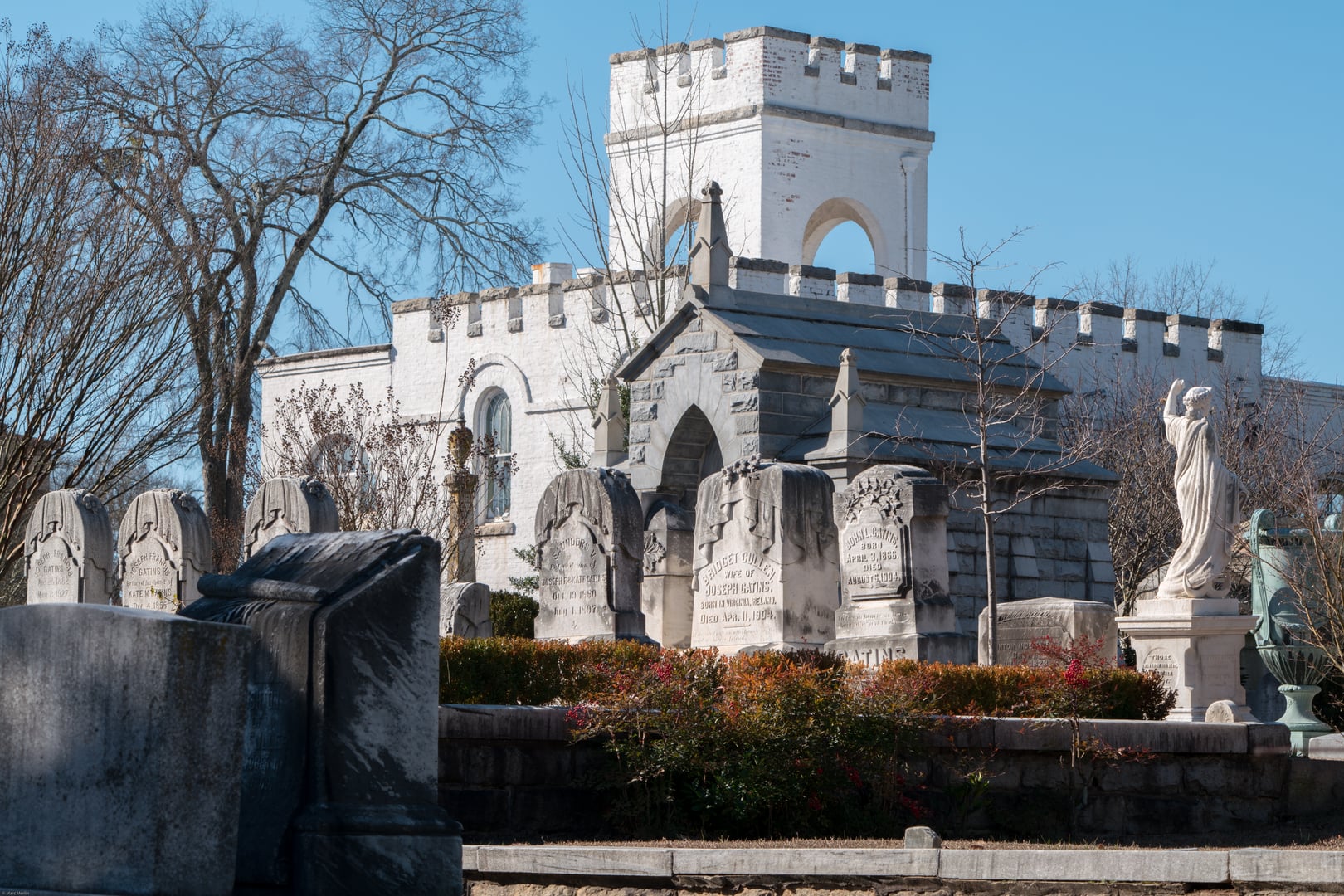
Christ Church Frederica remains an active Episcopal parish. The adjacent cemetery, with its oldest marked grave dating to 1803, is one of the state's historically significant colonial-era burial grounds. The church stands adjacent to Fort Frederica National Monument, managed by the National Park Service. In 1998, Anna Alexander — a Black deaconess who served the church community in the early twentieth century — was canonized by the Diocese of Georgia and added to the Episcopal Church's calendar of saints in 2018.
Sources
- https://en.wikipedia.org/wiki/Christ_Church_(St._Simons,_Georgia)
- https://www.ccfssi.org/history
- https://www.exploresouthernhistory.com/christchurch.html
- https://www.southernspiritguide.org/theres-a-light-christ-church-frederica/
- https://www.elegantislandliving.net/history/a-love-that-lives-on/
Flickering candle light above a specific tombstoneSense of peaceful presence in the churchyard
The ghost tradition at Christ Church Frederica is one of the most literary in Georgia — a story of love rather than terror, documented in multiple scholarly folklore collections and retold across generations of island residents.
The core legend centers on a woman buried in the churchyard who harbored a deep, irrational fear of the dark — a terror that reportedly dated to childhood and was reinforced by a Caribbean-born nurse's stories. Her husband, understanding her dread, made a nightly practice of placing a lit candle on her grave after her death, so that she would not lie in darkness.
When the husband himself died, islanders expected the candles to cease. They did not. Night after night, a flickering light appeared above one of the tombstones in the churchyard, visible to drivers passing slowly along the road with their lights dimmed — a practice that became, itself, a local ritual. No one ever identified who was lighting the candle.
The legend is documented in at least four independent print sources: Ronald G. Killion and Charles T. Waller's *A Treasury of Georgia Folklore* (1972), Burnette Vanstory's *Ghost Stories and Superstitions of Old St. Simons*, Kathryn Tucker Windham's *13 Georgia Ghosts and Jeffrey* (1973), and Chris Wangler's *Ghost Stories of Georgia: True Tales of Ghostly Hauntings* (2006). The Southern Spirit Guide has also published a dedicated article on the tradition.
Most accounts acknowledge that the phenomenon eventually ceased — attributed to the construction of a brick wall along Frederica Road and the installation of exterior spotlights on the church, which eliminated the darkness in which the single candle could be seen. The legend belongs entirely to the 19th and early 20th centuries.
Notable Entities
The 'Candle Woman' — unnamed woman afraid of darkness (antebellum era)
Media Appearances
- Windham, Kathryn Tucker. *13 Georgia Ghosts and Jeffrey.* 1973.
- Killion, Ronald G. & Waller, Charles T. *A Treasury of Georgia Folklore.* 1972.
- Wangler, Chris. *Ghost Stories of Georgia.* 2006.