Est. 1818 · Augusta's oldest established cemetery (1818) · Seven Confederate general officers buried on grounds · Sealed mausoleum associated with the Wylly Barron curse legend · Antebellum and Civil War era memorial architecture
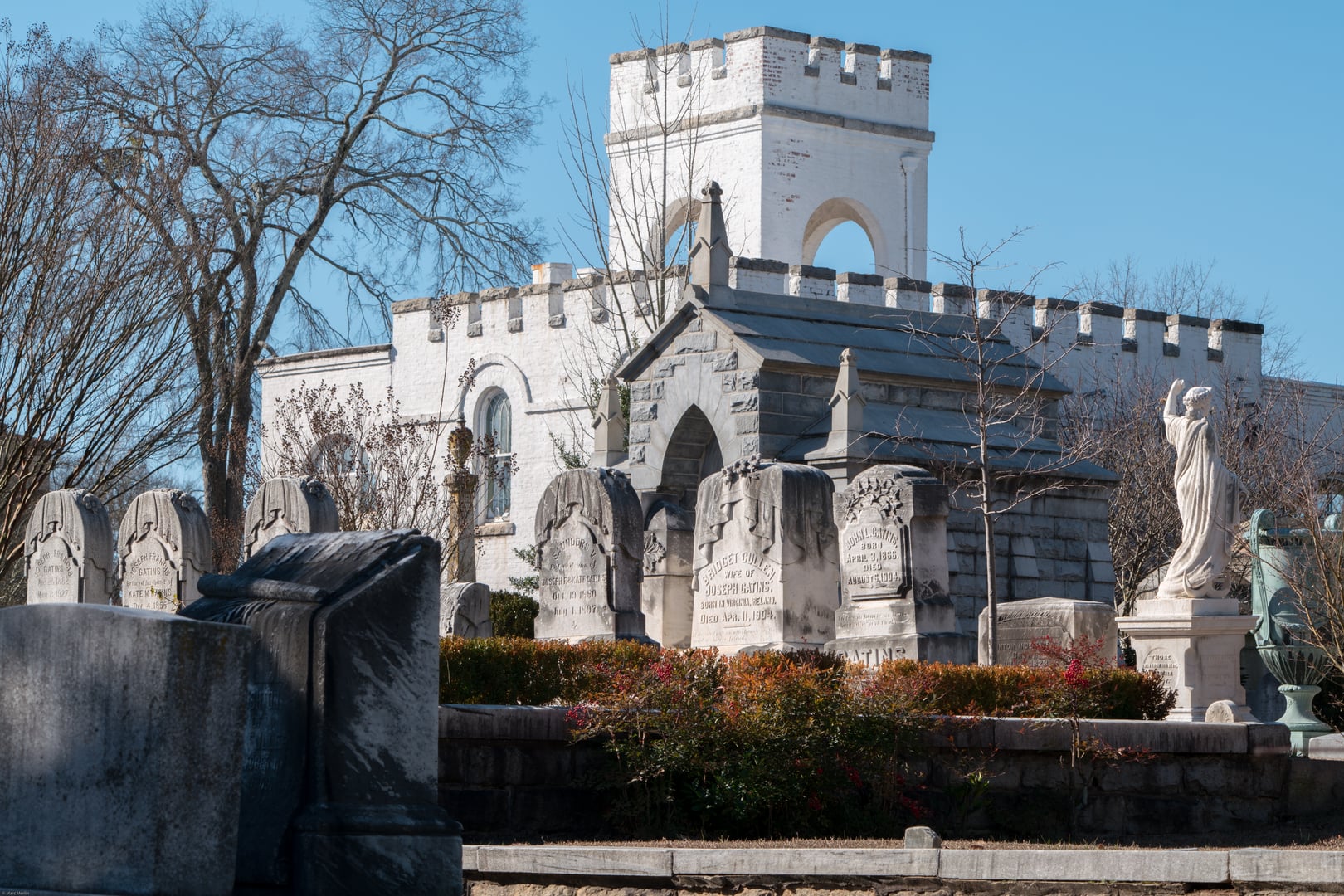
Magnolia Cemetery was established in 1818, making it Augusta's oldest formal cemetery and one of the earlier municipal burial grounds in the Georgia interior. The cemetery predates Augusta's rapid growth as a cotton trading hub, and its earliest sections reflect the Federal-period architecture of the surrounding Hill neighborhood.
The Civil War deposited an extraordinary concentration of Confederate military dead on the grounds. Seven general officers are buried here, among them William Henry Talbot Walker, killed at the Battle of Atlanta on July 22, 1864, and Paul Jones Semmes, mortally wounded at Gettysburg on July 10, 1863. The density of flag officers in a single cemetery of this size is unusual outside of major national cemeteries, reflecting Augusta's role as a Confederate manufacturing and administrative center during the war.
The most singular feature of Magnolia Cemetery is the mausoleum associated with a 19th-century gambler identified in local accounts as Wylly Barron. According to accounts documented by the City of Augusta and repeated in local news coverage, Barron constructed — or had constructed — a brick vault with no door, then had himself interred within it after throwing the key into the Savannah River. The stated motivation in the oral tradition was to circumvent a curse reportedly pronounced by a dying opponent: that Barron would never have a proper grave. Historians have not located documentary confirmation of the Barron mausoleum account beyond oral tradition and local legend, and the tomb itself, a sealed brick structure, is the only physical evidence.
The cemetery remains a public historic site and is listed in Augusta civic documents. No formal interpretive infrastructure exists on-site; the graves are identifiable primarily by monument inscriptions.
Sources
- https://en.wikipedia.org/wiki/Magnolia_Cemetery_(Augusta,_Georgia)
- https://www.augustaga.gov/1037/Legendary-Tales
- https://www.wrdw.com/content/news/Rich-and-unique-history-at-Magnolia-Cemetery-453315293.html
Audible whispers near sealed vaultUnexplained vibrationsCold spotsApparitions in older sections
The paranormal tradition at Magnolia Cemetery centers on the sealed tomb attributed to Wylly Barron. The legend, recorded in City of Augusta civic literature and covered by local television, holds that Barron — described as a gambler of some local notoriety — had a confrontation with a rival near the end of one of their lives. The dying man reportedly pronounced that Barron would never have a grave. Barron's response, as preserved in oral tradition, was to arrange for a brick mausoleum to be constructed with no door and no accessible key, then to be sealed inside after his death — the key thrown into the Savannah River to ensure no posthumous violation.
The practical result is a physical vault that cannot be lawfully entered, which creates the conditions for a persistent paranormal narrative. Visitors to the cemetery report hearing sounds — described variously as whispers, a low humming, or vibrations — when standing close to the Barron structure. Whether these acoustic anomalies reflect the resonance properties of a sealed brick chamber, environmental conditions near old masonry, or something harder to categorize is not documented in any systematic investigation.
The Confederate generals buried here attract a separate layer of accounts common to Civil War era cemeteries: battlefield trauma residue, reported cold spots near certain monuments, and occasional reports of uniformed figures in the older sections near dusk. None of these accounts have been formally investigated.
Notable Entities
Wylly Barron
Where this legend is told