Est. 1891 · Tallest building in Spokane for a decade after its 1891 completion · Continuous home of The Spokesman-Review since 1893 · Romanesque-eclectic landmark designed by Chauncey B. Seaton · 146-foot candle-snuffer tower is one of downtown Spokane's defining skyline features
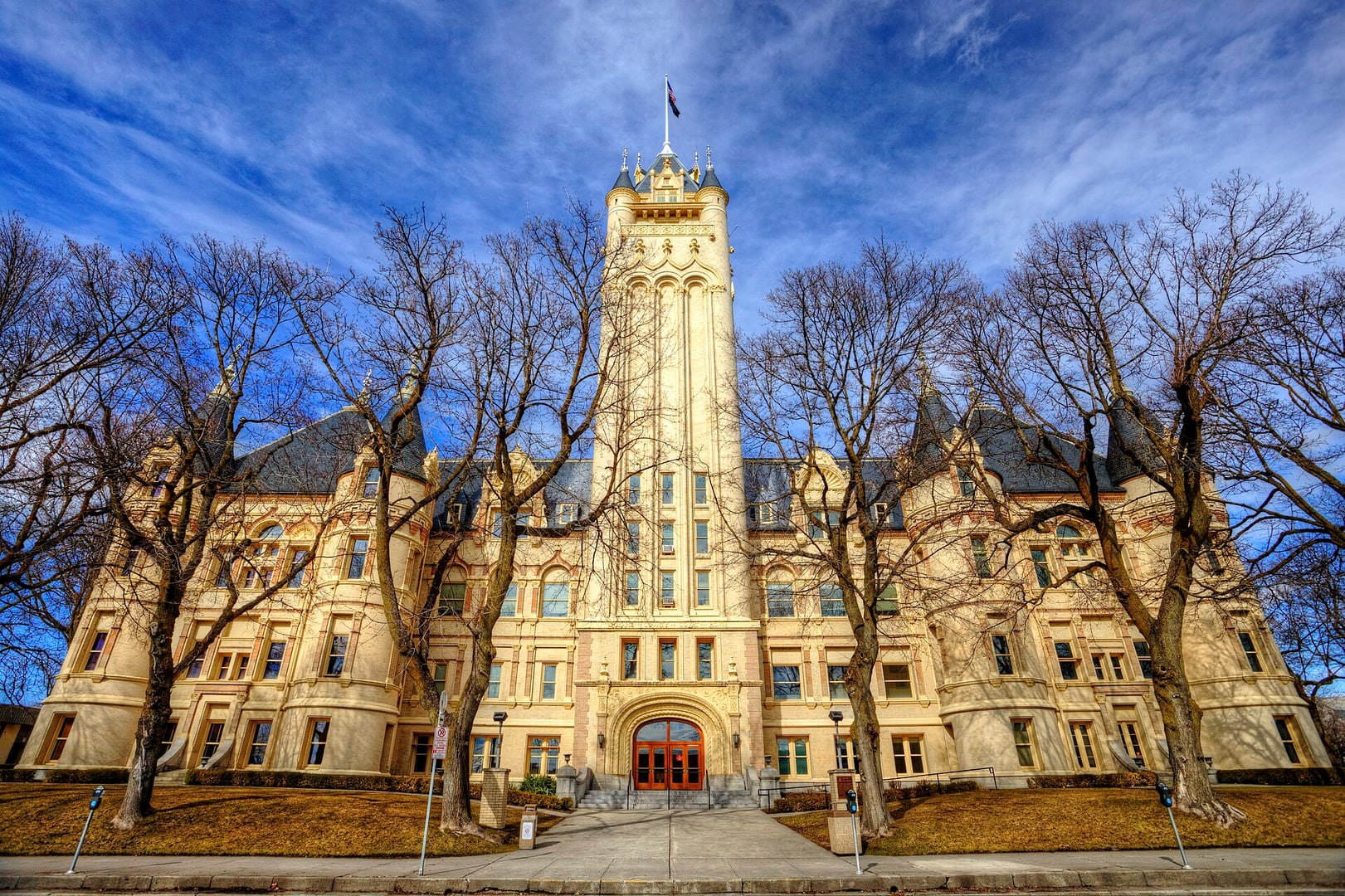
The Review Building was begun in March 1890 and completed in October 1891 to house the Spokane Falls Review, a newspaper venture jointly backed by the Portland Oregonian and Spokane investor A. M. Cannon. Architect Chauncey B. Seaton designed the seven-story Romanesque-influenced eclectic structure of red pressed brick and Montana granite, topped by a soaring 146-foot tower with a distinctive candle-snuffer cap.
When complete, the building dominated the still-recovering downtown Spokane skyline following the August 1889 Great Fire and remained the tallest building in the city for the next decade. In the financial downturn of 1893, the building was acquired by W.H. Cowles, who renamed the paper The Spokesman-Review. The Cowles family has continuously owned the paper and the building since.
The basement contains the newspaper's 'morgue' — newsroom terminology for the clipping archive — a windowless storage room packed with envelopes of articles clipped from the daily paper since the 1890s. The morgue has flooded multiple times over its history, damaging archives and causing mold growth. The building remains the operating headquarters of The Spokesman-Review newspaper. It is listed in the National Register of Historic Places and is a designated Spokane City Landmark.
Sources
- https://en.wikipedia.org/wiki/Review_Building
- https://spokanehistorical.org/items/show/85
- https://properties.historicspokane.org/property/?PropertyID=2012
- https://www.spokesman.com/stories/2020/mar/02/then-and-now-the-spokane-falls-review-tower/
- https://discoveryrobots.org/spokanehistory/reviewtower.html
Reported presence of two male spirits in the basement morgueReported 'agitated drunken man' on residential staircaseReported 'shooting victim' spirit on staircaseLong-running staff sense-of-presence in the basement archive
Per the Spokesman-Review's October 2018 feature 'Haunted tales of Spokane's past fill newspaper morgue,' staff and overnight workers have long described the basement clipping archive as the building's most unsettling space — windowless, rarely visited, and stacked with thousands of envelopes containing more than a century of obituaries and crime reporting. The paper's own writers have characterized the morgue as a place where 'eyes of Spokanites long dead stare out from yellowing paper.'
In the October 2025 follow-up feature 'Paranormal activity in Spokane?', the paper invited medium Jennifer Von Behren and investigator Kika Morelan to conduct an on-site investigation. Von Behren reported sensing two male spirits standing among the basement archives. On the building's upper staircase, she reported an 'agitated drunken man' and a 'shooting victim' identified by her translation rather than by historical record. The building's basement has flooded multiple times over its history, causing physical damage to the archives, mold growth, and (per staff) accompanying sensations of presence.
The paranormal coverage here is unusually well-documented for a ghost story because the host institution is the newspaper itself, which has published primary-source archival material alongside the lore. The medium-attributed identifications remain single-source.
Notable Entities
Two unnamed male spirits in the basement (medium-attributed)Unnamed 'agitated drunken man' (medium-attributed)Unnamed 'shooting victim' (medium-attributed)
Media Appearances
- Spokesman-Review October 2018 'Haunted tales fill newspaper morgue' feature
- Spokesman-Review October 2025 'Paranormal activity in Spokane?' feature