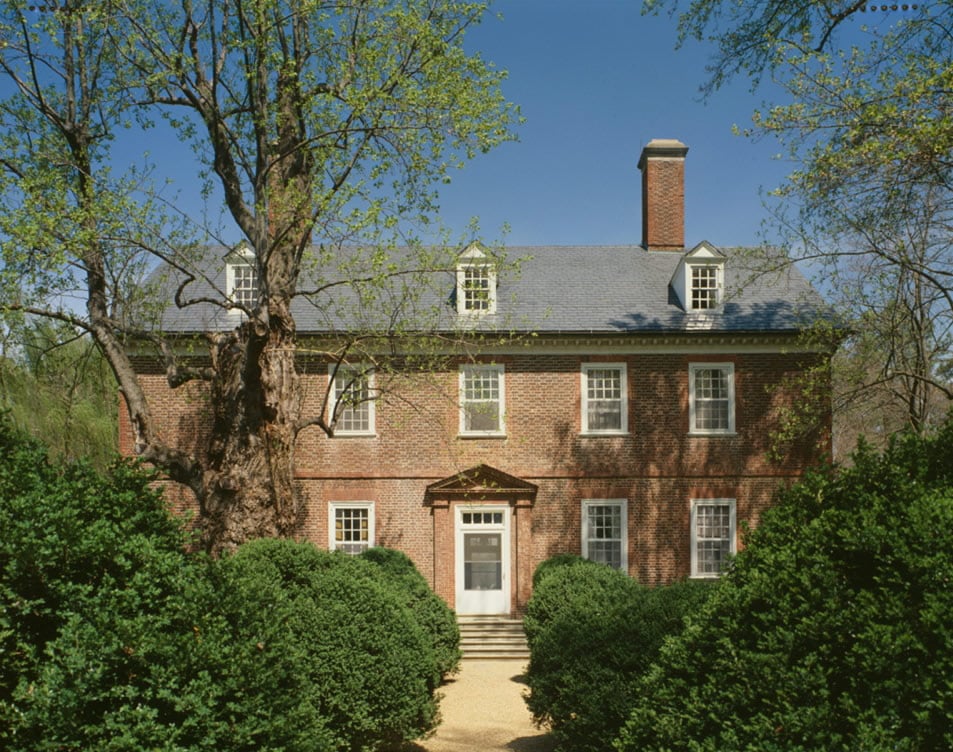
Est. 1722 · Residence of seven British royal governors of Virginia · Residence of Patrick Henry and Thomas Jefferson · 1781 Revolutionary War military hospital · 156 Revolutionary War-era remains exhumed in 1930s excavation
Construction of the Governor's Palace began in 1706 and was completed in 1722 as the official residence of the British royal governors of Virginia. The building served seven British royal governors before the Revolution and then, after Virginia declared independence in 1776, became the residence of the Commonwealth's first two governors: Patrick Henry (1776–1779) and Thomas Jefferson (1779–1781).
During the September–October 1781 Siege of Yorktown, the Palace was pressed into service as a hospital for wounded Continental Army soldiers. On December 22, 1781, the main building was destroyed by fire. The site lay vacant for more than 150 years.
In 1929, philanthropist John D. Rockefeller Jr. funded the Colonial Williamsburg restoration project. Excavation of the Palace site between 1929 and 1932 unearthed approximately 156 sets of human remains in a mass grave on the grounds, eventually identified as Continental Army soldiers and possibly civilians who had died of disease during the building's short use as a hospital. The remains were reinterred elsewhere on the property. The Palace itself was reconstructed in the 1930s on its original foundations using period architectural sources and is now one of Colonial Williamsburg's principal interpretive buildings.
The Palace's interior is best known for the entrance hall, decorated with an arrangement of more than 700 muskets, swords, and pistols (a reconstruction of an arrangement recorded by Thomas Jefferson during his stay). The formal gardens include a reconstruction of the boxwood maze planted by Governor Alexander Spotswood in the 1710s.
Sources
- https://en.wikipedia.org/wiki/Governor%27s_Palace_(Williamsburg,_Virginia)
- https://www.colonialwilliamsburg.org/events/governors-palace/
- https://williamsburgghosttour.com/governors-palace/
- https://virginialiving.com/virginiana/haunted-virginia/
Shadow figures in the formal-garden maze after duskFootsteps in upper roomsWhispers in the supper roomPipe-tobacco smell in the wine cellar
Williamsburg's commercial ghost-tour operators — including Williamsburg Ghost Tour and the Lizzie Borden organization — collect several recurring reports at the Palace.
In the formal gardens behind the building, visitors and staff have described shadow figures moving between the boxwood walls of the reconstructed maze, particularly after dusk. The accounts are typically associated in local tradition with the 156 sets of Revolutionary War-era remains exhumed during the 1930s reconstruction and with the broader history of the Palace as a military hospital in the fall of 1781.
A second, separate piece of folklore attaches to the wall along the front of the Palace property. According to early-twentieth-century Williamsburg tradition recorded by Virginia Living, a 1920s violent crime in the city is locally associated with the wall; the original Shadowlands account references this. The framing in primary-source documentation is thin, and the Hauntbound editorial position is to describe it as folklore rather than as documented history.
Inside the Palace, accounts include footsteps in the great chamber, whispers in the supper room, and the smell of pipe tobacco in the wine cellar.
Notable Entities
Revolutionary War soldiers (associated with the 156 exhumed remains)
Media Appearances
- Featured on multiple Williamsburg ghost tours
- Virginia Living haunted-Virginia features