Est. 1864 · National Register of Historic Places · Civil War Battlefield · African-American Military History
On November 30, 1864, roughly 5,000 Union troops, including the 54th and 55th Massachusetts Infantry and the 32nd, 35th, and 102nd United States Colored Troops, advanced inland from Boyd's Neck along a narrow road toward the Charleston and Savannah Railroad. Their objective was to cut Confederate rail communications in support of William Tecumseh Sherman's projected arrival at Savannah.
A few miles from Grahamville, the column encountered a hastily assembled Confederate defense under Col. Charles J. Colcock, supported by seven artillery pieces sited at the head of a swampy ravine. The position channeled the Union advance into a narrow killing ground. Repeated frontal assaults failed to dislodge the defenders. The South Carolina Encyclopedia and American Battlefield Trust both note the battle as one of the largest Civil War engagements in South Carolina and one of the most significant combat actions involving a majority African-American force on the Union side.
Union casualties exceeded 700, including dead, wounded, and missing. Confederate losses were under 100. The expedition withdrew to the coast, and the rail line remained intact until Sherman's army reached Savannah by other means.
The battlefield was placed on the National Register of Historic Places in 1975 as the Honey Hill/Boyd's Neck Battlefield. The Friends of Honey Hill Battlefield, a local nonprofit, manages preservation and interpretation. Volunteer-led restoration work has cleared much of the original terrain, exposing rifle pits and trenches that had been overgrown for more than a century.
Sources
- https://en.wikipedia.org/wiki/Battle_of_Honey_Hill
- https://www.battlefields.org/learn/civil-war/battles/battle-honey-hill
- https://www.scencyclopedia.org/sce/entries/honey-hill-battle-of/
- https://en.wikipedia.org/wiki/Honey_Hill-Boyd's_Neck_Battlefield
- https://www.ridgelandsc.gov/battle-of-honey-hill
- https://fohhb.org/contact-us/
Phantom soundsResidual haunting
Unlike Gettysburg, Antietam, or Shiloh, the Honey Hill Battlefield is not the subject of a documented body of paranormal investigations. The Friends of Honey Hill Battlefield organization promotes the site as a venue for living history and Civil War scholarship rather than as a paranormal destination.
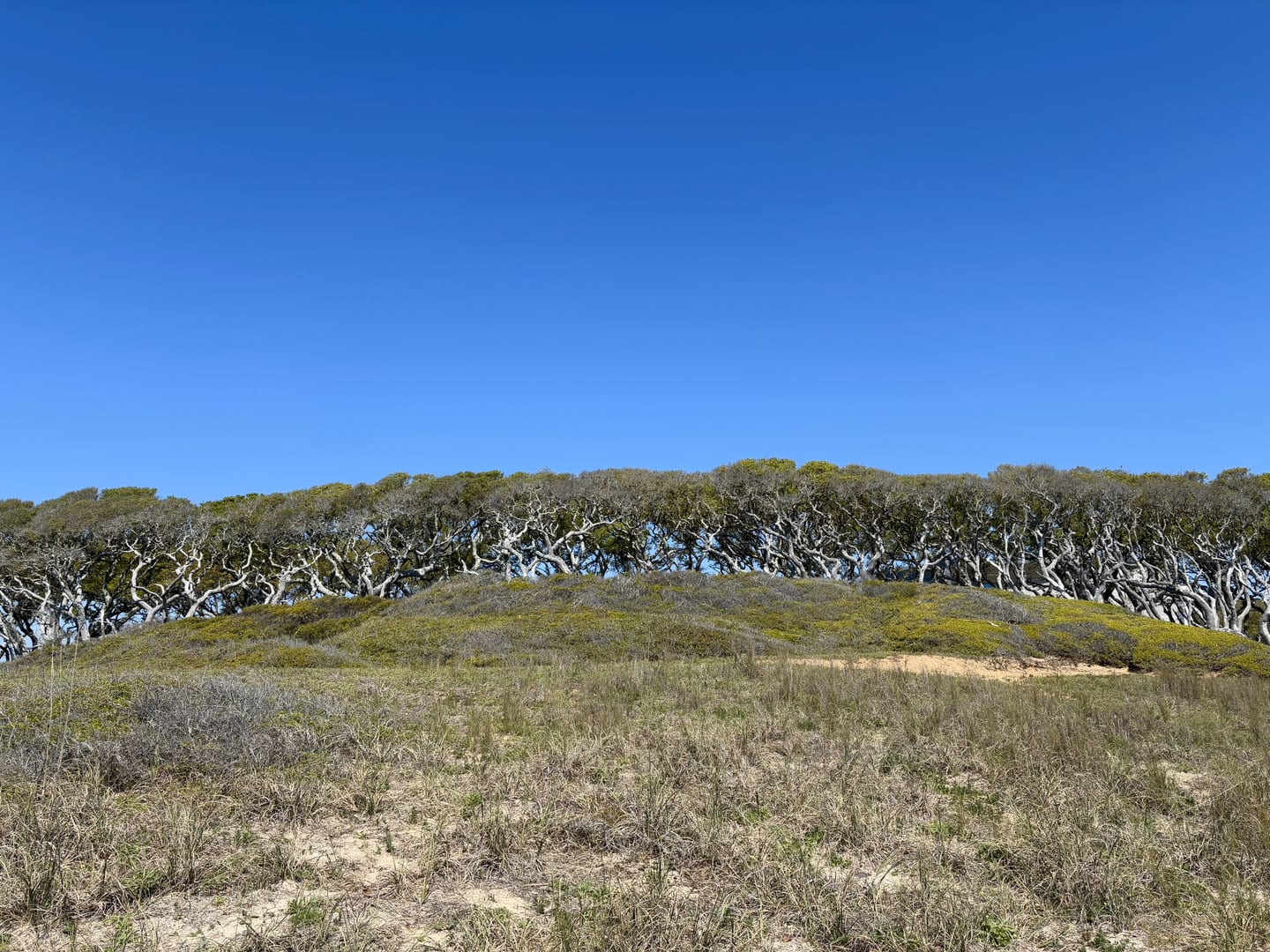
Local folklore, repeated in regional travel write-ups, describes occasional reports of distant cannon fire and the muffled cadence of musketry heard near the rifle pits at dusk. These accounts are anecdotal and unverified by any organized investigation. The battlefield's silence is itself part of its character: 75 acres of pine and palmetto, the swampy ravine that channeled the Union advance, and the trenches scraped into sandy soil 162 years ago and visible again after recent clearing.
The battlefield is open to the public as a preserved historic landscape. Visitors interested in residual phenomena are advised to walk the site as a battlefield first and as a folklore site second.