Est. 1859 · National Register of Historic Places · South Carolina State Historic Site · Antebellum Plantation Architecture
James Henry Hammond (1807-1864) acquired most of his wealth and political influence through marriage to Catherine Fitzsimons in 1831, which brought him the Silver Bluff Plantation and ownership of 147 enslaved people. Over the following decades he expanded his holdings to roughly 22 square miles across multiple plantations and held more than 300 people in slavery. He served as a U.S. representative (1835-1836), 60th governor of South Carolina (1842-1844), and U.S. senator (1857-1860), where he delivered the 1858 "Cotton is King" speech defending Southern slavery as the basis of the global economy.
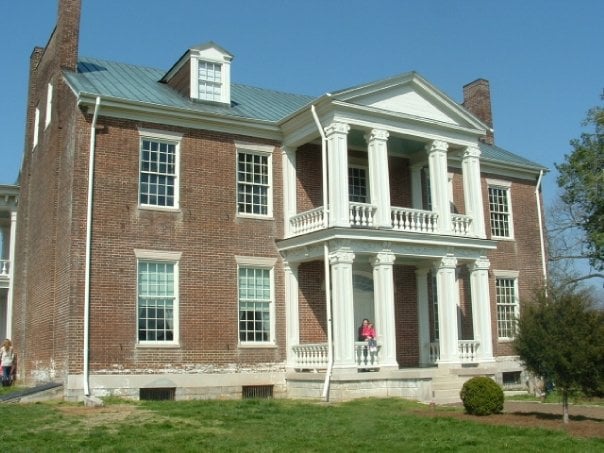
Hammond worked with contractor William Henry Goodrich to design Redcliffe, choosing transitional Greek Revival architecture with restrained Italianate elements unusual for South Carolina at the time. Construction took place between 1857 and 1859. The two-story frame mansion sits on a low rise overlooking the Savannah River valley, with a symmetrical magnolia allée Hammond planted along the entrance drive.
Hammond's political career ended in disgrace twice. In 1843, his sexual abuse of his four nieces, the daughters of Wade Hampton II (whose wife Ann Fitzsimmons was the older sister of Hammond's own wife, making Hampton his brother-in-law), became known within the state's elite and forced him from contention for office. The career was rebuilt; he was elected to the Senate in 1857. His private letters to his son Harry, made public after his death, also acknowledged Hammond's serial sexual abuse of an enslaved woman named Sally and her young daughter Louisa.
The property remained in Hammond family hands through the Reconstruction and into the 20th century. Hammond's great-grandson, journalist John Shaw Billings, served as managing editor of Time and Life magazines and inherited Redcliffe in the 1930s. He restored the mansion and donated it, with 363 acres, to the State of South Carolina in 1973. The site opened to the public in 1975 and is operated by South Carolina State Parks. The interpretation explicitly addresses both the elite domestic life of the Hammond family and the lives of the enslaved community whose labor sustained it.
Sources
- https://en.wikipedia.org/wiki/James_H._Hammond
- https://southcarolinaparks.com/redcliffe
- https://www.scpictureproject.org/aiken-county/redcliffe-plantation.html
- https://www.scencyclopedia.org/sce/entries/redcliffe/
- https://www.hmdb.org/m.asp?m=9591
ApparitionsShadow figuresTouching/pushingResidual haunting
The lore at Redcliffe is divided unevenly between the documented and the felt. The documented history is unsparing: Hammond's serial sexual abuse of enslaved women and of his own nieces is part of the standard tour interpretation. That heavy archive sits beneath any conversation about the property's atmosphere.
Reported phenomena tend to cluster in the mansion's second floor and in the magnolia allée Hammond planted. Staff have described the sensation of being observed from above while leading tours through the first-floor parlors. A figure of an older man in dark clothing has been reported by visitors looking up the central staircase, though no such figure is part of the tour. Whether observers are seeing a residual impression or simply imagining the mansion's most documented former resident is not something the site interprets.
The small field at the front of the property, with its three remaining trees standing isolated in cleared ground, generates its own local mythology. Some accounts describe sensations of pressure or oppression near the trees; others report shadow figures moving among them at dusk. The historical record connects Hammond to the symmetrical landscape design, but no specific event is documented at that location.
A shadowy figure described as standing close behind visitors and occasionally touching shoulders has been reported in multiple accounts spread across decades. The reports do not specify a room. Staff treat the phenomenon as a recurring guest experience rather than a story to promote, and Redcliffe is not marketed as a haunted site by the state park system. The interpretation focuses on Hammond's documented record and on the reconstructed lives of the enslaved community whose archived voices, where they survive at all, are present in the surviving cabins and the family papers.
Notable Entities
James Henry Hammond