Est. 1850 · NRHP 1978 · Hunley Submarine Crew Burials · Confederate Soldiers' Ground · Rural Cemetery Movement
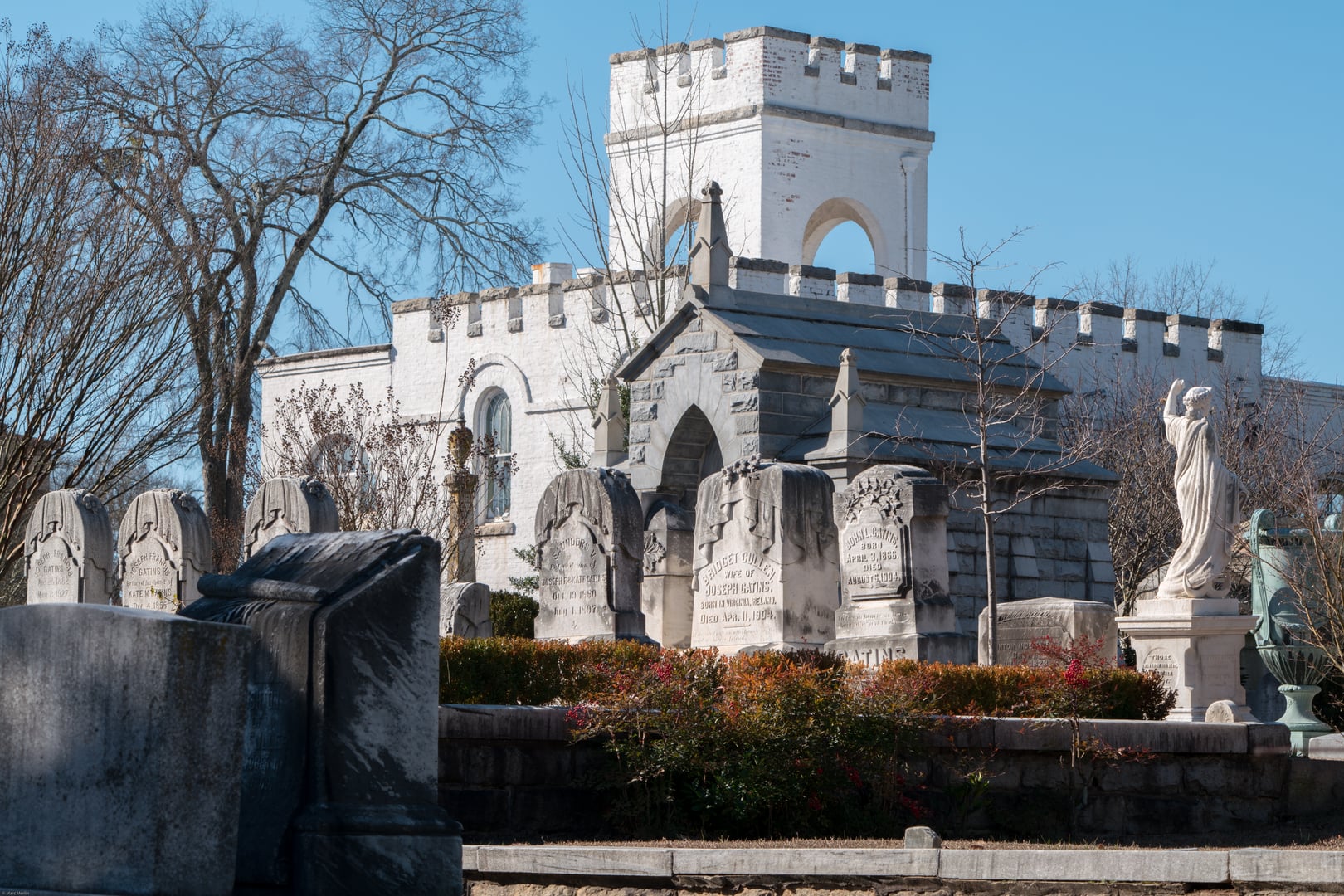
Magnolia Cemetery's first board of trustees was assembled in 1849, and the cemetery was dedicated on November 19, 1850. The 150-acre site northeast of the Charleston peninsula had been Magnolia Umbra Plantation. Charleston architect Edward C. Jones designed the rural cemetery in the picturesque tradition pioneered by Mount Auburn in Cambridge and Laurel Hill in Philadelphia, with curving carriage drives, water features, and a Gothic Revival chapel completed in 1851.
The Civil War transformed the cemetery's character. The Soldiers Ground section was designated as the principal Confederate burial location for the Charleston area, eventually holding 644 wartime burials. Recorded annual interments rose with the war: 15 in 1861, 158 in 1862, 224 in 1863, 142 in 1864, and 99 in 1865. The reinterment of 80 Confederate dead returned from Gettysburg in 1871 brought the total to 725 by that date. Estimates including Confederate dead in private family plots place the total above 3,000.
Among the cemetery's most-visited graves are the three crews of the Confederate submarine H.L. Hunley, recovered after the vessel was raised from Charleston Harbor in 2000 and reinterred together at Magnolia on April 17, 2004. The cemetery also holds the graves of six South Carolina governors, signers of the Ordinance of Secession, and Confederate Brigadier General Micah Jenkins.
Magnolia Cemetery was listed on the National Register of Historic Places as a Historic District in 1978. It remains an active cemetery owned by a private nonprofit trust.
Sources
- https://en.wikipedia.org/wiki/Magnolia_Cemetery_(Charleston,_South_Carolina)
- http://www.magnoliacemetery.net/
- https://www.scpictureproject.org/charleston-county/magnolia-cemetery.html
- https://www.hmdb.org/m.asp?m=23280
- https://scv4.org/blog/soldiers-ground-magnolia-cemetery/
- https://www.youtube.com/watch?v=LKD36Jajymc
- https://www.counton2.com/haunted-history/haunted-history-the-magnolia-cemetery/
- https://www.southernspiritguide.org/locked-in-charlestons-magnolia-cemetery/
ApparitionsPhantom footstepsPhantom soundsCold spotsPhantom smellsBattery drain
Magnolia Cemetery's reputation as a paranormally active site is sustained by Charleston's long tradition of ghost tours and Lowcountry oral history. The Soldiers Ground draws the most consistent reports. Visitors and tour guides describe the sound of marching footsteps along the gravel paths after dusk, faint bugle notes with no audible source, and the appearance of single figures in Confederate uniform standing among the headstones, observed long enough to be photographed before vanishing.
The Gothic Revival chapel at the cemetery's entrance is associated with reports of cold air on otherwise still summer evenings and the feeling of being watched from the upper windows. Charleston paranormal investigators have documented unexplained equipment battery drain during evening visits, though no longitudinal scientific study has been published.
Several above-ground mausoleums have their own folklore. The most-cited is the Smith family mausoleum, locally known as the Hutty Mausoleum, where visitors have reported the apparition of a young woman standing at the gate. Another tradition concerns the so-called 'Locked In' grave — a story passed down in Charleston that a young woman was accidentally buried alive in the cemetery during a yellow-fever outbreak. The story is unverified by surviving cemetery records but has been part of local oral tradition since the late 19th century.
The 2004 reinterment of the H.L. Hunley crews drew renewed paranormal attention to the cemetery. Some visitors to the Hunley plot have described the smell of seawater on still days.
Notable Entities
The Soldiers Ground Confederate apparitionThe Hutty Mausoleum ladyThe Locked In bride