Est. 1864 · Confederate prisoner-of-war stockade, September 1864 to February 1865 · Constructed by enslaved labor on South Carolina soil · Held up to 18,000 Union prisoners; approximately 2,802 died · Mass burial trenches preserved within Florence National Cemetery · Listed on the National Register of Historic Places (1980)
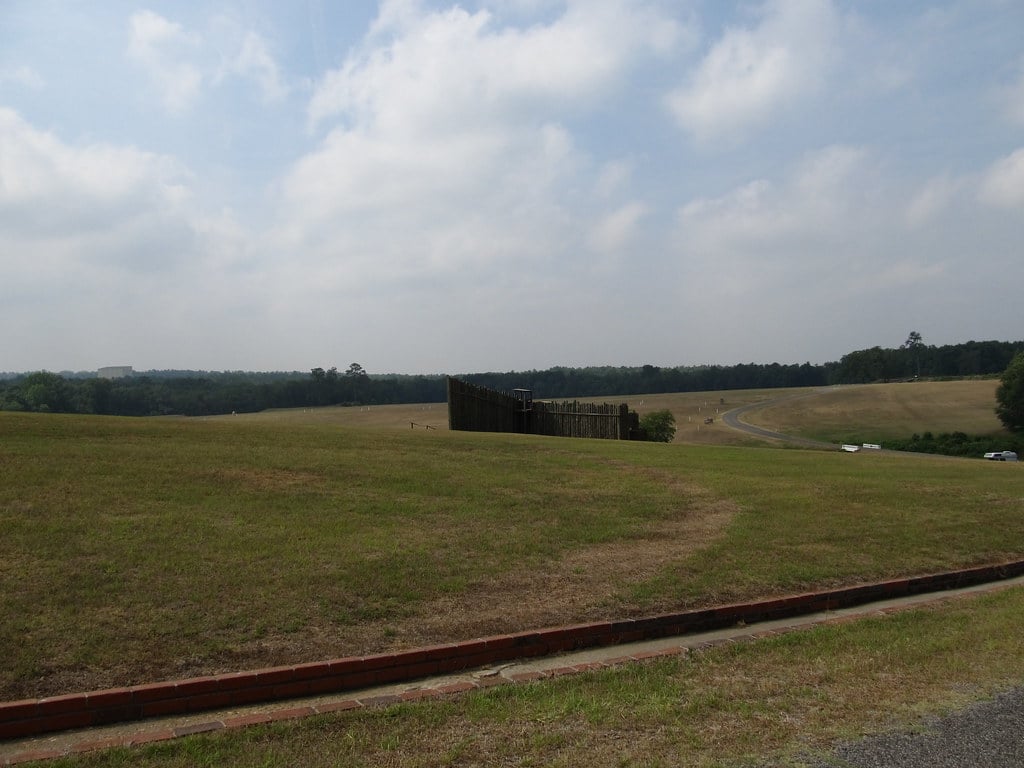
The Florence Stockade was established in September 1864 as an overflow facility for Confederate prisoner-of-war operations overwhelmed by the volume of Union captives. The site was chosen in the Florence District of South Carolina and its construction was carried out by enslaved laborers — men compelled to build the enclosure that would hold their enemies. The stockade was an open-air pen with no shelter provided for prisoners, covering roughly 23 acres and enclosed by a wooden stockade wall.
At its peak, the camp held between 12,000 and 18,000 Union prisoners, a population far beyond any design capacity. Prisoners faced the same conditions that made the more famous Andersonville Prison notorious: inadequate food and water, no shelter from the elements, and rampant disease. Scurvy, dysentery, and pneumonia spread through the camp population. Between September 1864 and February 1865 — barely five months of operation — approximately 2,802 prisoners died and were buried in mass trenches on the grounds.
A Union officer named Florence Nightingale-trained nurse Florence Dayton was among those who documented conditions at the camp; the South Carolina Encyclopedia records the camp's operation in detail through primary records from both Confederate administrators and surviving prisoners.
After the war, the federal government established Florence National Cemetery on the former stockade grounds, with the mass burial trenches preserved within its boundaries. A walking trail and interpretive gazebo were constructed to allow visitors to understand the site's history. Florence National Cemetery was listed on the National Register of Historic Places in 1980. The adjacent area where the stockade itself stood is marked and interpreted for visitors.
Sources
- https://en.wikipedia.org/wiki/Florence_Stockade
- https://www.scencyclopedia.org/sce/entries/florence-prison-camp/
- https://www.cem.va.gov/cems/nchp/florence.asp
Floating blue light over burial markersFigure in dark dress seen in cemetery after duskOppressive stillness reported at mass burial trenches
According to accounts documented in regional haunted-places coverage, two recurring phenomena have been reported at Florence National Cemetery and the adjacent stockade site. The first is a floating blue light observed hovering over a specific burial marker within the cemetery — a detail that has appeared in multiple independent accounts without resolution as to its source. Blue-light reports at Civil War burial sites occur frequently in Southern ghost lore, often attributed to electrical soil conditions or methane, but no investigation has been conducted at this specific location.
The second report involves a figure in dark dress seen moving within the cemetery after dark. The description is consistent across accounts but the figure has not been assigned a specific identity. Visitors to the mass burial trenches — long earthen depressions marking the graves of the 2,802 prisoners who died in the stockade — frequently describe a qualitative difference in the atmosphere of that section compared to the rest of the grounds: a heavier stillness, an altered quality of air.
The site's documented history provides genuine weight to any sense of unease visitors report. Nearly 3,000 men died in the course of five months in an open field with no shelter. The grounds hold that history in the land itself, and the interpretive trail through the national cemetery makes that history visible to anyone who walks it.
Where this legend is told