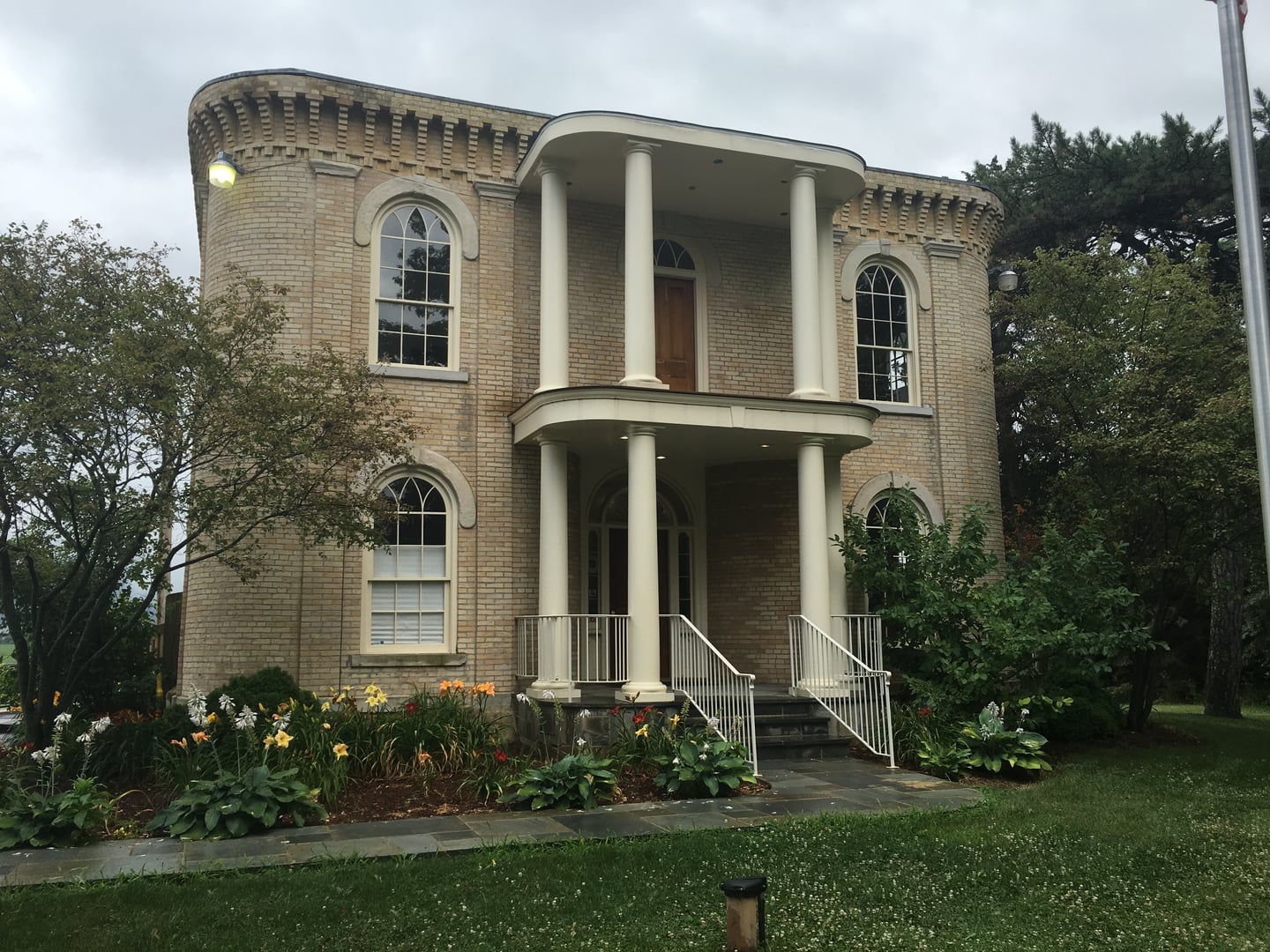
Est. 1828 · Listed on the National Register of Historic Places (NRHP) · Documented in Library of Congress Historic American Buildings Survey (HABS OH-339) · One of the oldest surviving stagecoach inns in northwest Ohio · Ohio Historical Marker on site · Connected to Maumee River frontier corridor (Fort Wayne–Detroit road)
In 1828, pioneer John Pray completed construction of the Columbian House on the banks of the Maumee River in what was then the young village of Waterville, Ohio. Built from 14-inch hand-hewn black walnut beams, the structure served as a combined trading post, tavern, and overnight hostel along the frontier road between Fort Wayne, Indiana and Detroit, Michigan—a vital corridor for westward travel.
Pray expanded the building significantly in 1837, adding a third story that served as the town's ballroom and converting the second floor to multi-use space including a single jail cell for holding prisoners. In 1843, the same year Pray sold the property and the Erie and Miami Canal opened, the Columbian House transitioned from a frontier stagecoach stop to a hub of the canal trade era.
Over its nearly 200-year history, the building has functioned as a hotel, jail, school, post office, and eventually a candlelit dinner restaurant beloved by northwest Ohio diners. In 1927, Henry Ford is said to have held a Halloween party in the building, drawn by its already well-established haunted reputation. The building was saved from disrepair in 1993 and is now owned by Thomas and Peggy Parker, who maintain it as a private preservation project.
The Columbian House is listed on the National Register of Historic Places and documented in the Library of Congress Historic American Buildings Survey (HABS designation OH-339). It holds an Ohio Historical Marker at the corner of N. River Rd and Farnsworth Rd.
Sources
- https://www.13abc.com/2021/03/03/new-life-for-old-stagecoach-stop-in-waterville/
- https://www.wtol.com/article/news/local/columbian-house-known-for-being-haunted-aims-to-rekindle-your-love-for-history/512-eed9eeb2-ab32-4ed2-bfc4-f5bbdd2f3e5d
- https://ohiomemory.ohiohistory.org/archives/1861
- https://www.loc.gov/item/oh0339/
- https://www.13abc.com/2026/03/17/we-people-preserving-columbian-house/
Furniture moved by unseen force (upstairs rooms)Pinching of guests and staff attributed to 'Jenny'Unexplained cold spotsLoud footsteps and pounding fists at nightCloud-like smoke apparitionsFiddle music heard in the third-floor ballroom
The Columbian House's ghost lore dates back at least to the mid-1800s. The most historically grounded paranormal tradition involves the murder of a traveling sheepherder who vanished from his second-floor room without a trace sometime in the 1840s. According to accounts compiled by Ohio History Connection and regional historians, a local farmer confessed the murder on his deathbed, disclosing the body's location; the remains were subsequently exhumed and the case resolved.
The building's most frequently reported ghost is a figure known as Jenny, believed by many investigators and longtime staff to be the spirit of a woman who was imprisoned in the inn after accidentally stabbing her stepbrother while trying to defend herself from a cruel stepfather. Jenny is reported to move furniture in the upstairs rooms, pinch employees and guests, and play pranks. Witnesses over the years have reported cold spots, sounds of loud footsteps and pounding fists at night, and apparitions in the form of cloud-like smoke.
By the early 1900s, the building's haunted reputation had become so intense that some Waterville residents called for its demolition. Instead, the Columbian House survived—and Henry Ford reportedly chose it specifically for his 1927 Halloween party because of its ghostly fame. According to the Ohio History Connection's Ohio Memory blog, paranormal reports have continued through multiple ownership changes and renovation eras.
Notable Entities
Jenny (imprisoned woman, second-floor room)Sheepherder (murder victim, 1840s)