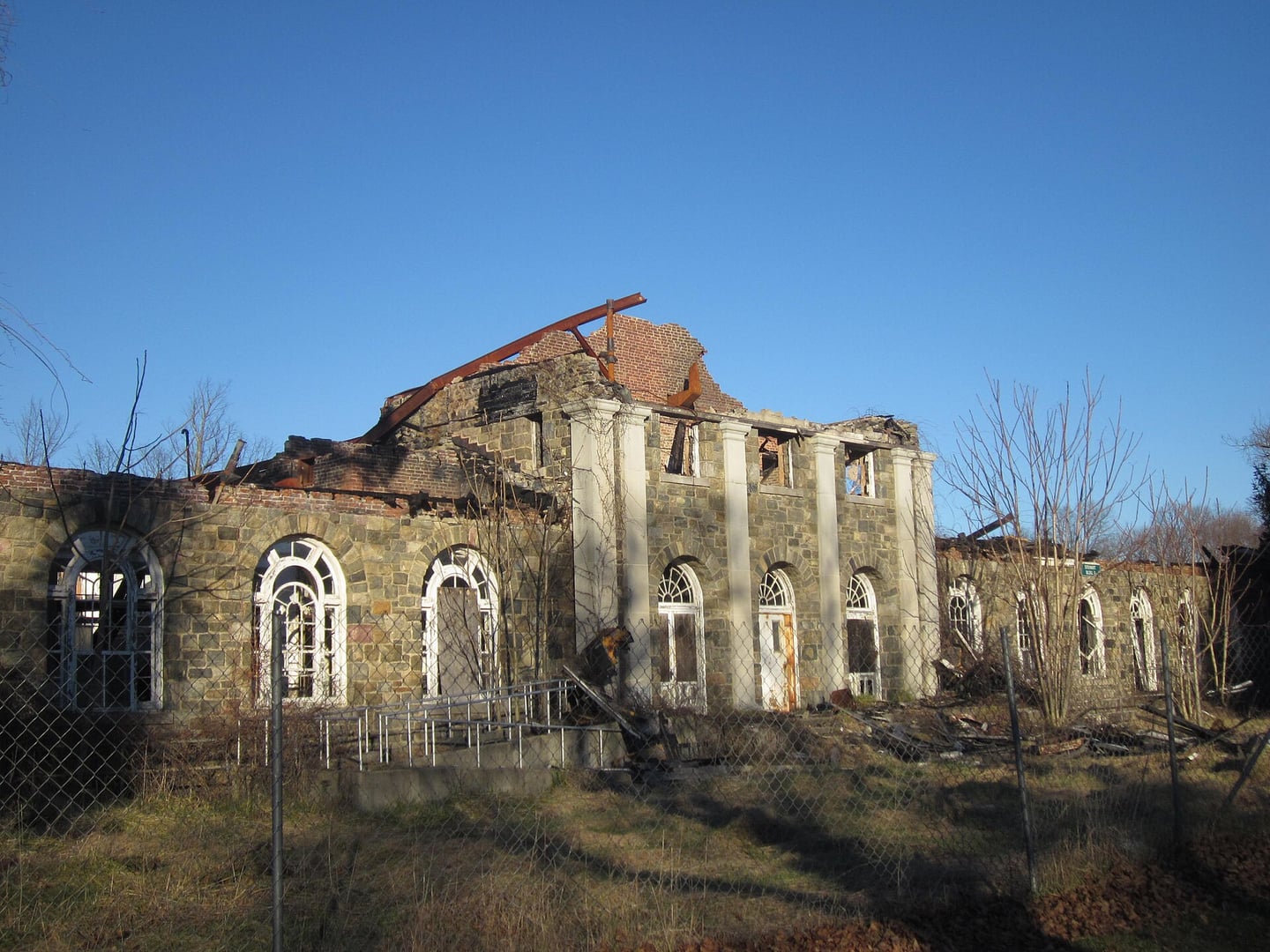
Est. 1864 · First State Inebriate Asylum in the United States (1864) · Converted to State Asylum for the Chronic Insane (1879) · Designed by Architect Isaac Perry · Listed on the National Register of Historic Places
Construction on the building known locally as "the Castle" began in the late 1850s on a hill overlooking Binghamton, to a Gothic Revival design by architect Isaac Perry. It opened in 1864 as the New York State Inebriate Asylum, the first institution chartered by a state to treat alcoholism as a medical condition rather than a moral failing. The reform-minded experiment proved short-lived as an inebriate asylum.
In 1879 the state repurposed the building as the New York State Asylum for the Chronic Insane, redirecting it toward the long-term care of patients considered incurable. Over the following decades it grew into the Binghamton State Hospital, a large institutional complex that operated for generations. The campus is now the Greater Binghamton Health Center, an active state mental-health facility.
The original Castle building is listed on the National Register of Historic Places for its architecture and its place in the history of American psychiatric and addiction treatment. Its limestone towers and steep rooflines have made it one of Binghamton's most photographed landmarks. The building has stood largely vacant in recent decades while the health center operates from newer structures on the same grounds.
Because the campus remains an active health facility, the Castle has no public interior access. Visitors view it from the public streets below.
Sources
- https://981thehawk.com/binghamton-state-hospital-castle/
- https://en.wikipedia.org/wiki/New_York_State_Inebriate_Asylum
- https://www.binghamtonhomepage.com/community/fall-fun-headquarters/watch-haunted-binghamton-castle-at-the-greater-binghamton-health-center/
Shadow figures in windowsDistant screamsFeelings of sorrow
The Castle's long institutional history and decades of vacancy have made it a fixture in Binghamton ghost lore, including a local TV news feature filmed at the Greater Binghamton Health Center grounds. The reports center on the original building's empty upper floors, where observers describe shadowy shapes moving past the windows.
Other accounts describe faint screams carried from the direction of the building and a heavy, sorrowful atmosphere that visitors attribute to the generations of patients institutionalized there. The lore draws directly on the site's documented past as an asylum for people committed for addiction and, later, chronic mental illness.
These claims are anecdotal, collected from local broadcast features and regional paranormal listings. The building is not open to the public, so the accounts come from people viewing it from outside the campus or from staff and visitors to the active health center. The reported phenomena are unverified, and the site's history of treating vulnerable patients warrants telling the story with that context in mind rather than as entertainment alone.
Media Appearances
- Haunted Binghamton Castle (local TV news feature, Binghamton Homepage)