Est. 1699 · Built c. 1685-1699 by Frederick Philipse I, first lord of Philipsburg Manor · One of oldest surviving religious structures in New York State · Field hospital and burial ground during Revolutionary War; Washington and Continental Army stopped here July 2, 1781 · One of highest concentrations of Revolutionary War veteran graves in New York State · Setting for Washington Irving's The Legend of Sleepy Hollow, 1820
The Old Dutch Church of Sleepy Hollow is one of the oldest surviving religious structures in New York State. Frederick Philipse I, who had risen from carpenter to the wealthiest merchant in colonial New York, broke ground in 1685 following his second wife Catharine Van Cortlandt Derval's encouragement to build a permanent stone church for his manor's tenants and laborers. Construction used fieldstone quarried locally, timber cut from the manor, and yellow brick shipped from the Netherlands. The structure was completed by approximately 1699.
Philipse I is buried in a crypt beneath the church floor. The burying ground holds Eleanor Van Tassel Brush, who some historians believe was the model for Irving's Katrina Van Tassel, and Hulda of Bohemia, a woman described in period accounts as a 'witch' who nonetheless served as an agent and scout for the Continental Army during the Revolution.
On July 2, 1781, George Washington and the Continental Army halted at the church during their march toward New York City in preparation for an attempted surprise attack on British positions. The burial ground around the church contains one of the highest concentrations of Revolutionary War veteran graves in New York State; some headstones bear musket ball impacts from the 1776-1781 campaigns.
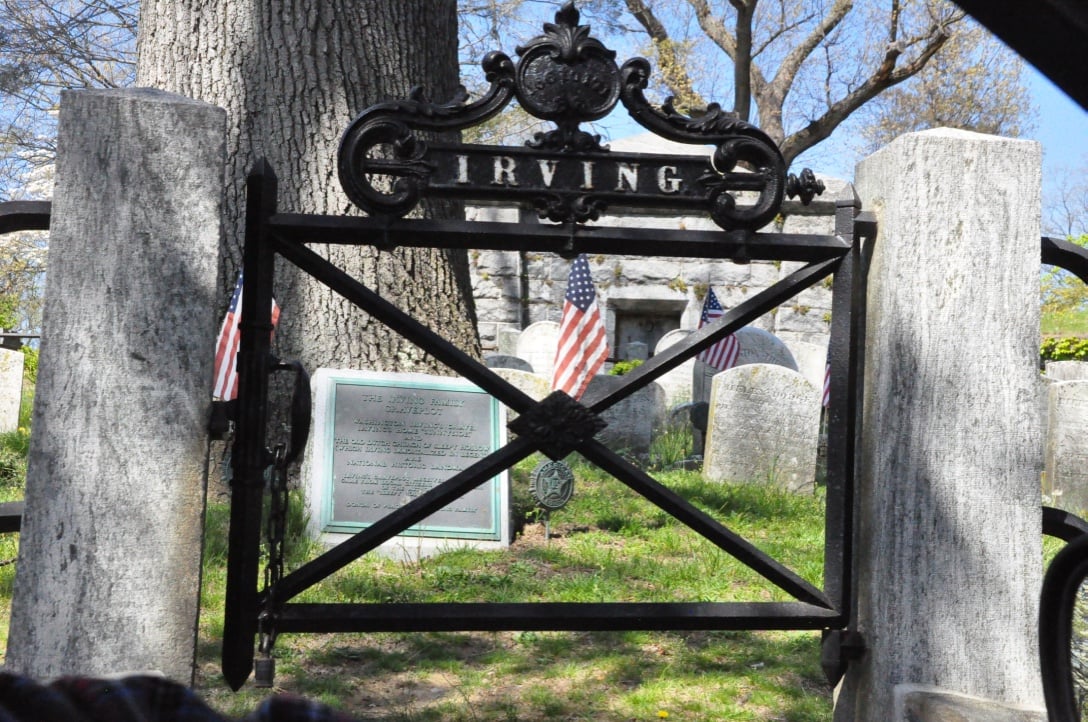
Washington Irving set The Legend of Sleepy Hollow, published 1820, in the landscape immediately surrounding this church. The story's narrator notes the churchyard as the Headless Horseman's home territory. Irving himself is buried in the adjacent Sleepy Hollow Cemetery, a short walk away.
Sources
- https://en.wikipedia.org/wiki/Old_Dutch_Church_of_Sleepy_Hollow
- https://reformedchurchtarrytowns.org/old-dutch-church/
Headless Horseman apparition (literary tradition with possible historical basis)General haunting reports in the burying ground, especially at nightRevolutionary War headstone damage consistent with musket ball impacts
The Headless Horseman of Sleepy Hollow is American literature's most famous ghost, and Washington Irving anchored the story explicitly to this church and its burying ground. In The Legend of Sleepy Hollow, published in 1820, the Horseman is identified as a Hessian trooper whose head was taken off by a cannonball during the Battle of White Plains in 1776. According to Irving and local oral tradition, the soldier is buried in the churchyard and rides forth each night in search of his skull.
The legend may have roots in a real incident. Irving and local historians have noted rumors that a headless corpse was discovered near the church following the battle — consistent with the kind of artillery casualty common at White Plains. No documentary record of the specific find has been confirmed, but the physical proximity of the battle and the church makes the underlying historical trauma plausible.
Irving was not inventing from nothing: he was writing about a landscape he had grown up in, populated with neighbors who carried living memory of the Revolution. The churchyard itself bears documented physical evidence of the war — headstones and the perimeter fence show impacts that match musket-ball dimensions. One Revolutionary-period headstone with visible damage is among the most photographed objects on the grounds.
Beyond the Headless Horseman legend, the site has been the subject of atmospheric haunting accounts for two centuries — largely undocumented but persistent. The burying ground's concentration of Revolutionary War graves and its connection to one of the most-read American ghost stories give it a dark-history standing that requires no embellishment.
Notable Entities
The Headless Horseman — Hessian soldier; lost head to cannonball at Battle of White Plains, 1776 (literary/legendary figure)Frederick Philipse I — builder; buried in church cryptEleanor Van Tassel Brush — buried in churchyard; possible model for Katrina Van TasselHulda of Bohemia — buried in churchyard; accused 'witch' and Revolutionary War scout
Where this legend is told