Self-Guided Visit
Exterior Drive-by
Pembroke Hall is a private historic property near Edenton. The mansion can be viewed from the public road as part of the broader Edenton ghost walk circuit.
- Duration:
- 15 min
HauntBound archive · catalog record
Reported phenomena — as catalogued
An 1850 antebellum mansion near Edenton where, in the 1920s, a woman fainted after reportedly encountering a disfigured Confederate colonel on the grounds — an account later published in The Virginian-Pilot.
Chowan County (near Edenton), Edenton, NC 27932
Research updated June 2026
Age
All Ages
Cost
Free
Private historic home; exterior viewing only from public road. No admission fee for drive-by.
Access
Limited Access
Private property viewed from public road; grounds not publicly accessible
Equipment
Photos OK
Est. 1850 · Antebellum Chowan County architecture · Civil War-era Edenton regional history · Documented in Edenton ghost walk tradition
Pembroke Hall, an antebellum mansion in Chowan County near Edenton, dates from around 1850. The property sits in a part of northeastern North Carolina that saw significant Civil War activity, and the house's history spans the war's aftermath and the region's slow economic transition through Reconstruction and into the 20th century.
The mansion remained in private hands throughout this period. Former residents, interviewed by sources including The Virginian-Pilot and local ghost walk chroniclers, recalled an encounter from the 1920s in which a woman walking between Pembroke Hall and a neighboring party fainted after seeing a figure with severe facial wounds — identified in the oral tradition as a Confederate colonel who had returned from battle with disfiguring injuries. The account was passed down through the families who lived at the property and documented by regional journalists.
Pembroke Hall does not operate as a public historic site or tour venue. It appears in Edenton's ghost walk tradition as one of several private properties in the area associated with Civil War-era ghost lore, referenced in the Edenton This Week overview of the town's haunted history and in accounts by local authors who conducted ghost walk research.
Sources
The Pembroke Hall ghost story has a specific origin and witness, though the original Virginian-Pilot source has not been independently digitized. In the 1920s, a young woman traveling between Pembroke Hall and a neighboring party encountered, on the grounds between the two houses, a figure she identified as a Confederate officer. His face, in the account passed down through the families involved, was disfigured by wounds — presumably from the Civil War, which had ended roughly sixty years prior.
The woman fainted. When she recovered, she described what she had seen, and the account was eventually shared with The Virginian-Pilot by people who had lived at or near Pembroke Hall. Local ghost walk chronicler Kathryn Louise Wood documented the story in a 2014 account of 300 years of Edenton haunted history, describing it as one of the more specific and historically grounded ghost accounts in the Edenton corpus.
No name for the colonel has been established in the sources reviewed, and no second witness account of the apparition has surfaced in the public record. The story remains part of Edenton's ghost walk oral tradition, presented as a regional family memory rather than a commercially promoted haunting.
Pembroke Hall is a private historic property near Edenton. The mansion can be viewed from the public road as part of the broader Edenton ghost walk circuit.
Some links on this page may earn HauntBound a small commission when you book, at no extra cost to you. Our editorial picks are independent. Full disclosure
Every HauntBound history is researched from documented sources. We clearly separate verified historical fact from paranormal folklore.
Free Guide
10 verified stops, rated for families, mapped in order. Free.
One email to confirm, then the guide link. Unsubscribe anytime.
Edenton, NC
Beverly Hall was built around 1810 and served dual purposes as a private residence and an informal bank, holding deposits for Edenton townspeople. The building is part of Edenton's well-preserved colonial and antebellum streetscape in the downtown historic district.
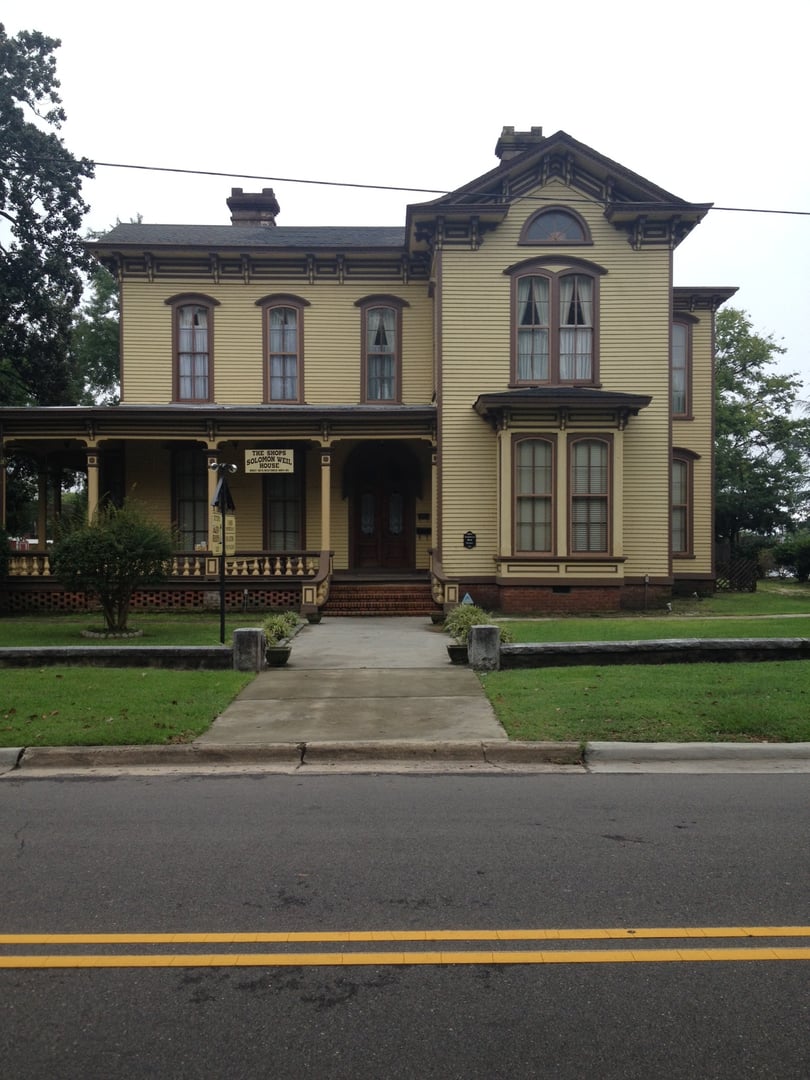
Goldsboro, NC
The Solomon Weil House was built in 1875 at 204 W. Chestnut St in Goldsboro, a yellow Victorian listed on the National Register of Historic Places. Solomon Weil and his brother Henry were prominent members of Goldsboro's German-Jewish merchant community. The house and the adjacent Henry Weil House are jointly listed on the National Register.
Augusta, GA
The Summerville Campus of Augusta University began as a United States Arsenal established in the 1820s on a hill above Augusta. Bellevue Hall and Benet House survive from that period. The campus passed to Augusta's educational institutions in the post-Civil War decades and has operated as a university campus since the early 20th century.