Est. 1834 · Third System Fort · Civil War Battlefield · WWII Coastal Defense · North Carolina State Park
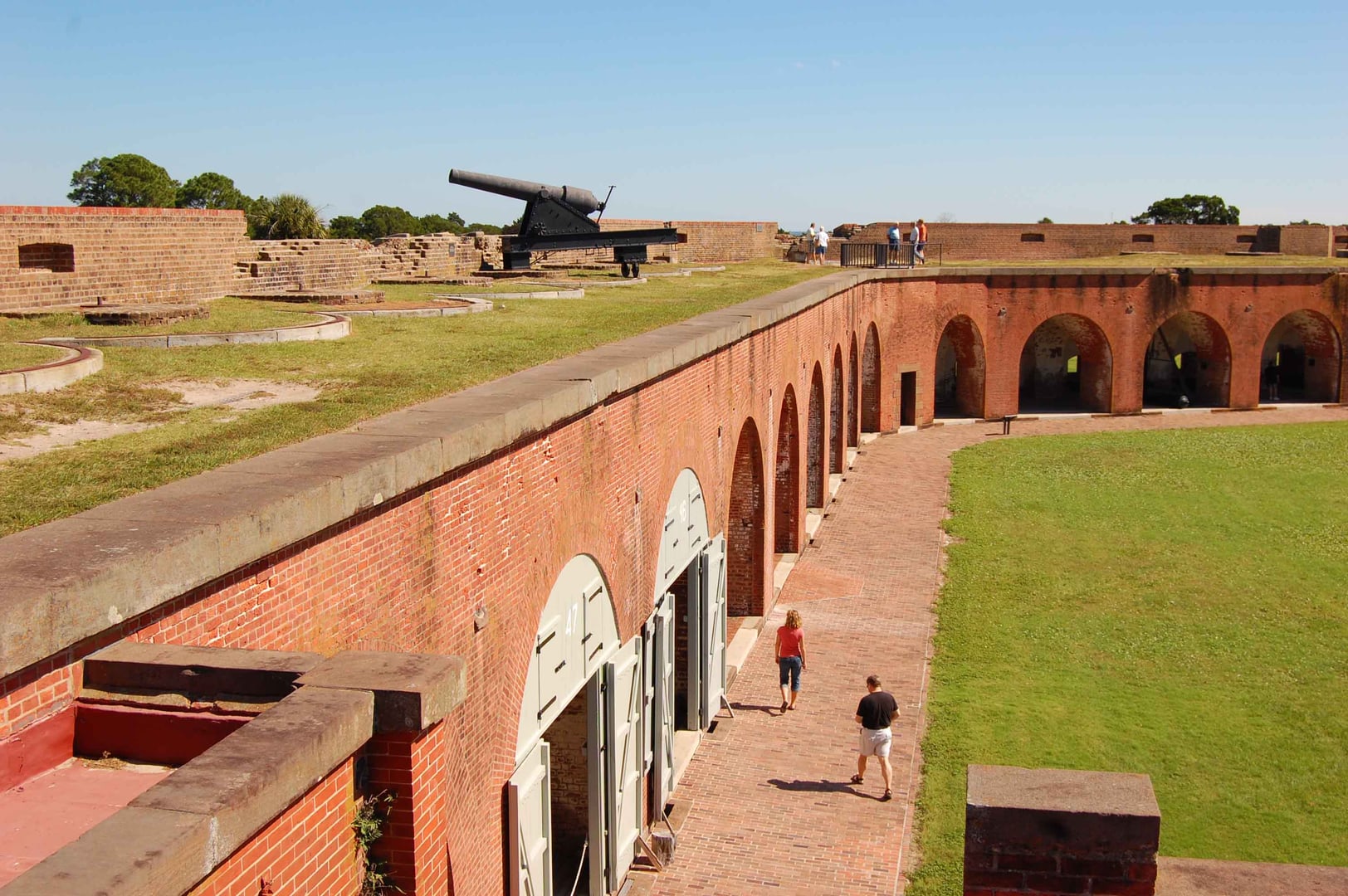
Construction of Fort Macon began in 1826 as part of the United States' Third System of coastal fortifications, a brick-and-masonry program designed to defend Atlantic harbors after the War of 1812. The fort was completed and garrisoned in 1834 and named for North Carolina senator Nathaniel Macon. Its mission was to protect Beaufort Inlet and the harbor at Beaufort, then one of the principal commercial ports on the southern coast.
On April 14, 1861, local militia took the fort for the state of North Carolina and the Confederacy without resistance. The garrison spent the next year preparing the fort against an anticipated Union assault. In April 1862, Major General Ambrose E. Burnside laid siege to Fort Macon during his North Carolina campaign. Union batteries on Bogue Banks and naval gunfire from the inlet breached the fort's masonry, and the Confederate garrison surrendered after a single day of bombardment. For the remainder of the Civil War, Fort Macon protected Union ships recoaling at Beaufort.
The fort continued in federal service after the war and was used briefly as a Federal prison. It was decommissioned, recommissioned for the Spanish-American War, and again garrisoned during World War II as part of coastal defenses against German U-boats. The U.S. Army formally turned the property over to the State of North Carolina in 1924, and it became one of the first units of the new state park system. The fort and 424 acres of surrounding maritime forest, beach, and sound shoreline are preserved today as Fort Macon State Park, with year-round daily tours and an interpretive visitor center.
Sources
- https://en.wikipedia.org/wiki/Fort_Macon_State_Park
- https://www.ncparks.gov/state-parks/fort-macon-state-park
- https://www.battlefields.org/visit/heritage-sites/fort-macon-state-park
ApparitionsPhantom footstepsDoors opening/closingResidual haunting
Fort Macon's paranormal reputation is rooted in two distinct historical layers. The Civil War siege left Confederate dead and wounded at the fort, and a recurring local story holds that figures dressed in 1860s uniform have been seen standing watch atop the ramparts, looking inland in the direction from which Burnside's batteries advanced.
The second layer is mid-twentieth-century. World War II garrison veterans, retold in regional folklore collections, describe an evening when the main gate of the fort closed on its own while sentries stood post outside. No mechanical or weather-related explanation has ever been published, and the story has become one of the more widely circulated military-era anecdotes attached to a North Carolina state park.
Visitor center staff have additionally reported phantom footsteps in interior rooms when no other staff or visitors are present, along with the impression of someone passing immediately behind them. The Friends of Fort Macon group hosts a seasonal Fear at the Fort hayride in October that uses the fort's historical context to introduce visitors to local folklore. The state park itself does not market the site as a paranormal destination outside of these scheduled events.
Notable Entities
Civil War sentries