Est. 1861 · Civil War Earthwork Fortification · Largest Confederate Coastal Defense · Blockade-Running Heritage · Death Site of Maj. Gen. W.H.C. Whiting
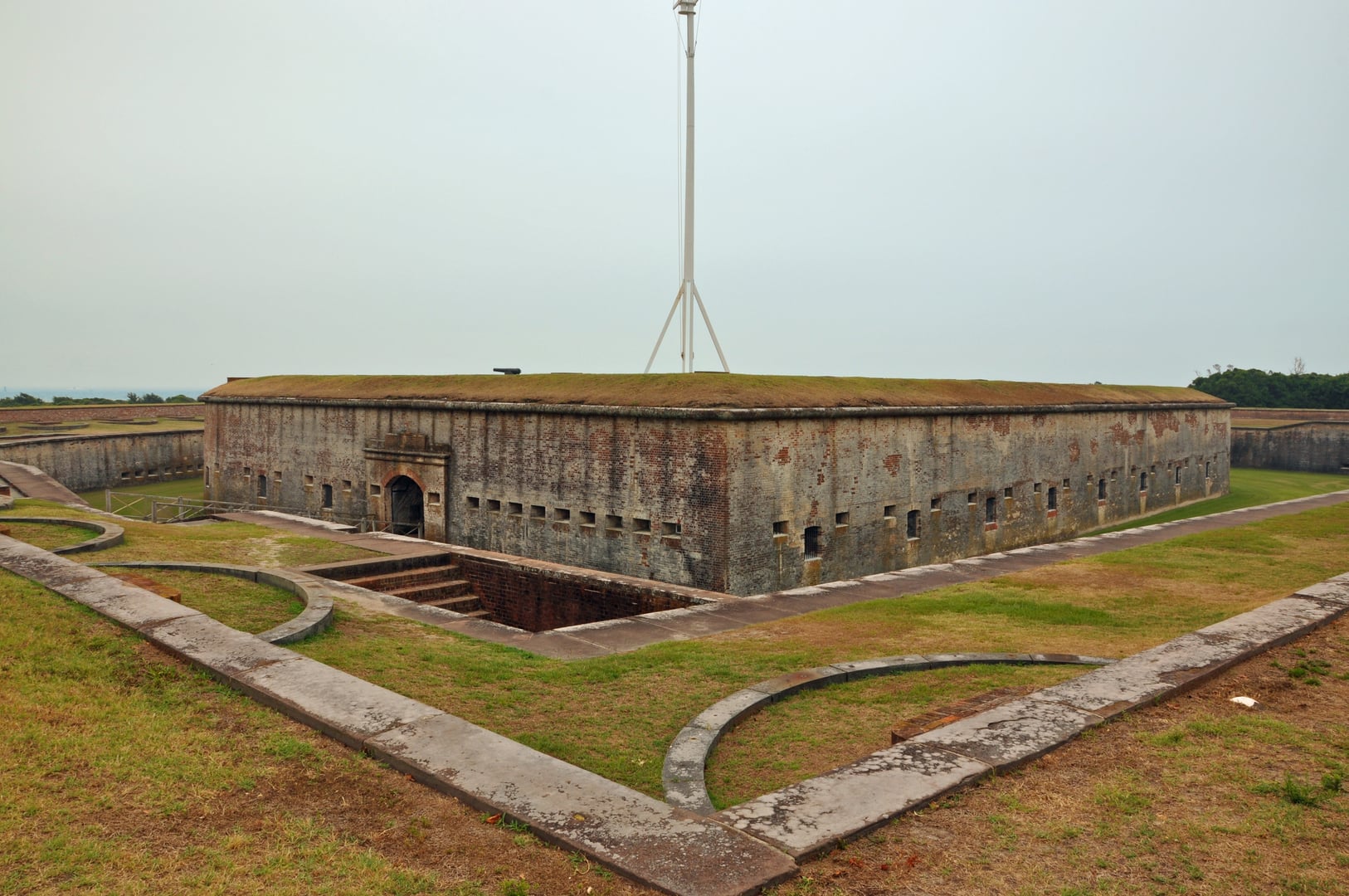
Fort Fisher's earthworks rise from the sand dunes at the southern tip of the peninsula separating the Cape Fear River from the Atlantic, about 18 miles south of Wilmington. Work on sand batteries at New Inlet began in the spring of 1861. Colonel William Lamb took command in July 1862 and found fewer than two dozen guns in place; over the next two and a half years he expanded the position into the largest earthen fort in the Confederacy. The state historic site's history notes that more than 500 African Americans, enslaved and free, worked on the construction, with the labor force peaking near 1,000. By January 1865 the sea face ran a mile with 22 guns, and the land face held 25 guns on 15 mounds about 32 feet high behind a nine-foot palisade. The fort's purpose was singular: to keep open the channel into Wilmington, the South's busiest blockade-running port in the last years of the war.
The first Union assault on December 24-25, 1864, failed. The second began with a naval bombardment on January 13, 1865, and ended on January 15 when more than 3,300 Union infantry, including the 27th U.S. Colored Troops, stormed the land face. Major General W.H.C. Whiting, commander of the District of the Cape Fear, was shot twice in the leg while leading a countercharge and was captured along with Lamb. He died of dysentery as a prisoner at Fort Columbus on Governors Island, New York, on March 10, 1865; his remains were moved to Oakdale Cemetery in Wilmington in 1900. The fall of Fort Fisher closed the last major Confederate seaport.
Erosion, the construction of US 421, and a World War II airstrip destroyed most of the works; roughly ten percent survives. A county marker went up in 1921, a preservation society formed in 1931, and the state leased 189 acres of federal land in 1958 and began developing the site in 1960. The fort was named a National Historic Landmark in the early 1960s, the first in North Carolina. A 20,000-square-foot visitor center opened on October 30, 2024. Admission is free.
Sources
- https://historicsites.nc.gov/all-sites/fort-fisher
- https://www.dncr.nc.gov/news/press-releases/2024/10/23/fort-fishers-new-visitor-center-open-public-oct-30
- https://historicsites.nc.gov/all-sites/fort-fisher/plan-your-visit
- https://www.coastalguide.com/ghost-of-fort-fisher.html
- https://en.wikipedia.org/wiki/Fort_Fisher
- https://historicsites.nc.gov/all-sites/fort-fisher/history
- https://www.ncpedia.org/fort-fisher
- https://www.battlefields.org/visit/heritage-sites/fort-fisher-state-historic-site
- https://www.ncpedia.org/biography/whiting-william-henry
- https://www.dncr.nc.gov/blog/2023/12/11/w-h-c-whiting-1824-1865-d-102
- https://www.saltmagazinenc.com/wilmingtons-five-most-famous-ghosts/
- https://books.google.com/books/about/Haunted_Places_in_the_American_South.html?id=QAfH-NKSFKMC
ApparitionsPhantom footstepsPhantom soundsTouching/pushingCold spotsSentinel apparition in the woods
Fort Fisher's reported phenomena center on Major General W.H.C. Whiting, wounded in the January 1865 assault and dead in Union custody two months later. The earliest story in print belongs to folklorist Alan Brown, whose Haunted Places in the American South (University Press of Mississippi, 2002) relates that three former soldiers attending an 1868 reunion at the fort saw a figure atop a gun emplacement raise its sword, and took it for their old commander. The Coastal Guide account dates the first recorded sighting of a different figure, a sentinel standing in the pine woods north of the fort, to the early 1900s, and adds that Colonel Lamb has also been reported on the parapet.
The most-told modern story, repeated in coastal-North-Carolina tourism writing, involves a Kure Beach police officer who picked up a man walking toward the fort at night; the rider, dressed in a full Confederate general's uniform, asked to be dropped near the entrance. Staff have for years described unexplained footsteps in the visitor center after closing, and the practice of saying goodnight to General Whiting is a long-running staff custom referenced in regional reporting. Visitors describe the sensation of someone passing close by on the earthworks trail in the late afternoon.
The Coastal Guide also records a night visit by the investigative group Haunted North Carolina, in which three members independently reported the soldier in the woods while the temperature at the spot dropped from 68 to 43 degrees; the group logged gunshot-like sounds and cries. Salt Magazine's August 2026 feature on Wilmington's five most famous ghosts, written by John Wolfe, places Whiting at the fort with his men and notes that soldiers have been both heard and seen there. The folklore stays restrained, in keeping with state-historic-site interpretation: serious history, modest claims.
Notable Entities
Maj. Gen. W.H.C. Whiting
Media Appearances
- Haunted Places in the American South by Alan Brown (book, 2002)
- Salt Magazine, 'Wilmington's Five Most Famous Ghosts' (press, 2026)