Est. 1822 · Birthplace of Jesse and Frank James · Site of the 1875 Pinkerton bombing · National Register of Historic Places, 1972 · 1995 forensic DNA exhumation of Jesse James's remains
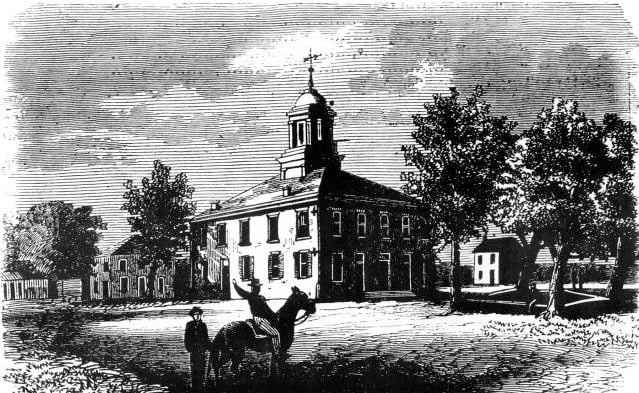
The log core of the James family farmhouse was built around 1822 and later expanded with a wood-frame addition into a T-shaped dwelling. Robert James, a Baptist minister, and his wife Zerelda raised their children here, including Jesse Woodson James, born on the property on September 5, 1847, and his older brother Frank.
The farm was not spared the violence of the Civil War in Missouri. In May 1863, a Union militia detail searching for Frank James and his guerrilla associates raided the farm, hanged stepfather Reuben Samuel from a tree in an attempt to force information out of him, and whipped the teenage Jesse. Within a year Jesse had joined his brother in William "Bloody Bill" Anderson's guerrilla band. The family's postwar notoriety brought further violence to the farm: on the night of January 25-26, 1875, Pinkerton National Detective Agency operatives, acting on a tip that Jesse and Frank were hiding there, threw an incendiary device into the house. It killed eight-year-old Archie Samuel, Jesse's half-brother, and forced the amputation of Zerelda Samuel's right arm below the elbow. The Pinkertons denied responsibility for the device, but the raid turned public sympathy toward the James family and helped cement Jesse's outlaw legend.
After Jesse was shot and killed by Robert Ford in St. Joseph in 1882, his mother had him buried in the farmyard, reportedly to keep the grave from being disturbed by curiosity seekers; she is said to have sold stone chips from the marker to visitors for twenty-five cents. His remains were later reinterred at Mount Olivet Cemetery in Kearney. A 1995 forensic exhumation of that grave, led by George Washington University professor James E. Starrs, used mitochondrial DNA from descendants of Jesse's sister to confirm the remains were his.
Clay County acquired the farm in 1974 and operates it today as a house museum, with the log-and-frame farmhouse, the original grave site, and a visitor center holding what the site describes as its collection of family artifacts. The property was added to the National Register of Historic Places in 1972, with a boundary expansion in 1978.
Sources
- https://en.wikipedia.org/wiki/James_Brothers%27_House_and_Farm
- https://www.battlefields.org/visit/heritage-sites/jesse-james-farm-and-museum
- https://jessejamesmuseum.org/
- https://www.realclearhistory.com/2022/01/27/pinkertons_attack_jesse_james_family_813587.html
- https://skepticalinquirer.org/2016/11/jesse-jamess-haunts-legends-history-and-forensic-science/
- https://www.pbs.org/wgbh/americanexperience/features/james-life-and-death-jesse-james/
- https://www.yourghoststories.com/real-ghost-story.php?story=5962
Lights moving inside the farmhouse after hoursHoofbeats and voices from the treeline at dawnStrong sense of presence inside the home
The James farm has a decades-long local reputation as one of the more talked-about haunted sites in Clay County, tied directly to the violence the family lived through here: the 1863 whipping of teenage Jesse, and the 1875 bombing that killed his young half-brother and maimed his mother in the front room of the house.
Regional ghost-lore writers describe recurring reports of lights moving inside the farmhouse after the museum has closed for the night, and of sounds carrying from the property at dawn -- horses' hooves, low voices, what some visitors describe as muffled gunfire or cries. Staff accounts describe an unusually strong sense of being watched inside the home itself.
Writing in Skeptical Inquirer, forensic investigator Joe Nickell examined these same reports after the 1995 exhumation of Jesse James's grave and offered a skeptical reading: the lights as reflections off old window glass, the voices and hoofbeats as wind moving through the nearby woods and pasture, amplified by the site's association with a violent history. No paranormal investigation team or television production has published a formal on-site study of the farmhouse itself.
Where this legend is told