Est. 1852 · National Register of Historic Places · Edgar Allan Poe Burial Site · 1787 Presbyterian Cemetery · University of Maryland Heritage Site
The First Presbyterian Church of Baltimore established the burying ground in January 1787, when the site sat at the western edge of the growing port city. Over the next six decades, interments included merchants, statesmen, dozens of Revolutionary War officers and enlisted men, and War of 1812 veterans. The cemetery's original brick perimeter and gravestone layout remain substantially intact today.
In 1852, congregation members built Westminster Presbyterian Church directly above the burying ground, raising the new building on brick piers and arched vaults rather than disturbing the earlier graves. The space beneath the church floor became the Westminster catacombs, a network of brick-arched chambers containing many of the original 1787-1840s burials. The architectural choice was deliberate; the congregation wanted to expand worship space without removing the dead.
The congregation eventually dissolved, and the building fell into disrepair through the mid-20th century. The Westminster Preservation Trust formed in 1977, and the University of Maryland School of Law took over stewardship. The structure now serves as a venue for academic events and weddings, and is listed on the National Register of Historic Places.
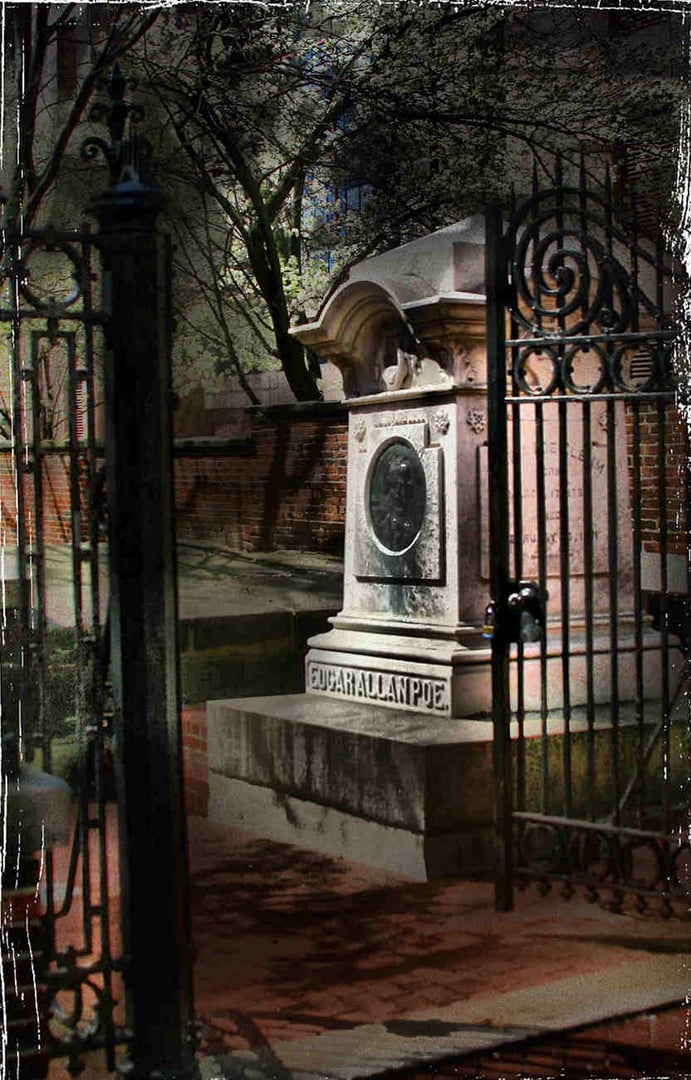
Edgar Allan Poe was buried at the back of the cemetery after his October 1849 death. In 1875, schoolchildren raised funds through the Pennies for Poe campaign, and a new monument at the cemetery's front corner now marks the resting place of Poe, his wife Virginia Clemm Poe, and his mother-in-law Maria Poe Clemm. The Poe Toaster tradition of leaving three roses and cognac on Poe's birthday continued from 1949 to 2009; Poe Baltimore now organizes an annual public birthday event.
Sources
- https://en.wikipedia.org/wiki/Westminster_Hall_and_Burying_Ground
- https://www.westminsterhall.org/about
- https://www.westminsterhall.org/tours
- https://baltimoreheritage.org/event/the-catacombs-under-westminster-two-hundred-years-of-tombs-and-edgar-allan-poes-gravesite-21/
- https://morbidlybeautiful.com/haunted-history-westminster/
- https://ghostcitytours.com/baltimore/haunted-baltimore/westminster-burial-grounds-haunted/
- https://frightfind.com/the-westminster-hall-and-burial-ground/
- https://tourbaltimoreghosts.com/westminster-hall-and-burying-ground/
- http://americashauntedroadtrip.com/westminster-hall-and-burying-ground-the-final-resting-place-of-edgar-allan-poe/
- https://midatlanticdaytrips.com/2024/10/westminster-burying-ground/
ApparitionsPhantom footstepsCold spotsPhantom smellsTouching/pushing
The catacombs concentrate the bulk of Westminster's paranormal reports. Tour visitors describe the sound of footsteps following them through the brick-vaulted chambers, sudden cold pockets where the surrounding air remains warm, and a pungent stale smell that briefly fills a corridor before clearing. Tour guides catalog these accounts as common but unverified.
The figure of Frank, sometimes called Leon, anchors the body-snatcher narrative. Local lore identifies him as a 19th-century resurrection man who exhumed Westminster burials and sold the cadavers to Baltimore medical schools during the early decades of formal anatomical training. Whether Frank existed as a specific individual or as a composite of the documented body-snatching trade is unclear in surviving records.
Above ground, Edgar Allan Poe's grave generates its own reports. Visitors over multiple decades describe a tall, thin figure in a long black coat, wide-brimmed hat, and scarf or wrap across the lower face standing near the monument. The description closely parallels the documented Poe Toaster, an anonymous visitor who left roses and cognac at the grave each January 19 from 1949 to 2009. Accounts of sightings precede and post-date the Toaster tradition; whether visitors are seeing a memorial gesture, a misidentification, or something else has never been resolved.
Westminster Hall does not formally market itself as a paranormal site, but tour guides incorporate the cemetery's reputation into the standard catacomb tour narration. The Westminster Preservation Trust treats these accounts as part of the building's cultural history rather than as endorsed paranormal claims.
Notable Entities
The figure at Poe's graveFrank the body snatcher