Edgar Allan Poe Burial Site · Revolutionary War and War of 1812 Veterans · Pre-Civil War Catacombs · University of Maryland Heritage Property
The First Presbyterian Church of Baltimore established the Westminster Burying Ground on what was then the western edge of the city; the current steward's history page gives 1786, while an earlier archival account of the land purchase gives 1787. Over the following 60 years, the grounds received the burials of Baltimore merchants, statesmen, and several dozen officers and enlisted veterans of the Revolutionary War and the War of 1812. The cemetery's original layout remains substantially intact.
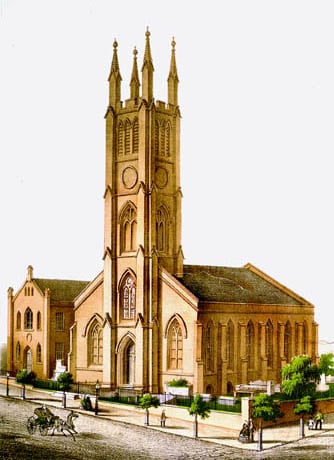
In 1852, the congregation built Westminster Presbyterian Church directly above the existing burials, supporting the new structure on brick piers and arches that left the older graves undisturbed beneath the building. The space between the original ground level and the church floor became a series of catacombs, accessible today by guided tour.
Edgar Allan Poe died in Baltimore on October 7, 1849, under circumstances that remain medically and historically debated. He was buried at Westminster in an unmarked grave at the back of the cemetery. In 1875, Baltimore schoolchildren raised money through a campaign called Pennies for Poe, and a new monument was dedicated at the front of the cemetery at the corner of Fayette and Greene. Poe's remains were moved to the new location and were later joined by those of his wife Virginia Clemm Poe and his aunt and mother-in-law Maria Poe Clemm.
From 1949 until 2009, an anonymous figure known as the Poe Toaster visited the grave each January 19, leaving three roses and a half-bottle of cognac. The tradition was discontinued; Poe Baltimore has since organized a public birthday-weekend event in its place. The University of Maryland School of Law assumed stewardship of Westminster Hall in 1977, and the building now operates as a venue and historic site. The burying ground is open for free self-guided visits daily; catacomb tours run on the first Saturday of each month.
Sources
- https://en.wikipedia.org/wiki/Westminster_Hall_and_Burying_Ground
- https://www.westminsterhall.org/about
- https://www.eapoe.org/balt/poegrave.htm
- https://www.visitmaryland.org/listing/history-heritage/westminster-burying-ground-catacombs
- https://morbidlybeautiful.com/haunted-history-westminster/
- https://midatlanticdaytrips.com/2024/10/westminster-burying-ground/
ApparitionsPhantom footstepsCold spotsPhantom smellsTouching/pushing
The Poe grave generates the cemetery's most-reported sightings. Visitors and tour guides have described a tall, thin figure in a long dark coat, wide-brimmed fedora, and a scarf or wrap across the lower face standing motionless near the monument. The description tracks closely with the Poe Toaster figure who visited the grave annually between 1949 and 2009, and accounts predating and postdating that tradition both exist. Whether visitors are seeing a memorial gesture, a misidentification, or something less easily classified, the description has remained consistent across decades.
The catacombs beneath the 1852 Westminster Presbyterian Church draw a different set of reports. Tour guides recount the story of Leon, sometimes called Frank, a body snatcher who allegedly worked the burying ground in the early 19th century to supply cadavers to Baltimore-area medical schools, including the early years of Johns Hopkins. Visitors have reported icy hands brushing shoulders in the catacombs, footsteps following them through the brick passages, and pockets of sour or putrid smell that fade as quickly as they arrive.
The Screaming Skull, said by local lore to belong to a murdered Cambridge minister whose burial was repeatedly disturbed, is another fixture of catacomb tour narration. These stories are presented by Westminster Hall staff as folkloric rather than historically verified.
Westminster's reputation among Baltimore's haunted destinations is reinforced by the cemetery's preserved historic character. The grave markers, the brick catacomb piers, and the proximity to a working law-school building create a setting where the line between archival history and folklore is unusually narrow.
Notable Entities
The figure at Poe's graveFrank the body snatcher