Drive-By
Campus exterior viewing
View Fenwick Hall and its clock tower from the Holy Cross campus. Interior access is restricted to college business.
- Duration:
- 30 min
HauntBound archive · catalog record
Reported phenomena, as catalogued
The 1843 original academic building at College of the Holy Cross and the locus of the campus's most enduring legend, the 'Exorcism Tower' and its Stairway to Nowhere.
1 College Street, Worcester, MA 01610
Research updated September 2026
Age
All Ages
Cost
Free
Active college campus; exterior is accessible to the public.
Access
Wheelchair OK
Hillside campus; building entry varies.
Equipment
Photos OK
Est. 1843 · Original (1843) academic building of the College of the Holy Cross · Founded by Benedict Joseph Fenwick, second Bishop of Boston · Oldest standing structure on campus · Cornerstone laid June 21, 1843; rebuilt after 1852 fire
The College of the Holy Cross was established in October 1843 on Mount Saint James in Worcester, founded by Benedict Joseph Fenwick, the second Bishop of Boston, who named the new college after his cathedral church, the Cathedral of the Holy Cross in Boston. Fenwick Hall, the inaugural academic building, had its cornerstone laid on June 21, 1843.
In 1852 the building was completely destroyed by fire. It was rebuilt and reopened in 1853, and stands today as the oldest structure on campus. Wikipedia's article on the college describes Fenwick Hall as 'the college's flagship building.' The building is now used for administrative and academic offices and houses the campus's prominent clock tower, which dominates views of the hillside campus.
A closely adjoining building, O'Kane Hall, contains the so-called Exorcism Room high in its upper floor; the rooms above the fourth floor are reached via a 20-step interior stairway. According to a feature in Holy Cross Magazine, a pre-1854 artist's rendering of Fenwick and O'Kane halls indicates the 'Stairs to Nowhere' were originally intended to lead to an observatory that was never built, leaving the staircase to end at a sealed wall.
Holy Cross is the oldest Catholic college in New England and remains a Jesuit liberal-arts institution. The Fenwick/O'Kane complex is both the architectural and the folkloric center of the campus.
Sources
Holy Cross's signature legend centers on the so-called Exorcism Tower in the upper floors of O'Kane Hall, attached to Fenwick Hall. Per Holy Cross Magazine's feature 'It Scares Us to Death – And We Love It' and the school's own coverage, the supposed former tower entrance is reached on the fourth floor by a 20-step 'Stairway to Nowhere' that ends abruptly at a sealed wall.
The most-told version of the story, recounted in The Pulse Magazine's 2015 'Worcester's haunted colleges' article and in Holy Cross Magazine, involves two Jesuit priests who attempt to exorcise a demonically possessed young woman in a room above the fourth floor. In this telling, one priest is thrown through a window and falls to his death, while the other priest and the young woman are never seen again. Variations have a bolt of lightning striking the tower or the clock breaking from the released spirits.
The legend's actual origin is more recent than the building. Holy Cross associate professor of theatre Scott Malia, quoted in Holy Cross Magazine, observes that the story 'has to be 50 years old or less because before that we weren't a coeducational institution,' suggesting it emerged after the college became coeducational in 1972. The school's official history 'Thy Honored Name' contains no mention of an exorcism, and a pre-1854 architect's rendering shows the Stairway to Nowhere was originally intended to lead to an observatory that was never built.
Holy Cross has embraced the folklore with what the magazine calls 'genial amusement,' offering occasional alumni tours of the Exorcism Room (which is now used for storage and remains locked the majority of the year) and inviting visitors to sign its walls. The lore is unusually well-attested in college-owned sources for a campus legend.
Notable Entities
Media Appearances
View Fenwick Hall and its clock tower from the Holy Cross campus. Interior access is restricted to college business.
Some links on this page may earn HauntBound a small commission when you book, at no extra cost to you. Our editorial picks are independent. Full disclosure
Every HauntBound history is researched from documented sources. We clearly separate verified historical fact from paranormal folklore.
Free Guide
11 verified stops, rated for families, mapped in order. Free.
One email to confirm, then the guide link. Unsubscribe anytime.
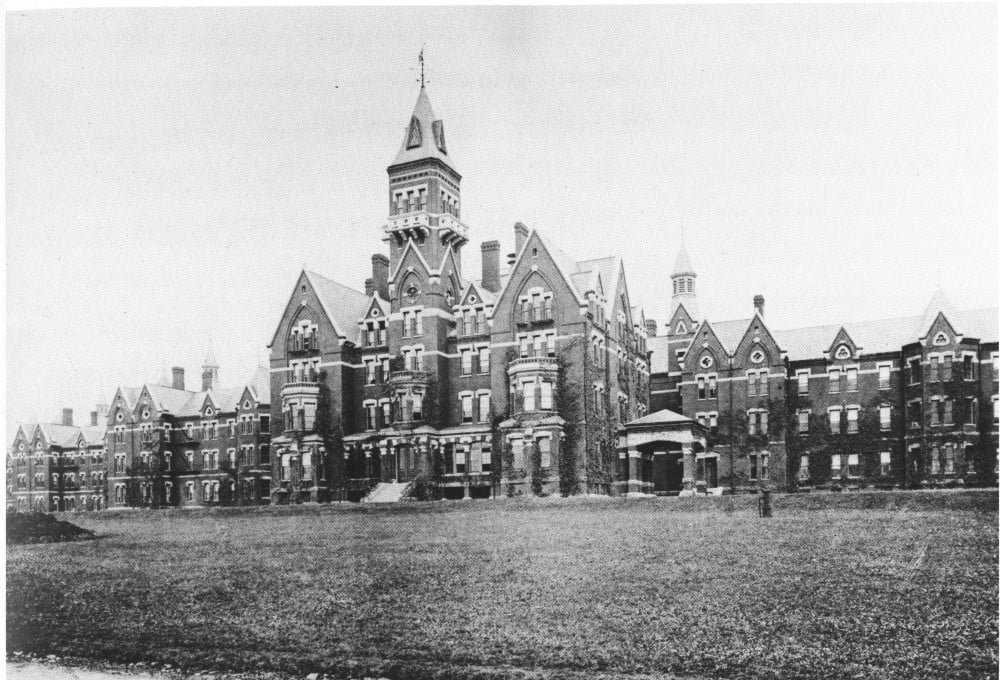
Danvers, MA
Danvers State Hospital was a Kirkbride Plan psychiatric facility designed by Nathaniel Jeremiah Bradlee, with construction starting in 1874 and the hospital opening in 1878, on a hill overlooking Danvers, Massachusetts. The hospital closed in 1992. The Kirkbride was largely demolished in January-June 2006 for AvalonBay's apartment redevelopment, with only the outermost brick shell of the administration block and immediate adjacent wards retained as facade.
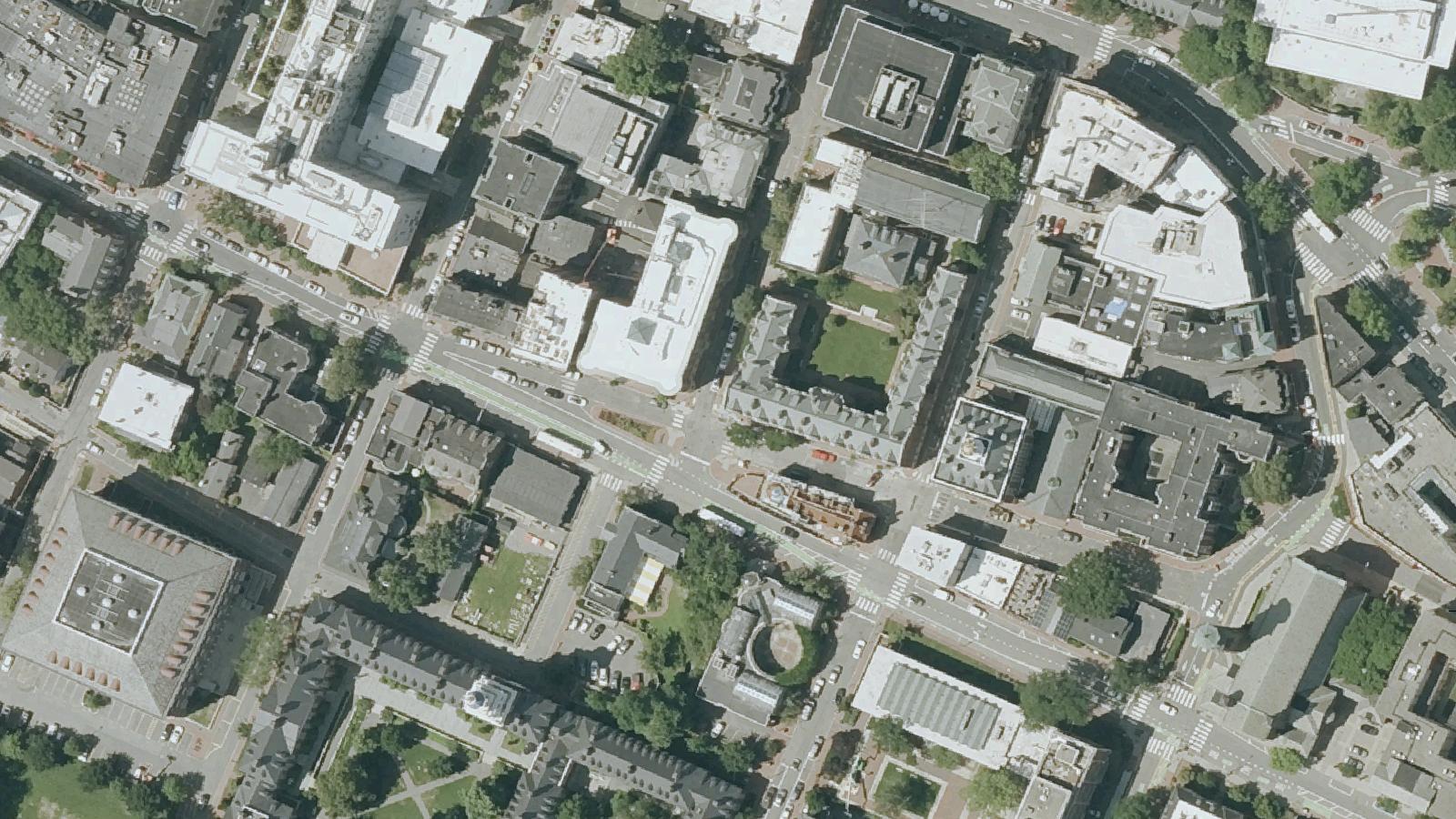 Aerial survey · USDA NAIP
Cambridge, MA
Lowell House is a Harvard upperclassman residential House opened in 1930 as one of the original seven Houses funded by Edward Harkness. Designed by Coolidge, Shepley, Bulfinch and Abbott in a Georgian style, it is named for the Lowell family — a Boston Brahmin clan whose members included poet James Russell Lowell, astronomer Percival Lowell, and Pulitzer Prize-winning poet Amy Lowell.
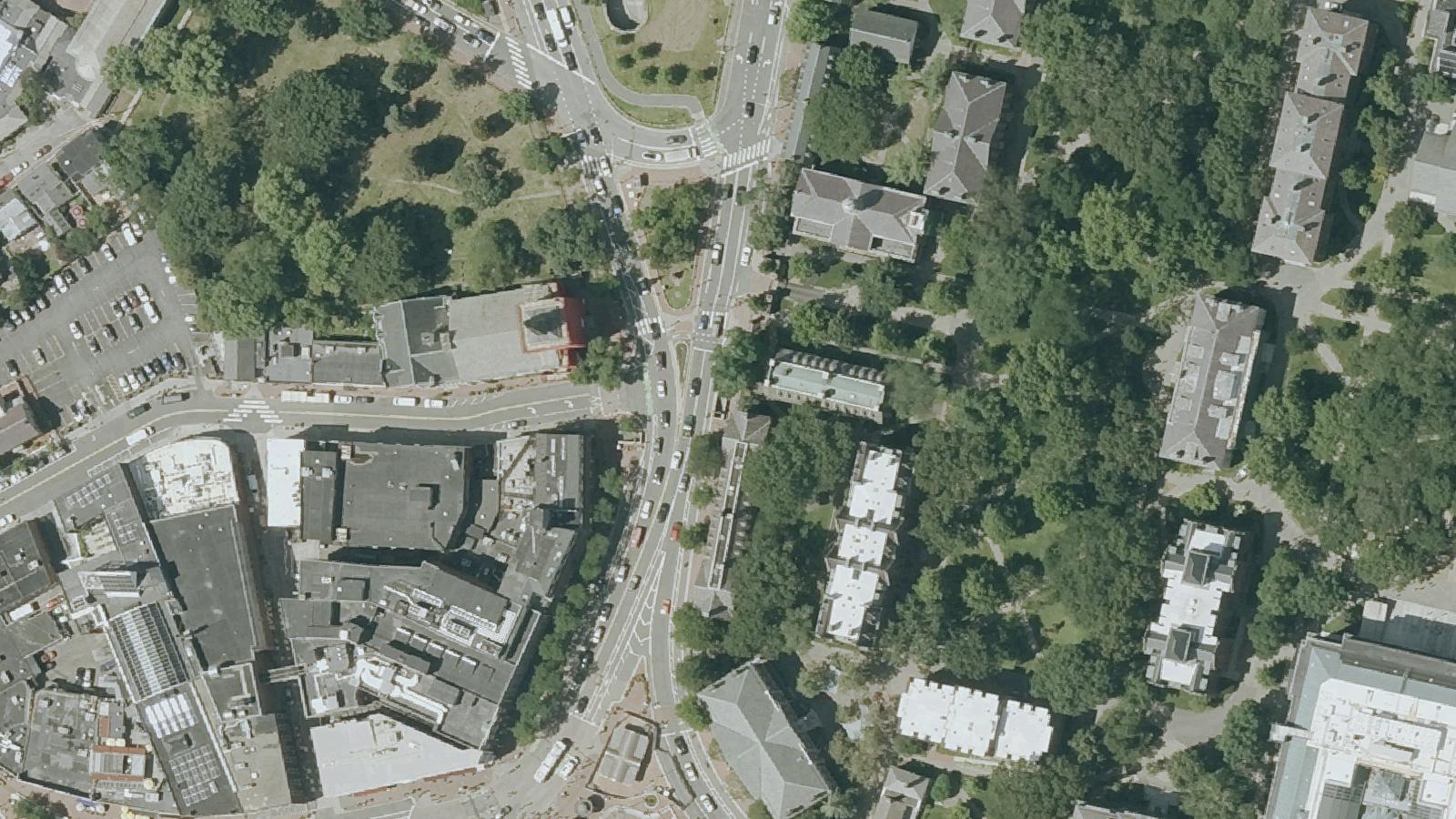 Aerial survey · USDA NAIP
Cambridge, MA
Massachusetts Hall, constructed 1718–1720, is the oldest surviving Harvard building and the second-oldest academic building in the United States. It was designed as a student dormitory and has served as a barracks for Continental troops, a classroom building, an office building, and — since 1939 — the office of the Harvard president. The upper floors are still occupied by freshman students each year.