Est. 1941 · National Park · UNESCO World Heritage Site · Enslaved Labor History · Saltpeter Mining · Civil War Era · Archaeological Site
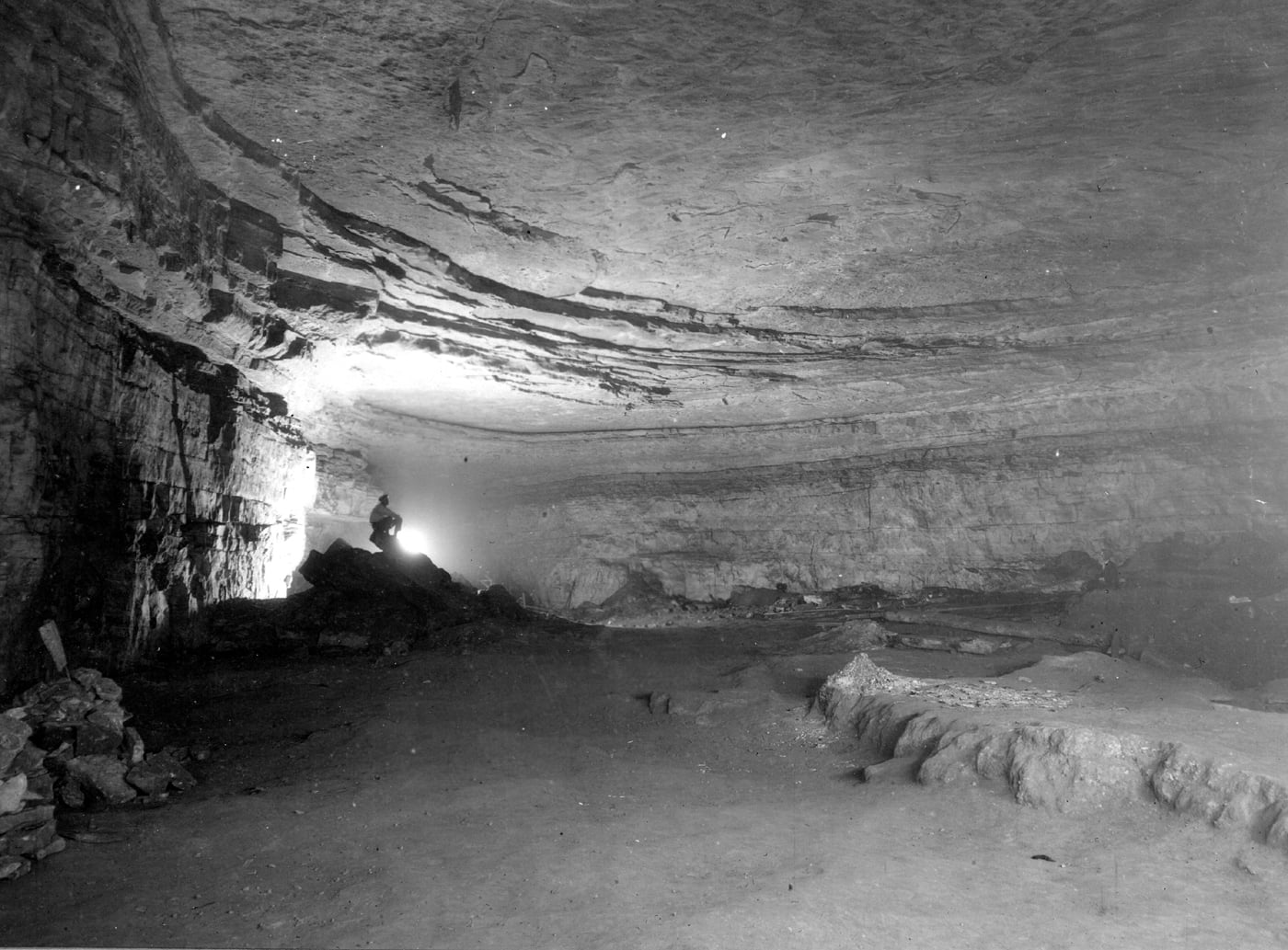
Archaeological evidence places the first humans in Mammoth Cave roughly 4,000 years ago — Indigenous people who mined gypsum and other minerals by torchlight, leaving behind reed torches, woven sandals, and gourd vessels that are among the best-preserved pre-Columbian artifacts in North America.
European Americans began commercializing the cave in the late 18th century. During the War of 1812, operators mined the cave for saltpeter — potassium nitrate — essential to gunpowder production. The distinctive wooden V-shaped pipes and hoppers from this operation remain visible in the Rotunda chamber today.
The cave's transformation into a major tourist attraction came in the antebellum decades, powered almost entirely by the knowledge and labor of enslaved men. Stephen Bishop, enslaved by cave owner Archibald Miller Jr., began guiding tours in 1838 at around age 17. He explored and named more passages than any guide before him, producing the first comprehensive map of the cave from memory. Bishop and the Bransford family — Mat, Nick, and Henry Bransford — built the expertise that made Mammoth Cave famous internationally. After emancipation, several Bransford descendants continued as free guides into the early 20th century.
The 1840s and 1850s brought a grim chapter: Dr. John Croghan attempted to use the cave's constant 54°F temperature and high humidity to cure tuberculosis. He constructed stone cottages inside the cave for patients in 1842. The experiment failed; several patients died underground within months. The stone hut ruins remain in the cave today.
The Floyd Collins tragedy of January 1925 brought Mammoth Cave national attention. Collins, an experienced cave explorer working to develop a commercial attraction at nearby Sand Cave, became trapped 55 feet underground when a rock pinned his leg in a narrow passage. The rescue attempt lasted two weeks and drew thousands of reporters and spectators — one of the first major media circuses of the broadcast era. Collins died of exposure before rescuers could reach him. His body was ultimately interred in a glass-topped coffin at the entrance to Crystal Cave, a commercially motivated burial that proved profitable until someone stole the body in 1929. The corpse was recovered, but its left leg was missing; neither was ever explained. Crystal Cave became part of Mammoth Cave National Park when the park was established in 1941.
The park encompasses 52,830 acres and receives roughly 600,000 visitors annually.
Sources
- https://www.nps.gov/maca/index.htm
- https://en.wikipedia.org/wiki/Mammoth_Cave_National_Park
- https://en.wikipedia.org/wiki/Floyd_Collins
- https://bgdailynews.com/2022/08/14/the-mysteries-of-mammoth-cave/
- https://skepticalinquirer.org/2017/07/murder-by-darkness-does-mammoth-caves-specter-harbor-a-secret/
ApparitionsPhantom smellsShadow figuresResidual haunting
The Melissa legend originated not from a death but from a short story. In 1858, writer Lillie Devereux Blake published a piece in The Knickerbocker magazine, recounting — fictionally — how a young woman named Melissa had lured her tutor deep into the cave and abandoned him there without a lamp because he had refused her affections. The man was never seen again, and Melissa's ghost searches the area near Echo River in remorse or obsession, depending on who tells the story. Despite its literary origins, the account has generated decades of genuine witness reports. Park rangers have noted the smell of an unfamiliar perfume in the Echo River passage. Guides have reported a woman's figure standing near the water's edge during early-morning preparation walks.
Floyd Collins died in Sand Cave in February 1925, but witnesses situate his apparition near the Historic Entrance and the old Crystal Cave area. The details reported are consistently specific: a man in worn work clothes, moving purposefully, who disappears when approached. Whether the accounts are shaped by knowledge of the Collins story is impossible to separate from the reports themselves.
A third recurring phenomenon involves a disembodied pair of legs — observed running down the hill near the main visitor center, dressed in denim overalls and work shoes, severed at the waist. No upper body. Multiple visitors and at least one ranger have reported this in separate accounts. The detail appears across sources without obvious cross-contamination.
A man in old-fashioned formal dress — described as a cummerbund and period coat — has been reported in the cave passages on multiple occasions since the 1970s. No historical figure has been identified as a match.
Notable Entities
MelissaFloyd Collins
Media Appearances
- Bowling Green Daily News (August 2022)
- Skeptical Inquirer (July 2017)
- Daily Beast feature on Floyd Collins