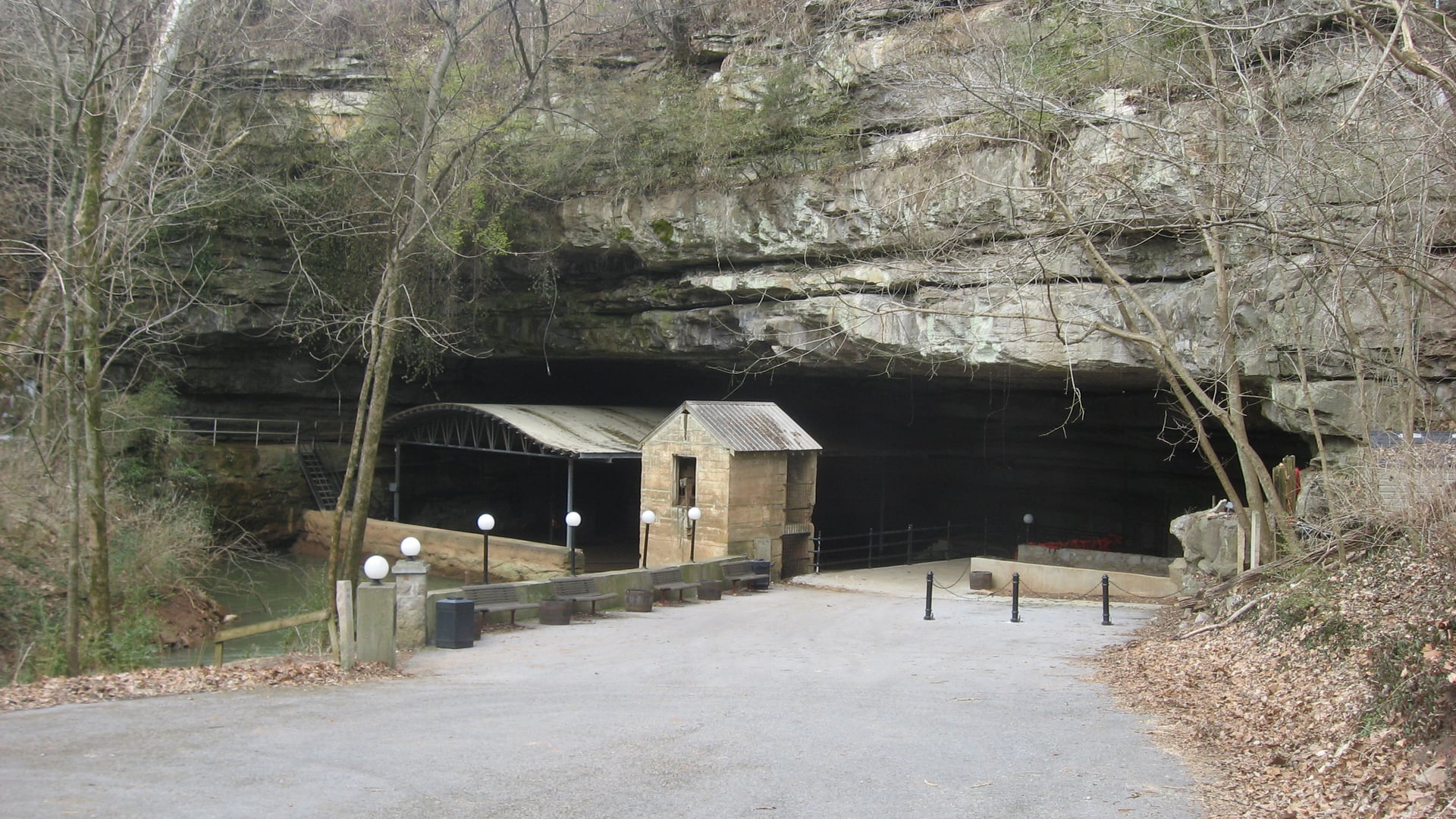
Est. 1816 · UNESCO World Heritage Site · International Biosphere Reserve · Longest Known Cave System · Stephen Bishop Exploration Legacy · 1842 Tuberculosis Experiment · Enslaved Labor History · Saltpeter Mining · Archaeological Site
Mammoth Cave has been used by humans for at least 5,000 years; mummified remains and prehistoric tools recovered from the cave document extensive Adena and other indigenous activity. Archaeological evidence places the first humans in Mammoth Cave roughly 4,000 years ago — Indigenous people who mined gypsum and other minerals by torchlight, leaving behind reed torches, woven sandals, and gourd vessels that are among the best-preserved pre-Columbian artifacts in North America.
Commercial tourism began in the 1810s, and the cave was a saltpeter mining site during the War of 1812. Operators mined the cave for saltpeter — potassium nitrate — essential to gunpowder production. The distinctive wooden V-shaped pipes and hoppers from this operation remain visible in the Rotunda chamber today.
In 1838, the lawyer Franklin Gorin purchased the cave and brought a 17-year-old enslaved African American man named Stephen Bishop to work as a guide. Bishop went on to become one of the most consequential cave explorers in American history. He crossed Bottomless Pit in 1838, opening the cave's western section, and mapped passages that he named River Styx, Great Relief Hall, Fat Man's Misery, and Lake Lethe. His 1842 map of the cave was used by guides for decades. Bishop and the Bransford family — Mat, Nick, and Henry Bransford — built the expertise that made Mammoth Cave famous internationally. After emancipation, several Bransford descendants continued as free guides into the early 20th century.
Dr. John Croghan of Louisville purchased the cave and the people Gorin had enslaved in 1839. In 1842 and 1843 Croghan established an experimental tuberculosis treatment facility inside the cave, theorizing that the constant temperature and humidity would cure consumption. Enslaved workers, including Bishop and members of the Bransford family, built limestone-walled huts at several levels of the cave for patients. The experiment was a failure. At least five patients died inside the cave; their bodies were laid out on a flat ledge now known to guides as Corpse Rock. Croghan himself died of tuberculosis in 1849. His will freed the enslaved people of his estate after a seven-year delay.
Stephen Bishop died in 1857 of unknown causes and was buried in what is now called the Old Guide's Cemetery on the surface above the cave. Members of the Bransford family continued to guide at Mammoth Cave through four generations into the 20th century.
The Floyd Collins tragedy of January 1925 brought Mammoth Cave national attention. Collins, an experienced cave explorer working to develop a commercial attraction at nearby Sand Cave, became trapped 55 feet underground when a rock pinned his leg in a narrow passage. The rescue attempt lasted two weeks and drew thousands of reporters and spectators — one of the first major media circuses of the broadcast era. Collins died of exposure before rescuers could reach him. His body was ultimately interred in a glass-topped coffin at the entrance to Crystal Cave, a commercially motivated burial that proved profitable until someone stole the body in 1929. The corpse was recovered, but its left leg was missing; neither was ever explained. Crystal Cave became part of Mammoth Cave National Park when the park was established in 1941.
Mammoth Cave National Park was established by an act of Congress in 1941. The cave system was designated a UNESCO World Heritage Site in 1981 and an International Biosphere Reserve in 1990. Continuing connections discovered since the 1970s have brought the surveyed length above 426 miles, by far the longest known cave in the world. The park encompasses 52,830 acres and receives roughly 600,000 visitors annually.