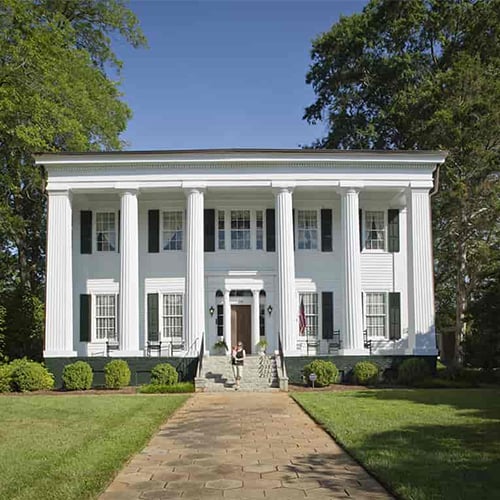
Est. 1834 · Antebellum Greek Revival with Octagon Additions · Home of Confederate Constitution Author T.R.R. Cobb · Site of Documented Enslavement History · Relocated and Restored National Register Property
The original Greek Revival four-over-four 'Plantation Plain' core of the house at what was once 194 Prince Avenue was built about 1834. In 1844, Joseph Henry Lumpkin — Georgia's first Chief Justice — gave the house to his daughter Marion as a wedding gift on her marriage to Thomas Reade Rootes Cobb. Cobb expanded the building over the next decade, adding the octagon wings and two-story portico that gave the house its distinctive silhouette by 1852.
Thomas Reade Rootes Cobb (1823 to 1862) was a Georgia attorney, slavery apologist, and prolific legal writer. He co-founded what became the University of Georgia School of Law and served as principal author of the Confederate States Constitution adopted in 1861. Cobb raised the regiment that became Cobb's Legion during the Civil War and was promoted to brigadier general before being killed by shrapnel from an exploding cannonball at the Battle of Fredericksburg in December 1862. His widow Marion sold the house in 1873.
The house's interpretation today does not separate the Cobb family from the people they enslaved. Museum programming explicitly addresses the labor, lives, and family ties of enslaved residents whose work made the household function and whose names appear in Cobb-family records.
In 1985 the Stone Mountain Memorial Association relocated the entire house from Prince Avenue to Stone Mountain Park, where preservation funding stalled. In 2004, the Watson-Brown Foundation purchased the house in partnership with the Georgia Trust for Historic Preservation and the Athens-Clarke Heritage Foundation. A Stone Mountain Memorial Association grant supported a 2005 move back to Athens, where the house was reassembled on a new site at 175 Hill Street in the Cobbham Historic District and restored to its 1850 appearance. The Georgia Trust awarded the restoration a 2008 Preservation Award, and the property was re-listed on the National Register of Historic Places on July 23, 2013.
Sources
- https://en.wikipedia.org/wiki/T._R._R._Cobb_House
- http://www.trrcobbhouse.org/
- https://exploregeorgia.org/athens/history-heritage/civil-war/trr-cobb-house
- https://www.visitathensga.com/listing/t-r-r-cobb-house/223/
Apparition on the staircaseSeated figure in the drawing roomPhantom pipe-smoke smellSense of presence
According to the University of Georgia Libraries' ghost-stories research guide and the Visit Athens GA tourism office's haunted-Athens overview, the most frequently reported phenomenon at the T.R.R. Cobb House is the apparition of a gentleman in a long old-style dressing gown. Tour guides have reported seeing this figure descend the central staircase and seat himself before the drawing-room fireplace, where he is said to appear to read briefly before vanishing.
Lore around the figure varies. Some accounts attribute it to T.R.R. Cobb himself; others to one of the male residents from the post-1873 era after Marion Cobb sold the house. The house's complicated relocation history — from Prince Avenue to Stone Mountain in 1985 and back to Hill Street in 2005 — is sometimes invoked to explain why the lore did not consistently appear in earlier published ghost compendia: the building was physically absent from Athens for two decades.
Reports gathered by the Southern Spirit Guide and by the Visit Athens GA office also describe the smell of pipe smoke in the drawing room and the impression of a heavy presence on the stairs. The museum administration treats the house principally as an interpretive historic site addressing slavery and the Cobb family's role in the Confederacy, not as a paranormal attraction; no formal published investigation has produced documented evidence that has entered the major American paranormal literature.
Notable Entities
Gentleman in a dressing gownPossibly T.R.R. Cobb