Est. 1872 · Georgia Lighthouse Service · National Register of Historic Places · Reconstruction-Era Federal Architecture
James Gould constructed the first lighthouse on St. Simons Island in 1810, marking the entrance to the Brunswick harbor and the St. Simons Sound. In 1862, retreating Confederate troops destroyed the original tower to prevent its use by Union forces during the Civil War.
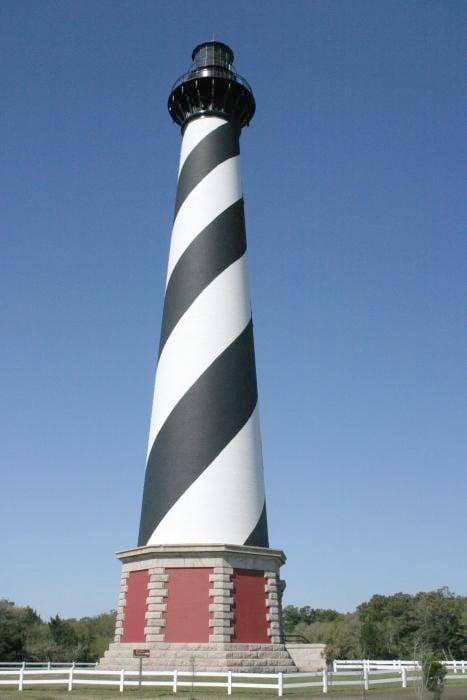
The current lighthouse was completed in 1872 under the supervision of Orlando Poe, chief engineer of the U.S. Lighthouse Board, with contractor work begun by Charles Cluskey, the architect of many notable antebellum Georgia buildings, who died in 1871 before the project's completion. The 104-foot brick tower is paired with a two-story keeper's dwelling. The original third-order Fresnel lens remains in service.
On the night of March 1, 1880, head keeper Frederick Osborne was shot and killed by his assistant, John L. Stevens, on the grounds of the light station. Accounts of the dispute differ. Some sources describe an exchange about Osborne making inappropriate remarks to Stevens' wife. Other accounts reverse the roles. Stevens was tried for murder and acquitted at a Glynn County jury trial. He was not reinstated as head keeper; the official record (Lighthousefriends.com, lighthousefriends.com/light.asp?ID=328) shows George W. Asbell appointed head keeper in 1880, followed by Isaac L. Peckham (1883–1892) and Joseph Champagne (1892–1907).
The lighthouse was automated in 1953 and the surrounding property transferred to the Coastal Georgia Historical Society in 2004. The Coast Guard continues to maintain the optic; the historical society operates the public tour program and the adjacent World War II Home Front Museum.
Sources
- https://www.coastalgeorgiahistory.org/visit/st-simons-lighthouse/
- https://www.lighthousefriends.com/light.asp?ID=328
- https://exploresouthernhistory.com/gastsimons2.html
ApparitionsPhantom footstepsCold spotsEVP
Local tradition attributes the lighthouse's most persistent reports to Frederick Osborne, the head keeper killed on the station grounds in March 1880. The earliest published account of his return appeared in 1908, when a later keeper's wife reported that Osborne's footsteps had begun pacing the tower stairs and the dwelling hallway during her husband's absence.
The 1908 account describes the woman calling out to Osborne by name when the lens mechanism began to fail, recalling an earlier conversation in which he had promised to help her if she ever needed it. The mechanism reportedly resumed normal operation moments later. Subsequent keepers and historical-society staff have continued to report unexplained footfalls on the spiral staircase, particularly at dusk and in the hour before the light is checked.
Visitors on the climb to the watch room describe a distinct change in air temperature near the upper landing, and several staff members have reported the sound of pacing in the keeper's dwelling when no one is upstairs. Investigators from regional paranormal groups have recorded what they describe as voice phenomena during overnight visits. The historical society does not promote the site as a paranormal attraction, but the Osborne narrative is included in the standard tour script.
Notable Entities
Frederick Osborne