Est. 1860 · Civil War Hospital · National Register of Historic Places · Oldest Georgia Private College Building · LaGrange College History
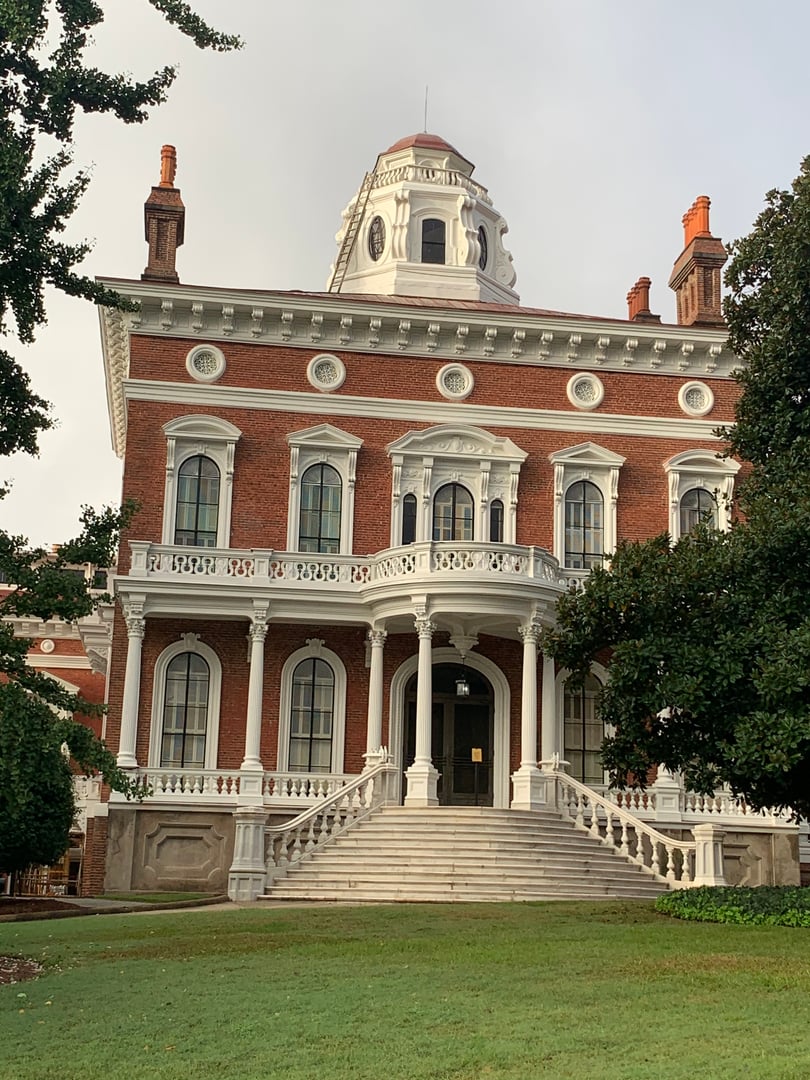
Joseph Montgomery built what was first called College Home in 1860, replacing a wooden boarding house that had burned that same year. The structure is made from handmade bricks of local clay and sits at the summit of the hill that defines the LaGrange College campus at 601 Broad Street in LaGrange, Troup County.
The building's four Doric columns at the entrance were named Matthew, Mark, Luke, and John — a reference to the college's Methodist founding ethos. In the spring of 1911, the building was formally named Smith Hall, honoring benefactor Oreon Mann Smith.
When the Civil War reached west Georgia, the Confederate government requisitioned the hall. From November 1863 to June 1864, Smith Hall served as a field hospital for soldiers wounded in the regional fighting. The Battle of Brown's Mill, fought July 30, 1864, in nearby Coweta County, was one of several engagements that brought casualties through the area.
Smith Hall is listed on the National Register of Historic Places and is considered Georgia's oldest private college building in continuous collegiate use. LaGrange College itself, founded in 1831, is the oldest private college in Georgia.
Sources
- https://lagrangecollegelibrary.blogspot.com/2013/01/iconic-smith-hall.html
- https://visitlagrange.com/nearly-200-years-of-history-at-the-oldest-private-college-in-georgia/
- https://www.georgiaencyclopedia.org/articles/education/lagrange-college/m-1480/
- https://en.wikipedia.org/wiki/LaGrange_College
ApparitionsPhysical contactUnexplained sounds
The central figure of Smith Hall's ghost tradition is John Griffen, a Confederate soldier whose sister Indiana (known as Diana) was enrolled at what was then LaGrange Female Academy. According to college records and campus tradition, Griffen was wounded at the Battle of Brown's Mill on July 30, 1864 — shot in the leg — and rather than report to an overcrowded Confederate field hospital, rode 35 miles to reach the college and his sister.
He arrived at Smith Hall, which was then functioning as a Confederate hospital, and received limited treatment. He died inside the building from his wounds.
The legend persisted across generations of students and faculty. Former college President Waights Gibbs Henry Jr. documented what he described as inexplicable happenings in the building in writing — a notable detail because Henry was a credentialed administrator, not a folklore enthusiast.
In 2006, psychic and television medium Chip Coffee was invited to campus. During his investigation, Coffee reported that the wounded soldier had been shot in the leg, had to be helped into the building due to weakness, and later died within Smith Hall. Visitors have reported that Griffen's presence is sometimes physically assertive — pushing and tripping people in the building's interior.
The Visit LaGrange tourism office includes Smith Hall among the city's documented haunted sites, and the Strange LaGrange ghost tour uses the building as a primary stop.
Notable Entities
John Griffen (Confederate soldier)
Where this legend is told