Est. 1850 · National Historic Landmark · General Sherman's Savannah Headquarters (1864–65) · Site of Sherman's Christmas Telegram to Lincoln · First Cast-Iron Gothic Revival House in the South · Designed by architect John Norris
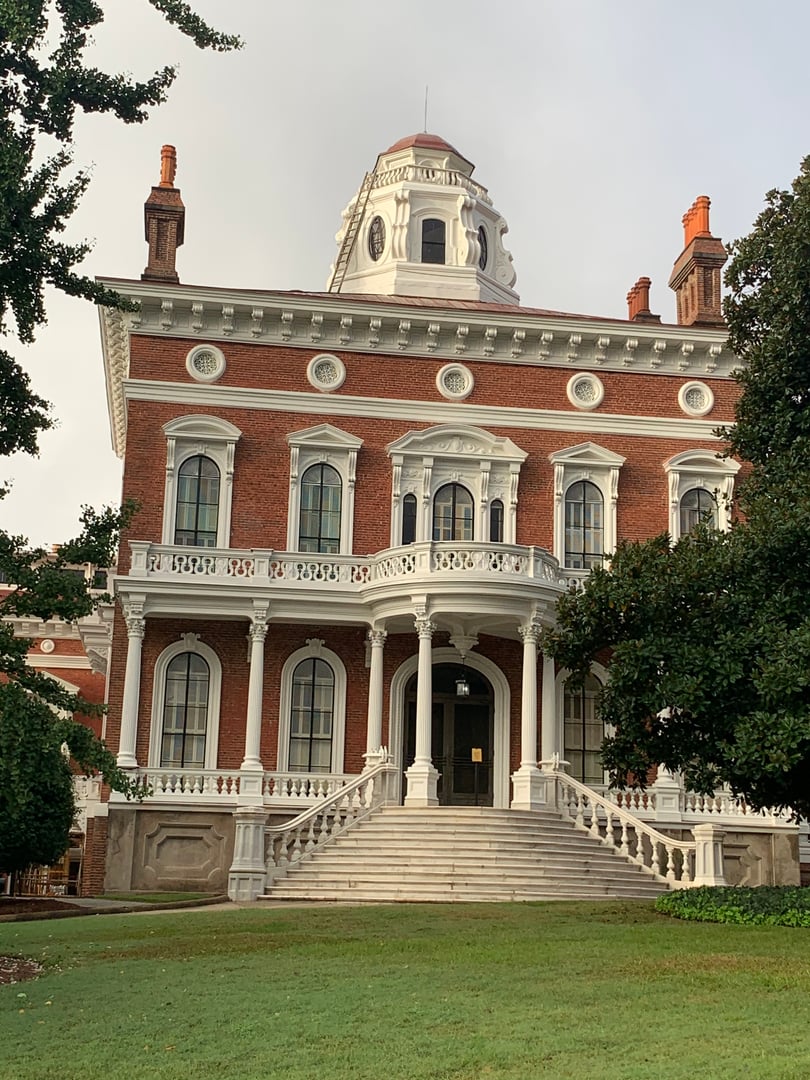
Charles Green arrived in America from England in 1833 and built one of the most successful cotton trading firms in antebellum Savannah. In 1850 he commissioned New York architect John Norris to design a residence on Madison Square that would reflect his standing. The result, completed in 1853, was a five-bay Gothic Revival villa — the first cast-iron Gothic-style house in the South — featuring oriel windows, lacework ironwork, and a projecting central bay with a two-story entrance porch.
When Union General William T. Sherman entered Savannah on December 21, 1864, completing his March to the Sea, Green greeted him and offered his home as headquarters. Sherman accepted. From the Green-Meldrim House, Sherman composed his telegram to President Lincoln presenting the city as a Christmas gift — a message that arrived on December 22 and became one of the most celebrated dispatches of the Civil War.
While Sherman occupied the house, Susie Baker King Taylor — who had escaped enslavement as a child in Savannah and taught freed people in the Sea Islands — was present in the city. She had worked for Union forces as a laundress, cook, nurse, and teacher to Black soldiers throughout the war.
Sherman departed in February 1865. Green sold the house in 1892 to Judge Peter Meldrim, whose family raised five children there over the following decades. Meldrim's son George served as Mayor of Savannah. St. John's Episcopal Church, which shares Madison Square with the property, purchased it in 1943 for $42,000 and has used it as a Parish House since. The house was designated a National Historic Landmark in 1976.
Sources
- https://www.greenmeldrimhouse.org/history-green-meldrim-sherman/
- https://www.battlefields.org/visit/heritage-sites/green-meldrim-house
- https://en.wikipedia.org/wiki/Green%E2%80%93Meldrim_House
ApparitionsDoors opening and closingDisembodied soundsCold spotsPhantom smells
The paranormal accounts associated with the Green-Meldrim House center on a specific and particular tradition: the spirit of an enslaved woman who worked in the household under Charles Green and who, in life, was known for stopping her work to attend musical gatherings. After her death, witnesses have reported that live music in the house triggers a distinct response — doors opening and closing on their own, disembodied voices that seem to hum along with the melody, and the scent of sweet perfume.
This account is handled with the seriousness it warrants. It reflects the real experience of an enslaved person in mid-nineteenth-century Savannah — a woman whose attachment to music was apparently strong enough to be remembered and passed down through the house's oral history. It does not name her, because her name was not preserved. The restraint of the tradition in this respect is itself significant: it attributes to her a full interior life while acknowledging the limits of the historical record.
The house's position on Madison Square adds a separate atmospheric dimension. The square was adjacent to fighting during the Siege of Savannah in 1779, and local accounts hold that there are bodies buried in the vicinity, including possibly beneath the Green-Meldrim grounds. Whether any archaeological evidence supports this specific claim is undocumented.
Savannah ghost tour companies regularly include the Green-Meldrim House in their itineraries, citing the music-triggered phenomena as among the more specific and consistently reported accounts in the city's haunting traditions.
Where this legend is told