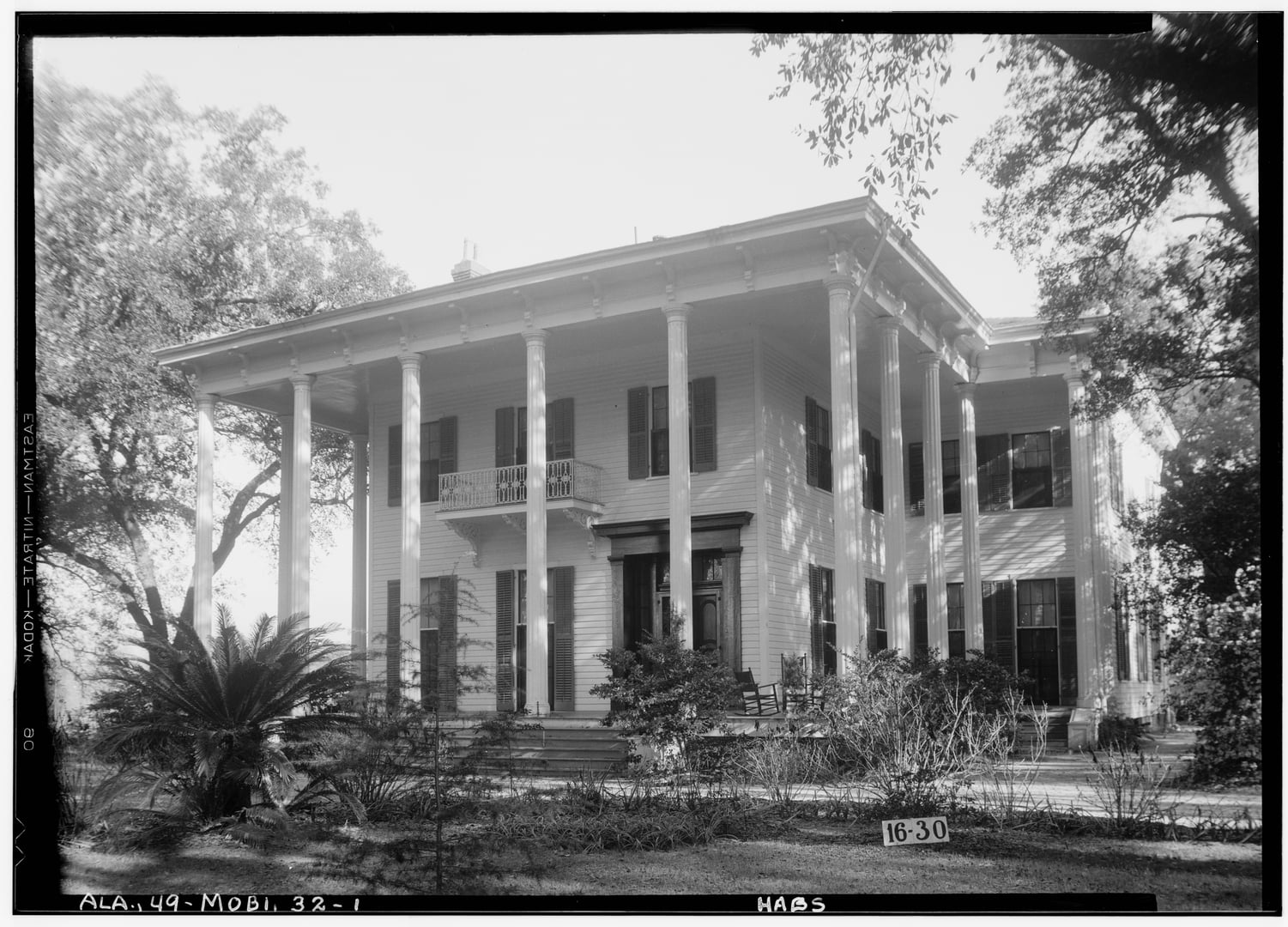
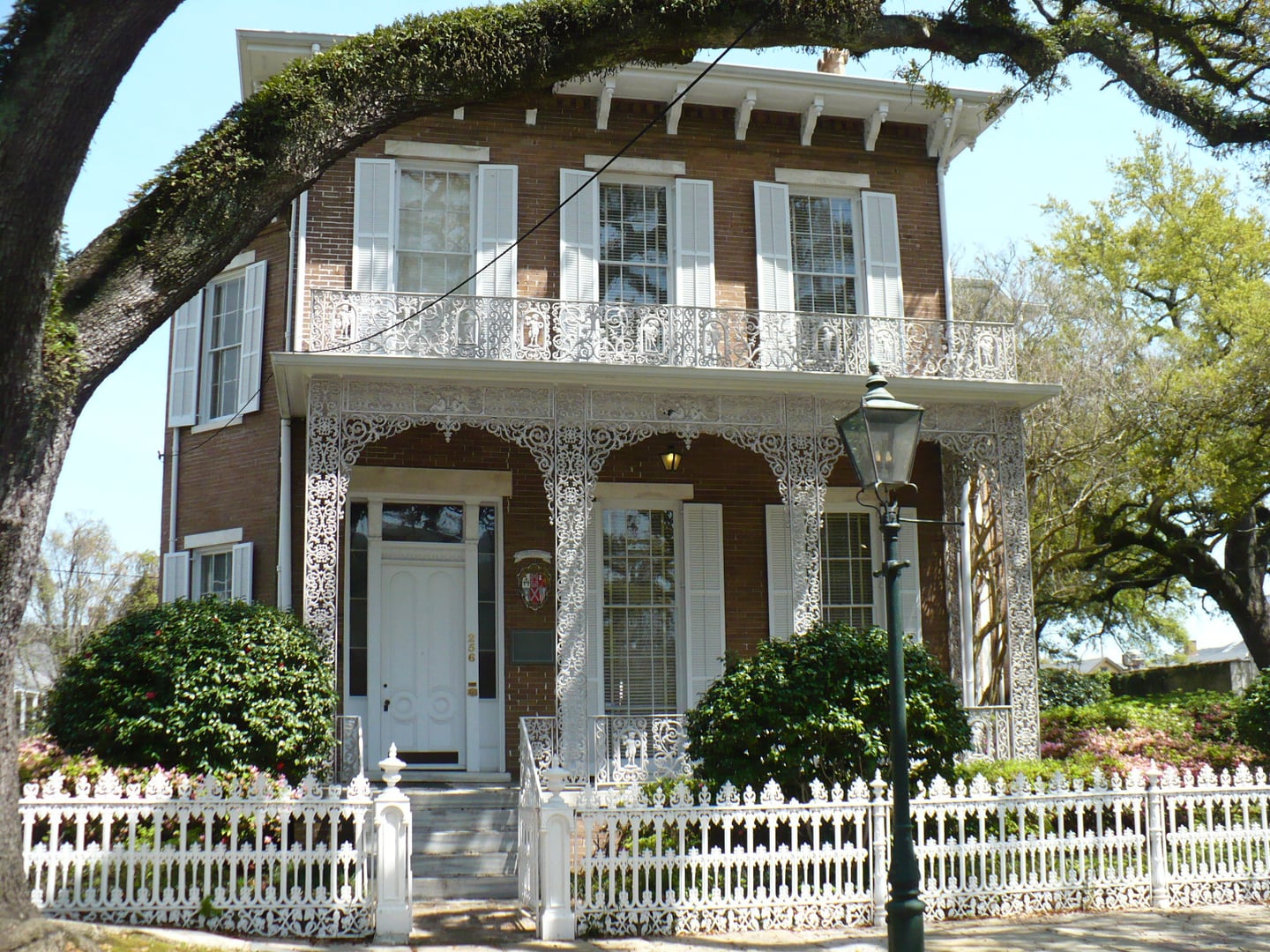
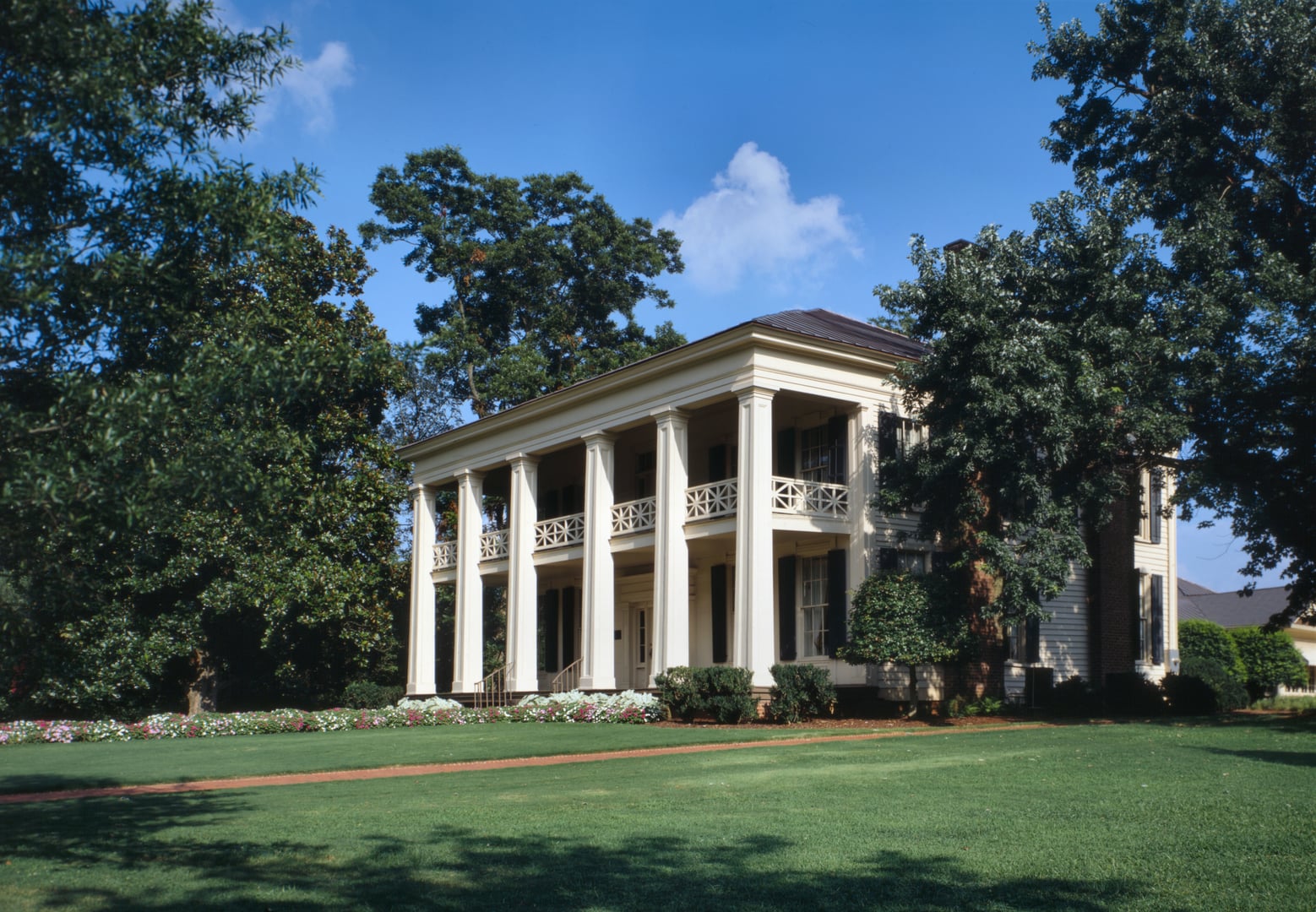
Est. 1833 · Mobile's oldest house museum · Greek Revival raised galleried villa · Library of Congress HABS AL-414 · Adjacent Union Barracks (1867) — Reconstruction-era urban Black-life interpretation · Operated by the Historic Mobile Preservation Society
James W. Roper, a brick mason from James City County, Virginia, purchased 33 acres west of Mobile in 1832 and constructed the Greek Revival raised villa now known as Oakleigh in 1833. Roper, who also worked as a dry-goods merchant and cotton factor, chose the site partly for its valuable clay pit. The house is built on a T-shaped plan — among the largest T-shaped antebellum houses in Alabama — and oriented to maximize cross-ventilation through Mobile's humid subtropical climate. The home's distinctive quarter-turn cantilever staircase, rising directly to the front door, was designed by Roper himself.
The Irwin family acquired the property in 1852 and occupied it for sixty-four years. During the Civil War, Margaret Kilshaw Irwin defended the home against Union soldiers by declaring the property neutral on the strength of her British citizenship and flying the Union Jack from the balcony. Alfred Irwin's granddaughter, Daisy Irwin Clisby, sold the property in 1916.
The Historic Mobile Preservation Society acquired Oakleigh and undertook its restoration; the home opened as Mobile's first house museum. The wider Oakleigh Historic Complex grew to include the Cox-Deasy Cottage (a roughly 1850 Creole cottage), the Minnie Mitchell Archives, and the structure currently called the Union Barracks — formerly known as the Cook's House. The Library of Congress Historic American Buildings Survey records the property as 'Oakleigh, House & Slave Quarters' (AL-414), reflecting its mid-twentieth-century interpretation.
Recent scholarship and museum reinterpretation have substantially reframed the Cook's House. It is now identified as a post-Civil War structure built in 1867 and used to tell the story of post-Emancipation life in Mobile — one of the few surviving urban Reconstruction-era domestic outbuildings in the city. The site nonetheless sits within the broader documentary record of antebellum urban slavery in Mobile; Roper, the Irwins, and their domestic households operated within and benefited from the city's enslaved-labor economy throughout the antebellum period, and the museum's current interpretation acknowledges this context directly.
Sources
- https://en.wikipedia.org/wiki/Oakleigh_Historic_Complex_(Mobile,_Alabama)
- https://encyclopediaofalabama.org/article/historic-oakleigh/
- https://www.loc.gov/item/al0414/
- https://www.wkrg.com/haunted-history/haunted-oakleigh-house-museum/
- https://www.pensacolaghostevents.com/post/16-of-mobile-alabama-s-most-haunted-locations
- https://bienvillebitesfoodtour.com/blog/12-haunted-places-in-mobile-alabama/
Figures in 19th-century clothing at windows and balconiesFemale apparition in the front parlor ('Miss Daisy')Male figure in a tail coatDisembodied voicesFurniture movementCold breezes through closed rooms
Oakleigh's paranormal reputation is anchored in the Irwin family's sixty-four-year occupancy (1852-1916), during which several members of the family — including Margaret, Corrine, Alfred, and T.K. Irwin — died inside the house. WKRG's haunted-history coverage and the Pensacola Ghost Events compilation both attribute the property's most-frequent activity to figures in nineteenth-century dress seen at windows and on the upper balconies, with staff identifying these figures as Irwin-family members rather than earlier or later occupants.
The front parlor is the most-reported single room. Staff and visitors describe a female apparition that has been nicknamed 'Miss Daisy,' though other accounts treat the parlor figure as a more general 'lady of the house.' Reports cluster around disembodied voices in the parlor, furniture rearranged between closing and opening, and occasional photographic anomalies during tour visits.
A secondary thread of the lore describes a male figure in a tail coat moving through the main floor, glimpsed in mirror reflections and at the foot of the cantilever staircase. Staff have also reported cold breezes passing through closed rooms and the sensation of being watched while alone in the second-floor hallway. None of the Oakleigh reports involve violent or distressed phenomena; the overall character of the lore is that of an Irwin household continuing in residence.
The museum incorporates lore into select seasonal programming but treats the Irwin family stories within their documented historical context. The slavery history of the property and the post-Emancipation interpretation of the Cook's House are core to the standard tour and are not displaced by the ghost narratives.
Notable Entities
The Irwin family (Margaret, Corrine, Alfred, T.K. Irwin)'Miss Daisy' (front parlor apparition)The Tail-Coated Man
Media Appearances
- WKRG Haunted History feature
- Pensacola Ghost Events compilation
- Bienville Bites Food Tour 12 Haunted Places coverage