Est. 1828 · 1762 Parish Foundation · Confederate Hospital 1861-1865 · CSS Virginia Congregation Site · Olde Towne Historic District · 40-Year Ghost Walk Anchor
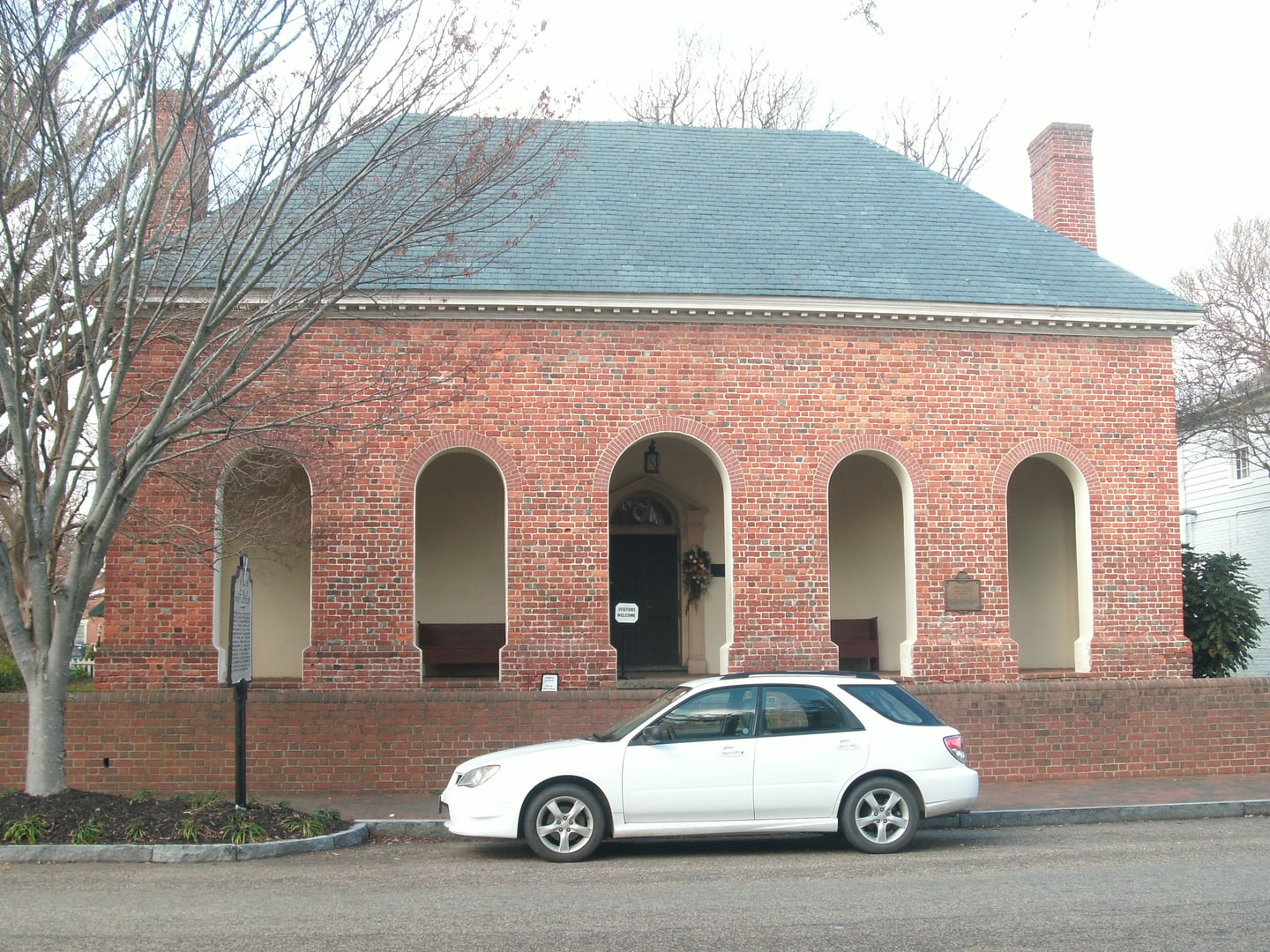
Trinity Episcopal Church stands at the corner of Court and High Streets in Portsmouth's Olde Towne Historic District, one of the oldest intact urban neighborhoods in Virginia. The congregation was founded in 1762, and a church occupied this site from that year. The present building was constructed between 1828 and 1830 in a Federal-influenced style that reflects the architecture of the early American republic.
When the Civil War came to Portsmouth in 1861, the congregation turned Trinity over for use as a Confederate military hospital. The city's position on the southern shore of Hampton Roads made it a logistical center for Confederate naval operations, and the church's large interior was adapted for the wounded. Among the congregation in those months was the crew of the ironclad CSS Virginia, the converted hull of the USS Merrimack, who worshipped at Trinity before the Virginia steamed out on March 8-9, 1862, to fight the USS Monitor in the world's first engagement between ironclad warships.
The church survived the war and continued to serve the Olde Towne neighborhood through the yellow fever era of the 1850s, the Reconstruction period, and into the 20th century. It remains an active Episcopal parish and a central institution in the Olde Towne Historic District, which was listed on the National Register of Historic Places.
For more than 40 years Trinity has served as the anchor point for the Olde Towne Ghost Walk, a community walking tour operated by the Olde Towne Portsmouth Civic League. The walk departs and returns to Trinity, threading through the blocks of Federal and antebellum architecture that surround it.
Sources
- https://en.wikipedia.org/wiki/Trinity_Episcopal_Church_(Portsmouth,_Virginia)
- https://otpcl.org/oldetowneghostwalk/
- https://www.trinityportsmouth.org/
ApparitionsBanshee (folkloric death-omen figure)
The primary paranormal tradition at Trinity Episcopal Church is a family banshee — a death-omen apparition associated in Scottish and Irish tradition with specific family lines. Local accounts identify the spirit as tied to a founding family of Scottish descent who were prominent parishioners in the 18th and 19th centuries. The banshee legend holds that the figure appears at or near the church before the death of a family member, a tradition documented in Portsmouth's oral history circuit but not in published historical records.
Trinity's longer paranormal significance is as the anchor of the Olde Towne Ghost Walk, the community-run walking tour that has been operating continuously for more than 40 years. The walk sets its historical and haunting frame at the church before moving through the surrounding blocks, connecting the yellow fever epidemic of 1855, the Civil War hospital use, and the architectural legacy of the Olde Towne neighborhood into a single guided narrative.
The church's documented history — Confederate hospital, CSS Virginia congregation, 1762 founding — gives it legitimate dark-historical weight that the ghost walk builds on without requiring paranormal elaboration. The banshee tradition is the only specifically supernatural claim; everything else is well-sourced history.
Notable Entities
Scottish family banshee (folkloric figure)CSS Virginia crew (historical)