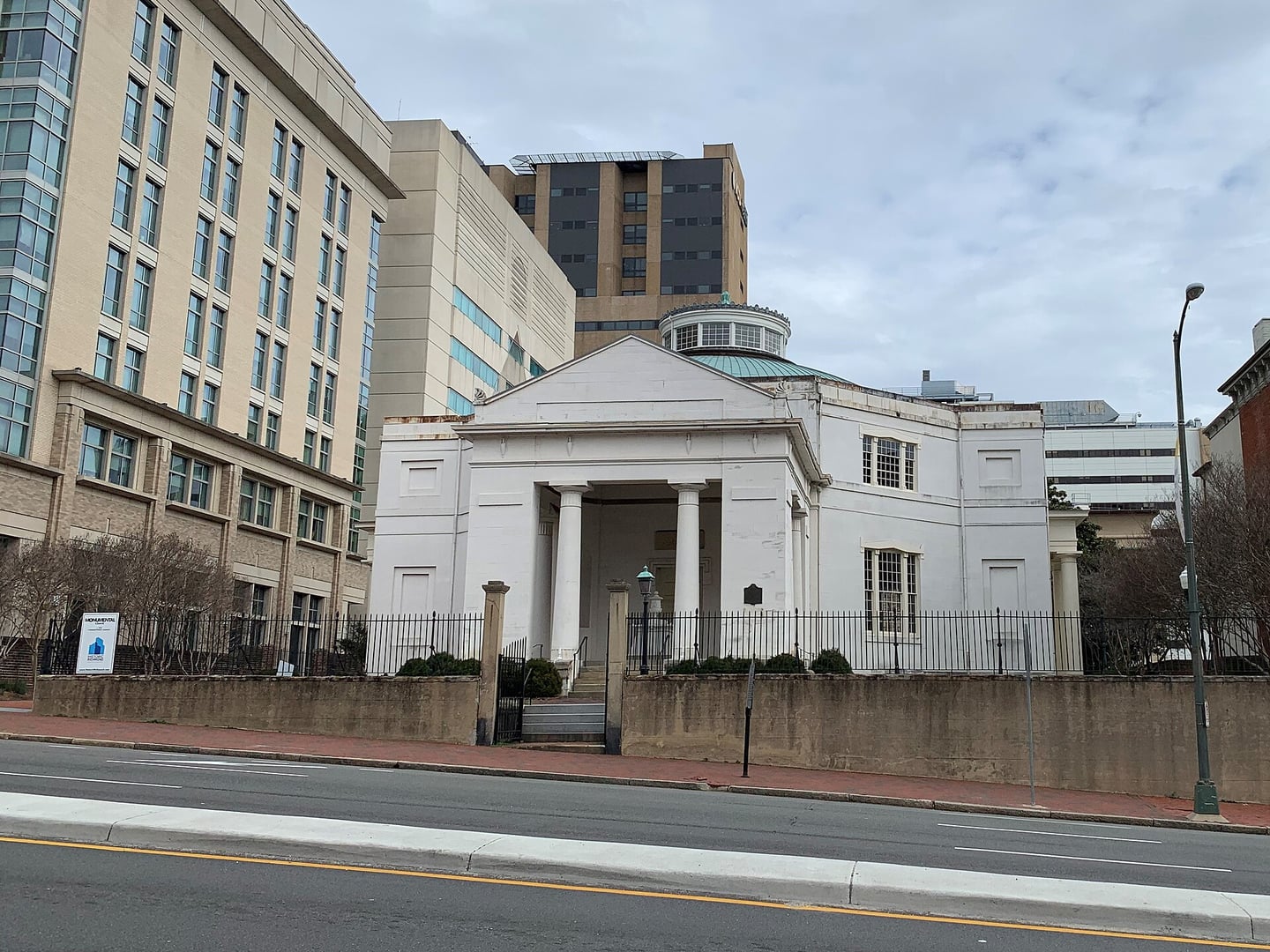
Est. 1741 · Site of Patrick Henry's March 23, 1775 'Give me liberty, or give me death' speech · Oldest standing church in Richmond · National Historic Landmark · Burial site of George Wythe, signer of the Declaration of Independence · Memorial site for Elizabeth Arnold Poe, mother of Edgar Allan Poe
St. John's Episcopal Church traces its origins to 1611 as the parish church of Henrico Parish, one of the earliest Anglican parishes in colonial Virginia. The present sanctuary was built in 1741 by Colonel Richard Randolph after the Henrico Parish vestry accepted a parcel of land from William Byrd II, founder of Richmond. The simple wood-frame church atop Church Hill became the largest meeting space in the young town.
The church's place in American history was secured on March 23, 1775, when delegates of the Second Virginia Convention—meeting at St. John's because no other building in Richmond was large enough—heard Patrick Henry deliver his impassioned call to arms. His closing words, 'I know not what course others may take; but as for me, give me liberty, or give me death!,' helped commit Virginia to armed resistance against Britain. The pew from which Henry rose to speak is still marked inside the sanctuary, and the convention's proceedings are reenacted on summer Sundays.
The surrounding churchyard contains an estimated several thousand interments dating from the eighteenth century onward, with many graves unmarked or with markers lost to weather. Among the documented burials are George Wythe, the first law professor in the United States and a signer of the Declaration of Independence, and Elizabeth Arnold Poe, the actress mother of Edgar Allan Poe whose exact grave location is unknown but is commemorated with a memorial stone.
The church was added to the National Register of Historic Places in 1966 and designated a National Historic Landmark. It is owned and operated by the Historic St. John's Church Foundation, which maintains an interpretive visitor center and offers guided tours of both the sanctuary and burial ground.
Sources
- https://en.wikipedia.org/wiki/St._John%27s_Episcopal_Church_(Richmond,_Virginia)
- https://www.historicstjohnschurch.org/
- https://www.dhr.virginia.gov/historic-registers/127-0013/
- https://www.richmondcemeteries.org/st-johns-churchyard/
Apparition in colonial clothing near the pulpitDisembodied voices in the empty sanctuaryCold spots near older pewsUnexplained light anomalies photographed in the churchyardShadowy movement among the gravestones
According to Richmond ghost-tour operators and local folklore aggregators, the most-reported apparition at St. John's is a tall figure in colonial clothing, seen near the pulpit and identified by tradition as Patrick Henry himself. Witnesses describe shadowy movement among the gravestones and occasional disembodied voices in the empty sanctuary—lore that paranormal-tour narrators tie to the emotional weight of the 1775 convention.
Additional accounts gathered by Encyclopedia Strange and other Richmond paranormal blogs describe muffled conversations in unoccupied corners of the building, cold spots near the older pews, and unexplained light anomalies photographed in the churchyard at dusk. Some reports also describe the spirit of a woman said to have died in childbirth lingering among the graves, though no specific historical figure has been documented behind that claim.
The church itself does not officially endorse paranormal narratives, but the site appears regularly on Richmond Ghost Tour and Haunts of Richmond itineraries, and ghost-tour audio guides treat it as a foundational Richmond haunt. Most claims trace to tour-operator sources rather than independently documented investigations, so the lore is best understood as a layer of local storytelling on top of the church's well-documented history.
Notable Entities
Spirit identified by lore as Patrick HenryUnnamed female spirit said to have died in childbirth