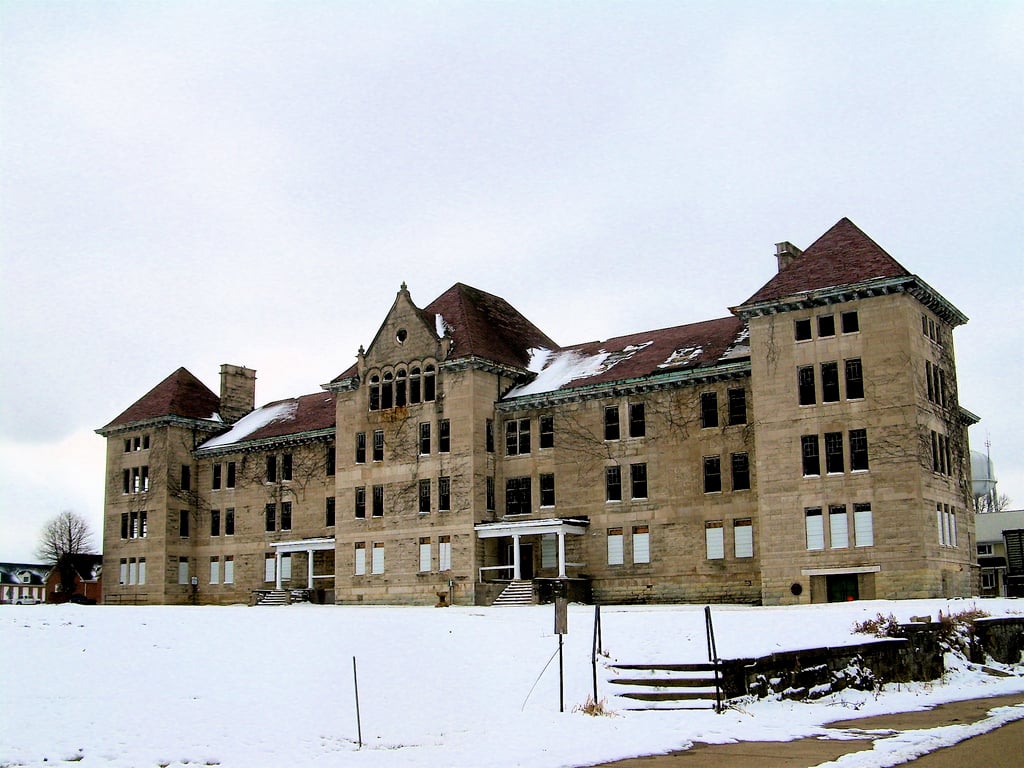
Est. 1886 · East Tennessee Psychiatric Care History · Kirkbride-Era Asylum
The Lakeshore Mental Health Institute campus along the Tennessee River in west Knoxville was originally the East Tennessee Hospital for the Insane. Construction began in 1883 and the institution opened in 1886. The campus followed the Kirkbride-influenced layout common to nineteenth-century state asylums, with a primary administrative building flanked by ward wings on a large landscaped property.
The hospital served as the principal state psychiatric facility for East Tennessee for more than a century. At its peak in the 1960s the institution housed roughly 2,800 patients, with hundreds of staff, an in-house farm, and an extensive support infrastructure. The 1980s brought the deinstitutionalization wave that affected American state psychiatric care nationally. Newspaper coverage from the period documented overcrowding, deteriorating conditions, and reduced services. State planning began in 1980 to shift patients into community-based services. The transition was gradual; the hospital remained operational, in steadily reduced form, until its final closure in 2012.
Most of the original buildings have been demolished. A small number — including the administration building — remain. The administration building has been renovated for use by the Knoxville parks department, and the surrounding land is now Lakeshore Park, a public recreational green space at 6410 South Northshore Drive. The original 1886 building burned in the 1920s and is in ruins; the institution rebuilt and continued operating in successor structures.
Sources
- https://lakeshoreparkknoxville.org/history
- https://kgh.knoxcotn.org/east-tennessee-insane-asylum-established-in-1883-in-knoxville/
- https://www.utdailybeacon.com/news/former-mental-hospital-leaves-mark-on-knoxville-community/article_978e84b3-5625-5e24-9102-0ec943180db3.html
- https://www.wbir.com/article/news/local/west-knoxville-farragut/a-look-inside-former-lakeshore-mental-health-institute/51-95168558
- https://www.tn.gov/behavioral-health/who-we-are/history/mental-health-milestones---first-100-years.html
Disembodied screamingPhantom soundsApparitionsPhantom voices
The Lakeshore Mental Health Institute carries one of East Tennessee's longest-running paranormal reputations. The most-cited body of folklore predates the hospital's 2012 closure and centers on the original 1886 building, which burned in the 1920s and remained in partial ruin on the grounds for decades.
Reports collected in regional Knoxville folklore — including the Tapatalk-archived Knoxville News Sentinel coverage and University of Tennessee Daily Beacon student reporting — describe the sound of patient screams, the sound of shackles or metal on stone, disembodied voices, and apparitions in the older portions of the campus. Allegations of physical mistreatment of patients during the 1960s circulate in the lore but have not been independently verified in archival news coverage.
The site today is a public park. The remaining historic structures are managed by the Knoxville parks department and are not open for paranormal investigation. Visitors interested in the institutional history are best served by the Lakeshore Park interpretive signage and the published University of Tennessee oral-history material on the hospital's later decades. The lore is well-established in regional folklore but should be treated as folkloric tradition rather than confirmed historical events.