Est. 1878 · 1878 Deadwood Gold Rush era mine · 15,000 ounces of gold produced · Located within Deadwood National Historic Landmark District
The Black Hills gold rush began in 1876 following George Custer's 1874 expedition, which confirmed gold deposits on Sioux territory in violation of the 1868 Fort Laramie Treaty. Deadwood grew from a tent camp to a rough boomtown within months, drawing thousands of fortune seekers into what remained legally Sioux land.
Olaf Seim staked the claim that would become the Broken Boot Mine in 1878. Like many small operations in the Deadwood Gulch area, it was a hard-rock gold mine following quartz veins into the hillside. The Broken Boot Mine produced approximately 15,000 ounces of gold in its working lifetime before the ore ran out and operations ceased.
The mine's rediscovery is explained in tours by a standard piece of its origin legend: during renovation work on the mine, workers found a single old boot left in a back chamber. No owner was identified. The mine's operators adopted the boot as the site's name and mascot.
Deadwood itself was a town shaped by the economics of violence and death. Hickok was shot at Nuttall and Mann's No. 10 Saloon in August 1876. Calamity Jane ended her days there. The town's cemetery on Mount Moriah holds many of the Black Hills gold rush era's most prominent figures. The mine operates in the context of a National Historic Landmark district where the history of gaming, death, and fortune is part of the civic identity.
Sources
- https://brokenbootgoldmine.com/
- https://www.deadwood.com/business/experiential-tours/broken-boot-gold-mine-2/candlelight-tours-broken-boot-gold-mine/
- https://www.travelsouthdakota.com/deadwood/arts-culture-history/westernold-west/broken-boot-gold-mine
- https://www.roadsideamerica.com/story/69627
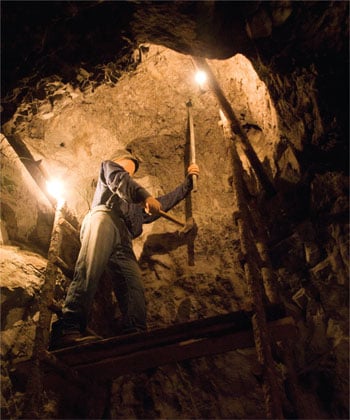
Atmospheric underground environment used for ghost tour programming
The Broken Boot Mine's ghost tour program is explicit about its approach: the mine is a portal into Deadwood's documented violent history rather than a site with well-defined mine-specific haunting accounts. The candlelight format — underground, low ceilings, no natural light — creates conditions that tour guides exploit as atmospheric backdrop for narratives drawn from the wider Deadwood National Historic Landmark District.
Deadwood's documented history provides real material: Wild Bill Hickok shot dead at a poker table in August 1876; the systematic violence of claim-jumping and saloon disputes; the cemetery on Mount Moriah filled with men who died from bullets, fever, and exposure. The town's identity as a place where death was normalized by frontier economics is the consistent theme of its paranormal tourism.
Within the mine itself, visitors on the Candlelight Ghost Tour report the atmosphere of the tunnels as inherently unsettling — the weight of the rock, the absence of daylight, and the knowledge of what kind of labor happened underground at these depths. Whether any accounts of apparitions or specific phenomena are attached to Broken Boot's own workings, as distinct from Deadwood's street-level lore, is not well documented in published sources.
Roadsideamerica.com and state tourism board documentation confirm the mine's operation and tour format; neither records specific paranormal incidents at the site itself.
Where this legend is told