Est. 1883 · Filming location for One Flew Over the Cuckoo's Nest (Academy Award Best Picture, 1975) · 3,423 copper cinerary urns of unclaimed patients (1913–1971) on public memorial display · November 17, 1942: 47 patients killed, 467 sickened by accidental sodium fluoride poisoning · Oregon State Hospital Museum of Mental Health open to public
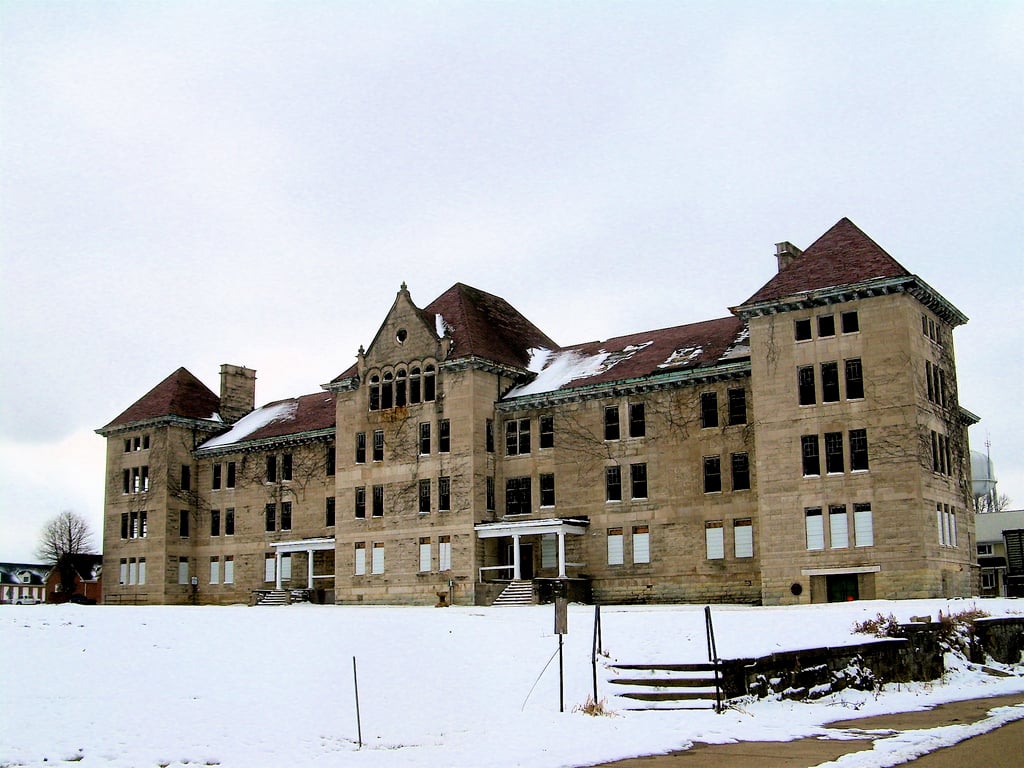
Oregon State Hospital opened in Salem in 1883 as the State Insane Asylum, Oregon's primary public institution for people committed under mental illness laws. The original Kirkbride-plan building — a massive Victorian structure intended to provide therapeutic architecture for patients — was expanded repeatedly through the late 19th and early 20th centuries as the patient population grew beyond its design capacity.
On November 17, 1942, a kitchen worker at the hospital made a catastrophic error: he used a 10-pound bag of sodium fluoride cockroach poison in place of powdered milk while preparing scrambled eggs for patients. Forty-seven patients died from the poisoning, and 467 more were sickened. A subsequent investigation found the error was unintentional. The incident received national coverage and prompted reform discussions around institutional food handling, but the systemic overcrowding and underfunding that left such errors possible remained largely unaddressed.
In 2004, hospital staff discovered approximately 3,500 copper cinerary urns in a disused basement. The urns held the cremated remains of patients who had died at the facility between 1913 and 1971 and whose families had never claimed them. Many had been stored for decades. After a restoration and identification effort, 3,423 urns were placed in a purpose-built memorial in Building 60 on the campus, creating one of the few physical monuments in the United States where the remains of unclaimed psychiatric patients are publicly accessible.
In 1975, director Milos Forman chose Oregon State Hospital as the filming location for One Flew Over the Cuckoo's Nest, the adaptation of Ken Kesey's 1962 novel. The film won five Academy Awards including Best Picture and featured the hospital's Kirkbride building and actual patients as extras. The connection to the film has sustained public awareness of the institution and contributes to its visibility as a dark-tourism destination.
The Museum of Mental Health, operated by the Oregon State Hospital Museum Foundation, opened on the campus and is open to the public Wednesday through Sunday.
Sources
- https://oshmuseum.org/
- https://www.oregon.gov/oha/osh/pages/memorial.aspx
- https://portland.daveknows.org/2011/11/18/november-18-1942-hundreds-poisoned-dozens-die-at-oregon-state-hospital-for-the-insane/
- https://medium.com/illumination/haunted-story-of-oregon-state-hospital-salem-f10ec83c96d4
- https://puzzleboxhorror.com/creepy-state-hospital-oregon/
Apparitions in Kirkbride building corridorsCold spotsUnexplained sounds in unoccupied areas
Oregon State Hospital has a substantial presence in Pacific Northwest haunted-location accounts, fed by multiple distinct historical events. The Kirkbride building and the older corridors of the campus are most frequently cited in paranormal reports, with accounts of dark figures, cold spots, and sounds from unoccupied areas. These reports are anecdotal and not tied to specific named individuals in the reviewed sources.
The 1942 poisoning — 47 deaths in a single morning from a kitchen error — represents an acute and well-documented mass death event on the campus. The scale of that incident, and the fact that it occurred in a context of institutional confinement where patients had no recourse, gives it a different character than individual deaths over time.
The basement discovery of 3,423 copper urns in 2004 is the event that most consistently appears in dark-tourism accounts. The image of years of unclaimed dead stored in corroding copper vessels in a hospital basement — overlooked and forgotten rather than deliberately hidden — captures something about the institutional disregard that runs through the facility's long history.
The Cuckoo's Nest connection adds a cultural layer that sustains visitor interest independent of paranormal claims. The film's portrayal of psychiatric abuse was explicitly modeled on real conditions at Oregon State Hospital, and the actual building appears in the film, giving visitors a direct visual connection between the fictional and institutional histories.
Media Appearances
- One Flew Over the Cuckoo's Nest (film, 1975)
Where this legend is told