Drive-By
Historic exterior viewing
View the 1898 county jail's limestone-and-brick exterior within Guthrie's National Historic Landmark district.
- Duration:
- 20 min
HauntBound archive · catalog record
Reported phenomena, as catalogued
+ 1 further entry on record
Guthrie's limestone-and-brick county jail has held prisoners since 1898, including members of the Dalton Gang and Bill Doolin, and is reputed to be haunted by inmates who died within its walls.
216 S Broad St, Guthrie, OK 73044
Research updated May 2026
Age
All Ages
Cost
Free
Active sheriff's office and detention center; the building exterior is part of Guthrie's historic district. No public interior tours of the jail itself.
Access
Wheelchair OK
Paved downtown sidewalks.
Equipment
Photos OK
Est. 1898 · Continuously operating county detention site since 1898 · Held Old West outlaws including the Dalton Gang and Bill Doolin · Located within Guthrie's National Historic Landmark district, Oklahoma's first capital · Site of the documented 1903 killing of Jailer Jerry Emerson
The Logan County Jail stands at 216 South Broad Street in Guthrie, Oklahoma, the community that served as the territorial and first state capital of Oklahoma. The county has maintained a detention center on the site since 1898, and the historic structure was built with eighteen-inch-thick walls of dark limestone and brick, capable of housing roughly ninety prisoners across two stories and a basement. It is frequently cited as among the oldest continuously operating jails in the region.
The jail's history is woven into the Old West story of Oklahoma Territory. The notorious Dalton Gang and outlaw Bill Doolin were among its most famous inmates, and in the early 1890s the noted lawman James Masterson served as a Logan County deputy sheriff. The building witnessed genuine violence: on May 14, 1903, Jailer Jerry Emerson was shot and killed by a prisoner escaping the jail, after a woman infatuated with the suspect smuggled him the firearm used in the breakout. Records also note James Phillips, reported as the first white man hanged at the facility in June 1907.
Guthrie's downtown, including the jail, lies within a large National Historic Landmark district that preserves one of the most complete collections of late-Victorian commercial architecture in the United States. The jail remains an active Logan County Sheriff's Office and detention center today, so its interior is not open to the public, but its exterior and history are featured on local heritage and ghost tours.
The combination of documented suicides, executions, and the 1903 jailer killing has given the building a dark reputation that local historians and paranormal investigators alike have explored.
Sources
Both the original Shadowlands submission (from a person describing themselves as a jail worker) and independent local sources describe a persistently haunted reputation at the Logan County Jail. The recurring account holds that numerous inmates and trustees took their own lives over the decades, chiefly by hanging in the kitchen, and that the lights are never turned off because of the unsettling atmosphere. Workers describe hearing odd noises after everyone has settled for the night, seeing figures appear on the cell-monitoring cameras, and witnessing the apparition of a man hanging from a rope in the kitchen. Objects are said to move on their own, and a kitchen door reportedly slammed and locked behind workers.
The Haunted Oklahoma project and other regional sources add further lore: apparitions in the hallways, the voice of a young woman singing in Victorian-era dress, and self-locking doors. The paranormal investigation group G.H.O.U.L.I. reported collecting two electronic voice phenomena (EVP) recordings during an investigation of the building. Some accounts tie the activity to specific historical deaths, including James Phillips, said to have been the first white man hanged at the jail in June 1907.
Because the jail is an active law-enforcement facility, the paranormal accounts come primarily from staff and from documented investigations rather than from open public access. The lore is corroborated across multiple independent Oklahoma sources, distinguishing it from many single-source rural legends, though specific apparition claims remain anecdotal.
Notable Entities
View the 1898 county jail's limestone-and-brick exterior within Guthrie's National Historic Landmark district.
Local ghost and history walking tours of downtown Guthrie include the Logan County Jail's outlaw and paranormal lore.
Some links on this page may earn HauntBound a small commission when you book, at no extra cost to you. Our editorial picks are independent. Full disclosure
Every HauntBound history is researched from documented sources. We clearly separate verified historical fact from paranormal folklore.
Free Guide
9 verified stops, rated for families, mapped in order. Free.
One email to confirm, then the guide link. Unsubscribe anytime.
Guthrie, OK
The First Territorial Prison, known locally as the Black Jail, was built in 1892 at 200 North Noble Avenue in Guthrie — the first federal prison constructed in the American Midwest. Its 18-inch limestone and brick walls were designed to hold 90 inmates, including a basement solitary confinement block. Bill Doolin and 13 fellow outlaws escaped in 1896. The structure later served as a Nazarene church and then as the headquarters of a religious group called the Samaritan Foundation before being condemned.
Hannibal, MO
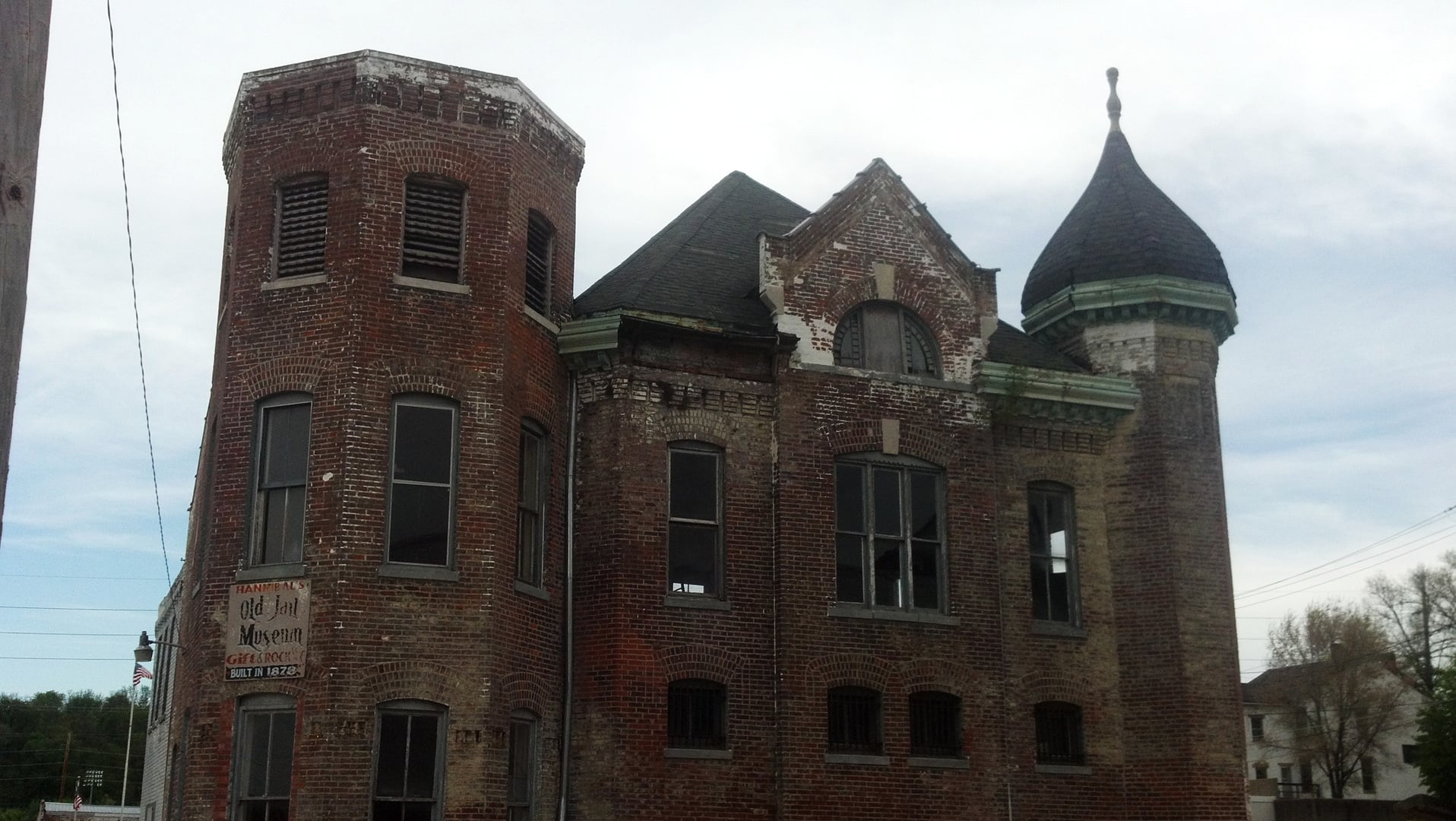
The Hannibal Old Police Station and Jail was built in 1878-1879 as a two-story late-Victorian eclectic brick building with two octagonal towers of different heights and a complex roofline. It is on the National Register of Historic Places (listed July 17, 1979) and contributes to the Central Park Historic District. Tour narration places the building at 208 Hill Street; the structure no longer functions as an active police station.
Phoenix, AZ
Arizona State Prison Complex - Phoenix, specifically the Flamenco Unit, opened in 1985 as a 105-bed psychiatric hospital for adult males. The facility's primary function is housing inmates with mental health issues and those in protective or maximum security custody. The Flamenco Unit represents a contemporary correctional mental health facility rather than a historical institutional site.