Est. 1766 · Oldest public building in Manhattan in continuous use since 1766 · Survived the 1776 Great Fire that destroyed Trinity Church · George Washington's regular worship site during his presidency in New York · Burial site of British actor George Frederick Cooke (d. 1812) · Active 9/11 relief center 2001–2002
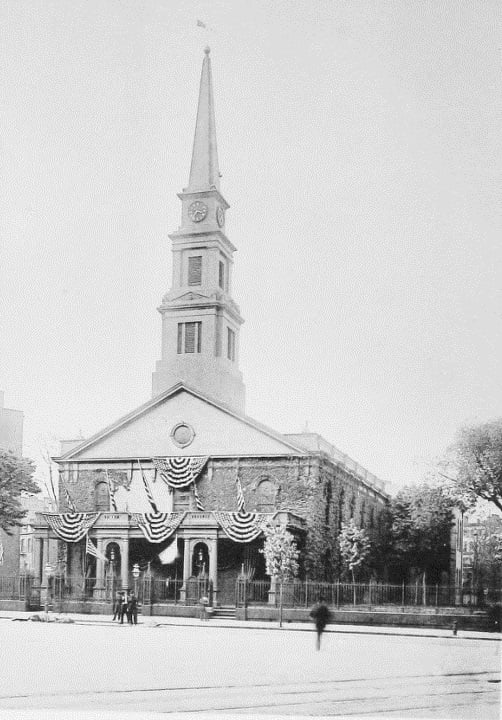
St. Paul's Chapel was built between 1764 and 1766 as an uptown chapel for the Trinity Church parish, which had outgrown its original Lower Manhattan location. Designed in the Georgian style by Thomas McBean, the chapel was the tallest building in New York at its completion. It survived the 1776 Great Fire of New York — which destroyed Trinity Church and much of the surrounding city — and has been in continuous use since the year it opened.
The chapel's most prominent association is with George Washington. Following his inauguration as president on April 30, 1789, Washington walked to St. Paul's for a thanksgiving service. He worshipped at the chapel regularly during the two years that New York served as the national capital, and the pew he used is preserved.
George Frederick Cooke, one of the leading British stage actors of the early 19th century, arrived in New York in 1810 for an American tour. He made his American debut as Richard III to critical acclaim. The War of 1812 stranded him in the city, and he died on September 26, 1812, of complications from cirrhosis. He was initially buried in the Stranger's Vault on the chapel grounds.
In 1820, the American actor Edmund Kean arranged for Cooke to receive a proper monument. When Cooke's remains were moved from the vault to a marked grave in preparation for the monument's installation in 1821, the skull was found to be missing. The most plausible reconstruction, documented by theater historians, is that Cooke had agreed to donate his head to science to settle debts. The skull eventually reached the Jefferson Medical College in Philadelphia, and a portion was used to make a death mask; the bulk of the skull was donated to the college library in 1938.
Sources
- https://en.wikipedia.org/wiki/St._Paul%27s_Chapel
- https://trinitychurchnyc.org/visit-history/places/st-pauls-chapel
- https://travsd.wordpress.com/2022/04/17/the-scattered-remains-of-george-frederick-cooke/
- https://the-line-up.com/the-headless-ghost-of-st-pauls-chapel
Headless apparition in the churchyardFigure searching near Ann Street alleyGeneral unease and cold spots in the churchyard at night
The headless ghost story at St. Paul's Chapel is built on a documented historical fact: when George Frederick Cooke's remains were moved in preparation for his 1821 monument, the skull was missing. Theater historian Paul Fryer and the Travalanche blog have documented the circumstances in detail — the most credible explanation involves Cooke having donated his skull to a physician in exchange for debt forgiveness, a transaction common enough among financially struggling artists of the period.
The haunting accounts date consistently from 1821, the year the monument went up and the headless burial became public knowledge. The apparition is described as a well-dressed figure moving through the churchyard at night, stopping in the alley on Ann Street where the Park Theatre once stood nearby — a theater Cooke performed in during his American season. The ghost appears to be searching the ground, which tradition interprets as searching for the missing skull.
The Line-Up and the Buried Secrets Podcast have both covered the Cooke legend as one of Lower Manhattan's better-sourced ghost stories, given that the biographical circumstances are documented and the haunting accounts correlate with the specific detail (missing head) that distinguishes Cooke's burial from others on the grounds.
St. Paul's gained a modern layer of historical significance as a relief center during and after September 11, 2001, operating continuously for eight months as a support station for rescue and recovery workers. The memorial exhibition inside the chapel documents this period.
Notable Entities
George Frederick Cooke (1756–1812; British actor; headless burial on-site since 1812)
Where this legend is told