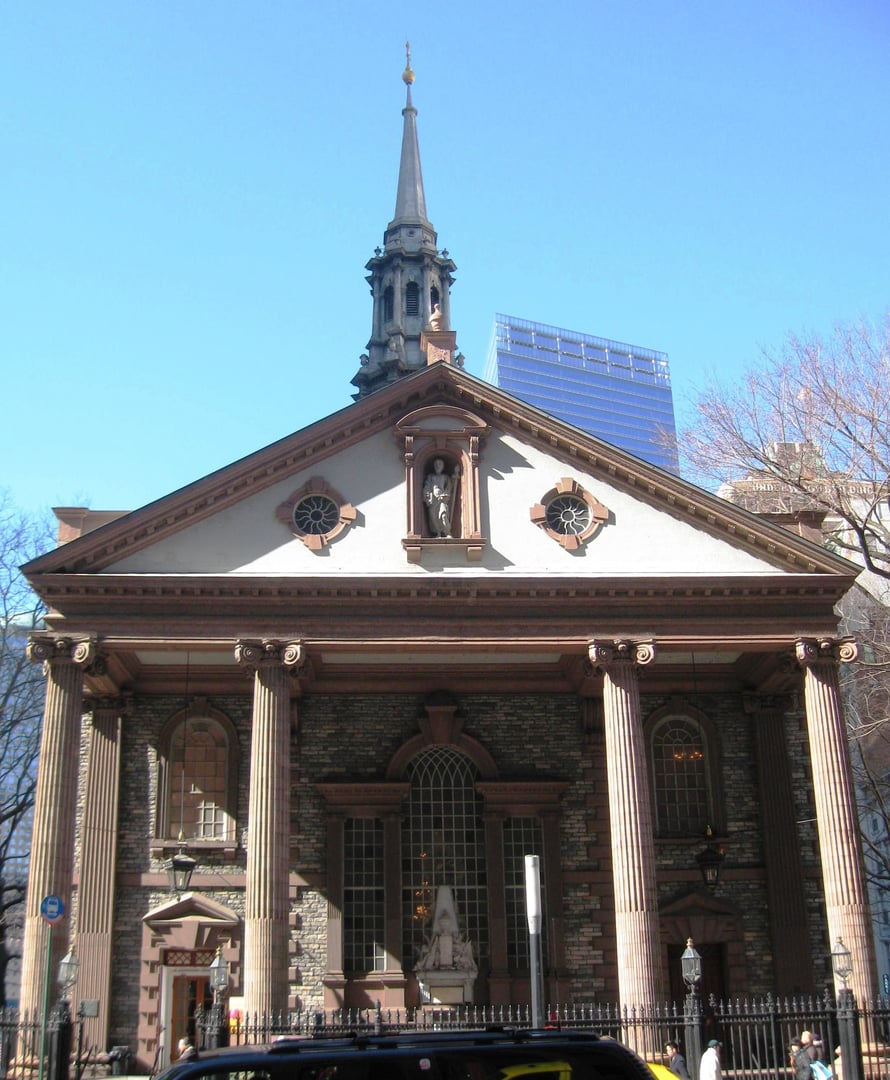
Est. 1799 · Oldest continuously active site of Christian worship in New York City · Built on Peter Stuyvesant's 17th-century farm and chapel site · Stuyvesant interred here since 1672 · National Historic Landmark
Peter Stuyvesant arrived in New Amsterdam in 1647 as the Dutch West India Company's Director-General and governed the colony until the English seized it in 1664. He had already lost a leg during a West Indies campaign against the Spanish — a wound that required amputation and led to the silver-studded peg leg he wore for the rest of his life. After the English takeover he retired to his farm in what is now the East Village, where he had built a private chapel around 1660.
Stuyvesant died on his farm in 1672 and was interred in a vault beneath the chapel. His family continued to worship there, and in 1793 the Stuyvesant heirs deeded the property to the Episcopal Church of New York on the condition that a new church be built on the site. The present building, a Federal-style structure designed with a brownstone exterior and Georgian interior elements, was completed in 1799.
The church has operated continuously since its opening, making the Stuyvesant site the oldest continuously active place of Christian worship in New York City. The churchyard holds the burials of multiple prominent New Yorkers; Stuyvesant's vault remains beneath the church's east wall, as it has since 1672.
A fire in 1978 gutted much of the interior, but the exterior walls survived and the building was reconstructed over the following years, reopening in 1990. St. Mark's today is an Episcopal parish and a prominent East Village arts organization, hosting poetry readings, dance, and theater in addition to religious services.
Sources
- https://en.wikipedia.org/wiki/St._Mark%27s_Church_in-the-Bowery
- https://stmarksbowery.org
- https://www.boweryboyshistory.com/2015/10/the-ghost-of-peter-stuyvesant-may-still-haunt-the-east-village.html
Peg-leg footsteps in pews and corridorsChurch bells ringing without rope movementFigure in Dutch period dressShadowy movements seen through windowsFemale apparition seated in pews
Peter Stuyvesant's ghost is one of the older documented haunting legends in Manhattan. Accounts appeared in print as early as the 1800s and have been periodically collected by New York City historians, most notably by The Bowery Boys history blog, which traced the story through primary-era sources.
The most specific account is from Good Friday, April 14, 1865 — three days after Lincoln was shot — when the church rector reported that the bell began to ring in the empty tower. When he went to investigate, the rope was not moving; it had been cut some days before. He reported seeing a figure in Dutch-period dress running from the bell chamber. The date and circumstances made the incident memorable enough to survive in church tradition.
More general accounts from multiple centuries describe the sound of a peg leg moving through the church — an uneven, distinctive gait identifiable with Stuyvesant — in the pews and side corridors after services have ended. Visitors on the street have reported seeing shadows and motion in the church windows at night.
A secondary haunting account describes a woman in the pews, usually seated alone, who disappears when approached. Her identity is not established in any source reviewed for this entry.
NY Ghosts and the Buried Secrets Podcast have both documented the Stuyvesant legend and the 1865 bell account as among the better-sourced church haunting stories in Manhattan, given the specificity of date and the rector's direct account.
Notable Entities
Peter Stuyvesant (1610–1672; last Dutch Director-General of New Amsterdam, interred on-site)
Where this legend is told