Self-Guided Visit
Rundel Memorial Library Visit
Visit the public Beaux-Arts/Art Deco library building and view its historic interior architecture. The closed stacks where ghost lore is concentrated are not open to the public.
- Duration:
- 45 min
HauntBound archive · catalog record
Reported phenomena, as catalogued
+ 1 further entry on record
Rochester's 1936 Beaux-Arts central library sits over the Johnson & Seymour Mill Race, where the body of 26-year-old Laura Young was found in 1902 — the anchoring story behind decades of staff ghost reports.
115 South Avenue, Rochester, NY 14604
Research updated June 2026
Age
All Ages
Cost
Free
Free public library access.
Access
Wheelchair OK
Indoor library with elevators between floors.
Equipment
Photos OK
Est. 1936 · Designed by Gordon & Kaelber (1933-1936) · Beaux-Arts/Art Deco Central Library of Rochester and Monroe County · Built over the Johnson & Seymour Mill Race · National Register of Historic Places (1985)
Rochester's Central Library, known as the Rundel Memorial Building, was constructed between 1933 and 1936 with funds from a bequest by lumber-yard owner Morton W. Rundel. Architects Gordon & Kaelber produced a building that blends Beaux-Arts massing with Art Deco ornament — including allegorical reliefs, stylized lettering, and bronze grilles — for what was then one of upstate New York's most ambitious municipal library projects.
The building was constructed directly over the Johnson & Seymour Mill Race, a 19th-century industrial waterway that powered flour mills along the Genesee River gorge. Portions of the mill race continue to flow beneath the basement and closed stacks. The building was added to the National Register of Historic Places in 1985 and remains the Central Library of Rochester and Monroe County.
The site's most-cited tragedy predates the library itself. In 1902, the body of 26-year-old Laura Young was discovered in the waterway that runs beneath the building's footprint. Press accounts at the time noted she had last been seen at a tavern with her husband during a period of marital trouble. The coroner ruled her death a suicide by drowning; her family disputed the ruling. The library was built more than three decades later atop the same waterway.
The Rundel building was extensively renovated in the 2000s and 2010s and continues to serve as Rochester's central public library, with reading rooms, a children's wing, archives, and special-collections galleries.
Sources
According to NY Ghosts and Campus Times, paranormal reports at Rundel are concentrated in the building's closed stacks, which sit directly above the surviving section of the Johnson & Seymour Mill Race. Staff have described shadowy figures in the aisles, doors opening and closing without an obvious cause, voices echoing through empty hallways, books that appear to have been thrown from shelves, and motion alarms triggering in unoccupied rooms after closing.
The most-cited explanation in local lore involves Laura Young, the 26-year-old woman whose body was found in the mill race beneath the building's footprint in 1902. Per RochesterSubway.com's coverage, a witness last saw her at a local bar with her husband, who became abusive when she begged him to take her home. Laura left, and what happened to her next remains unclear; her husband reportedly searched for her for a week without telling police. The coroner ruled the death a suicide while family and friends disputed the conclusion.
The Syfy series Ghost Hunters investigated the library in 2012 in an episode titled 'Due Date with Death,' per RochesterSubway.com's reporting at the time. The Campus Times has also covered student fascination with the legend, and the library staff have occasionally hosted Halloween-themed storytelling around the lore.
Notable Entities
Media Appearances
Visit the public Beaux-Arts/Art Deco library building and view its historic interior architecture. The closed stacks where ghost lore is concentrated are not open to the public.
Some links on this page may earn HauntBound a small commission when you book, at no extra cost to you. Our editorial picks are independent. Full disclosure
Every HauntBound history is researched from documented sources. We clearly separate verified historical fact from paranormal folklore.
Free Guide
10 verified stops, rated for families, mapped in order. Free.
One email to confirm, then the guide link. Unsubscribe anytime.
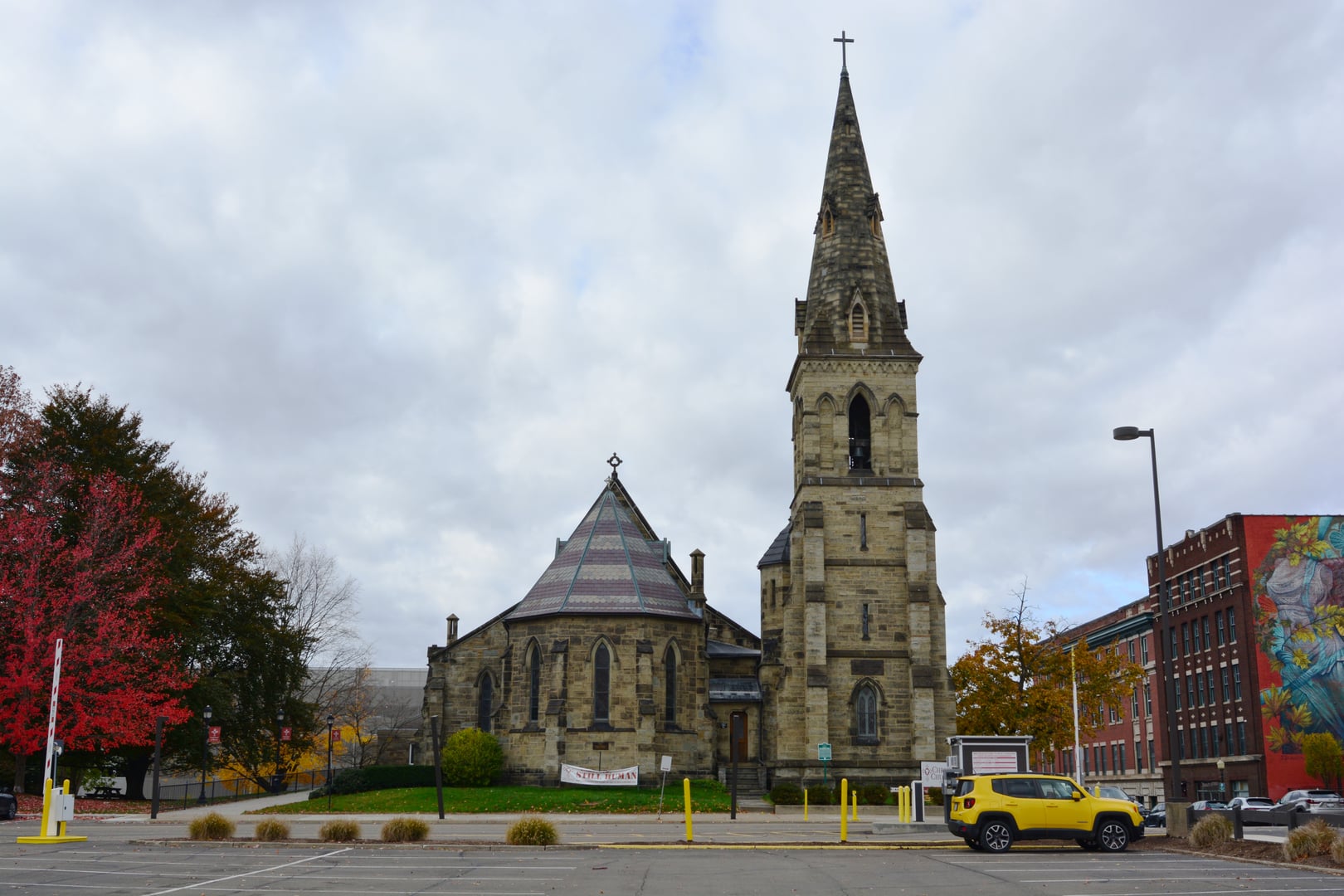
Binghamton, NY
Christ Church is Binghamton's oldest organized congregation, formed in 1810 by founders meeting at the county courthouse on a lot secured by city land agent Joshua Whitney. The current stone sanctuary at Henry and Washington Streets was designed by architect Richard Upjohn and built between 1853 and 1855, with its 110-foot steeple completed decades later.
Newark, NY
On March 31, 1848, sisters Kate (age 11) and Margaretta 'Maggie' Fox (age 14) reported communicating with a spirit through a series of knocking sounds in their Arcadia Township farmhouse, touching off the American Spiritualist movement. The sisters later confessed the raps were produced by cracking their toe and knee joints. The cottage was moved to Lily Dale, NY in 1916 and destroyed by fire in 1955; Wayne County preserves the stone foundation as a public park.
Mount Morris, NY
The Mount Morris Tuberculosis Sanatorium was built 1932–1936 as a state tuberculosis treatment campus; Eleanor Roosevelt visited the site while Franklin Roosevelt was governor of New York. The WPA supplied approximately 240 artworks to the campus in 1937. The sanatorium operated until 1971, then transferred to Livingston County, which converted it to offices and a gallery housing the New Deal collection.