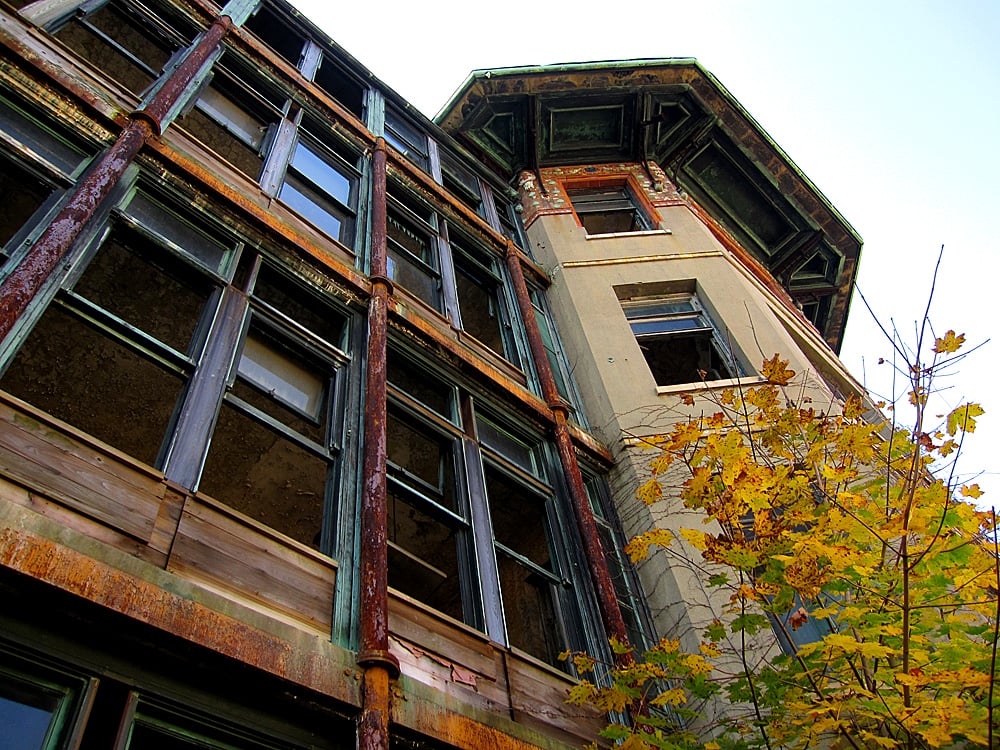
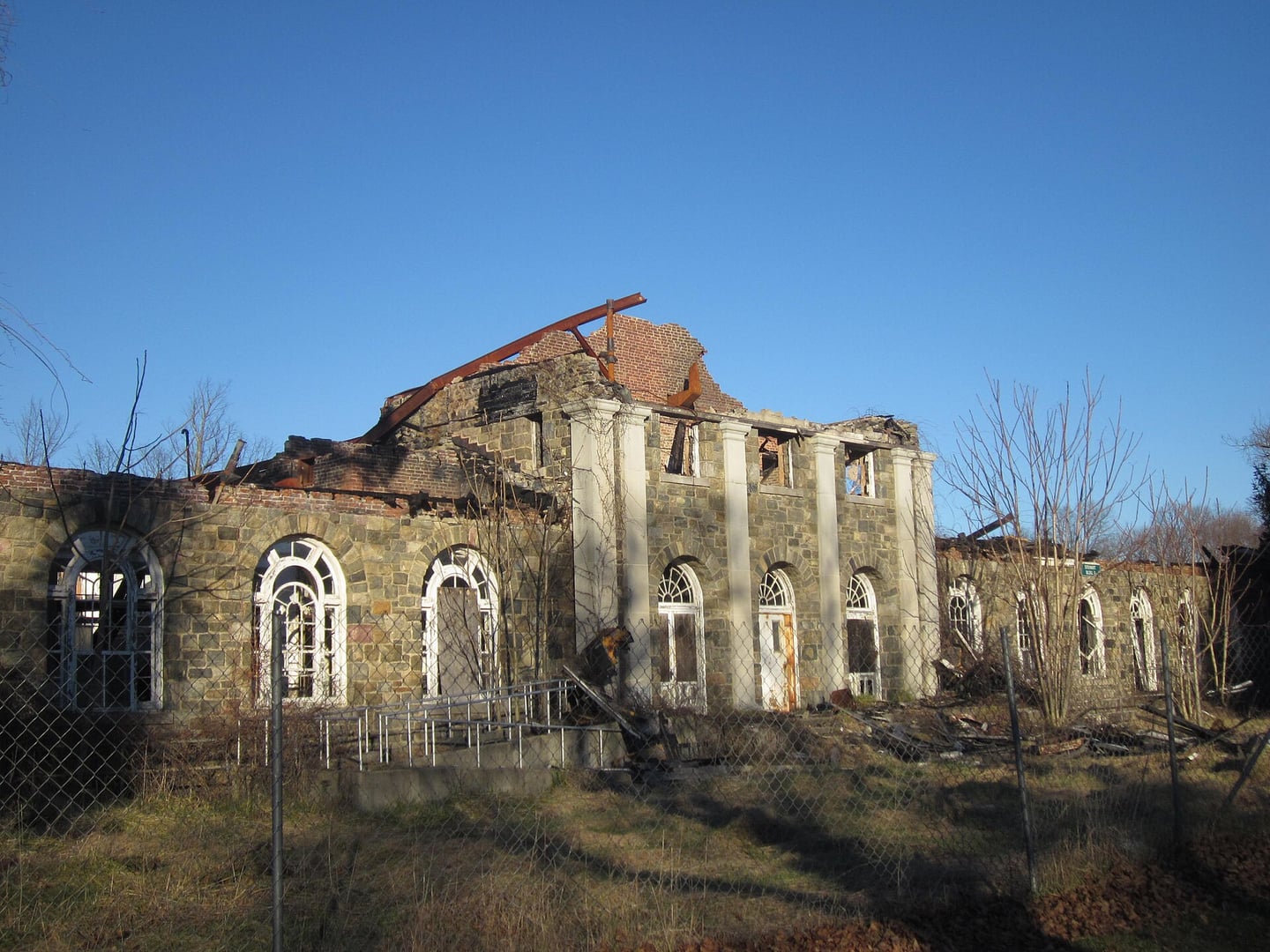
Est. 1885 · Site of 1904 General Slocum disaster — 1,021 dead, NYC's worst disaster before 9/11 · Riverside Hospital (1885–1963) — quarantine facility for smallpox, tuberculosis, typhoid · Site of Mary Mallon's quarantine from 1907 until her death in 1938 · Approximately 25 abandoned hospital structures remain, inaccessible to the public · Now a Forever Wild bird sanctuary; no public access
North Brother Island has been a site of forced separation and mass death for most of its recorded history. The island came under New York County jurisdiction in 1881, and Riverside Hospital was established there in 1885 specifically to isolate patients with highly contagious diseases — smallpox, tuberculosis, yellow fever, and typhus — away from the city's population.
On June 15, 1904, the steamship General Slocum left the Third Street pier in Manhattan carrying roughly 1,342 passengers for the annual summer outing of St. Mark's Evangelical Lutheran Church. The congregation drew from Kleindeutschland, the German immigrant enclave on the Lower East Side. Within an hour, fire broke out in a forward cabin. The ship's fire hoses — required by law but never tested — burst when activated. Crew members had received no fire training. Captain Van Schaick, rather than docking at nearby piers where the fire could have been fought on land, steered the vessel at full speed toward North Brother Island. When the ship beached, 1,021 of the 1,342 aboard were dead, most of them women and children. It remains New York City's deadliest single event until the September 11 attacks. Van Schaick was convicted of criminal negligence and sentenced to ten years; President Taft pardoned him in 1912 after he had served four years.
The island's second dark chapter began in 1907, when city health officials forcibly transported Mary Mallon — identified as an asymptomatic typhoid carrier who had infected numerous households where she worked as a cook — to a cottage on the island's grounds. Mallon protested her quarantine as illegal and was released in 1910 after agreeing not to work as a cook. She was re-quarantined in 1915 after being found cooking under a false name at a Bronx hospital, where 25 people were infected and two died. She remained on the island until her death from a stroke on November 11, 1938 — a total of 26 years of enforced isolation. The Tuberculosis Pavilion opened in 1943 but was rendered obsolete by vaccine advances within a decade. The hospital closed in 1963, and approximately 25 original structures remain on the island in severe dilapidation. Both North and South Brother Islands are now designated Forever Wild preserves managed by NYC Parks.
Sources
- https://en.wikipedia.org/wiki/North_and_South_Brother_Islands_(New_York_City)
- https://www.smithsonianmag.com/history/a-spectacle-of-horror-the-burning-of-the-general-slocum-104712974/
- https://www.nycgovparks.org/parks/north-brother-island/visit
Screams from hospital ruinsWhispers and shadow figures in abandoned wardsApparitions of people in hospital gownsSpectral figures reported on the water near shoreUnexplained movement and sounds in overgrown corridors
North Brother Island has been inaccessible to the public since 1963, which means paranormal accounts come primarily from the handful of researchers, journalists, and urban explorers who have obtained permits or trespassed. Those accounts are secondhand-filtered and should be read accordingly.
The most frequently cited reports describe screams from the center of the island and from the ruins of Riverside Hospital — attributed by witnesses to the lingering trauma of the Slocum disaster and the generations of isolation patients who died on the grounds. Accounts collected by NY Ghosts and the Lunatics Project describe whispers, shadow figures moving through the overgrown corridors, and orb phenomena. Several sources describe spectral figures walking on the water near the island's shore, connected in the paranormal tradition to the 1,021 Slocum victims who drowned within sight of land.
The most specifically identified figure is a woman reported near the area of Mallon's cottage — described by one account as an orderly from the hospital's later drug-treatment-program era (1952–1963) who followed a woman down a corridor, only to find the room she entered empty. Whether this account has a verifiable source is unclear; it circulates widely in aggregator-based paranormal writing without named attribution. The Slocum dead and the tuberculosis and typhoid patients who died in the hospital wards across its 78-year operation provide the historical weight behind the island's dark tourism reputation.
Notable Entities
Mary Mallon (Typhoid Mary) — quarantined 1907–19381,021 General Slocum victims
Where this legend is told