Est. 1927 · Route 66 Architecture · Pueblo Deco Style Origin · New Mexico Historic Preservation · National Register of Historic Places
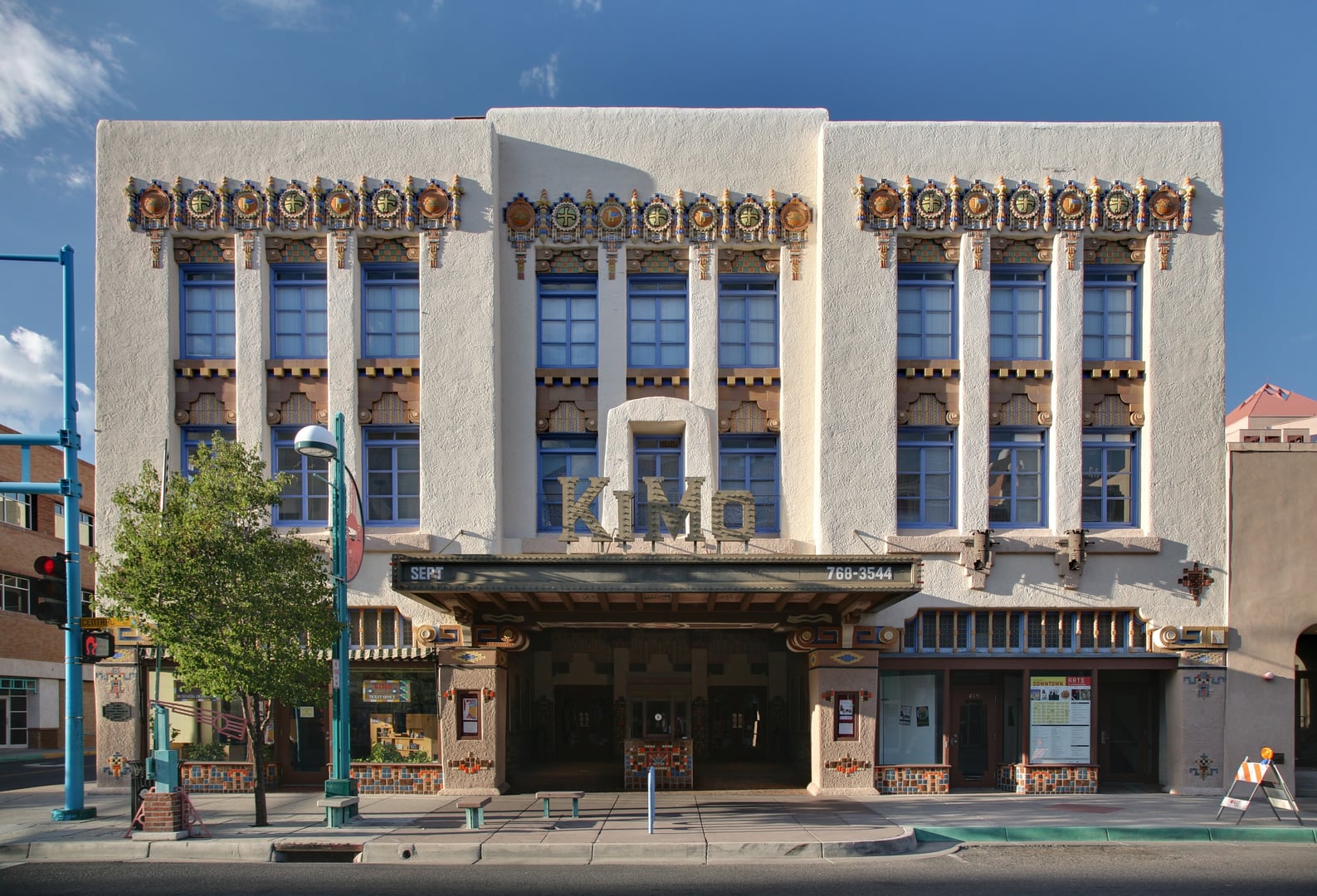
Central Avenue in 1927 was Route 66 — the most romantic stretch of American highway, already accumulating its mythology. The KiMo opened on September 19 of that year, on the northeast corner of Central and Fifth Street, with a program that included Native American dancers and singers, the debut of an $18,000 Wurlitzer theater organ, and a comedy film called Painting the Town.
The building's architectural language was unprecedented. Architect Carl Boller created what would be the first and most complete expression of Pueblo Deco — a style that fused the rounded corners and earthen palette of adobe Pueblo Revival with the vertical thrust and geometric ornamentation of Art Deco, overlaid with specific decorative motifs drawn from indigenous cultures. Buffalo skulls with glowing amber eyes serve as sconces. Air vents are disguised as Navajo rugs. Chandeliers are shaped as war drums and American Indian funeral canoes. Wrought-iron birds descend the staircases. Carl Von Hassler painted seven murals of the Seven Cities of Cibola in oil directly on the walls.
The name came from a public contest. Pablo Abeita, former governor of Isleta Pueblo, submitted 'Kimo' — loosely translatable as 'mountain lion' or 'king of the beasts.' His entry was chosen.
The theater went through the standard arc of American movie palaces: prosperity, decline, near-demolition. In 1977, Albuquerque voters chose to purchase the building rather than let it be razed. The most recent restoration, completed in 2000, installed new seating and carpet, a main stage curtain, a rebuilt tech booth, and a recreated version of the original proscenium arch. The KiMo is now owned and operated by the City of Albuquerque.
In June 1951, the theater's boiler exploded. A six-year-old boy named Bobby Darnall was killed. He had been in the balcony with friends, was frightened by something on screen, and ran to the lobby — where the boiler was located beneath the concession stand — at the moment the explosion occurred.
Sources
- https://en.wikipedia.org/wiki/KiMo_Theater
- https://www.cabq.gov/artsculture/kimo/history-of-the-kimo
- https://www.legendsofamerica.com/nm-kimotheatre/
- https://www.cabq.gov/artsculture/kimo/history-of-the-kimo/kimo-history/ghost
ApparitionsObject movementEquipment malfunctionTouching/pushing
The boiler explosion of 1951 killed Bobby Darnall and demolished part of the original lobby. He had been sitting in the balcony. Something on the screen frightened him. He ran downstairs. The lobby and Bobby were destroyed together.
The ghost tradition at the KiMo didn't begin immediately. A theater director involved with the building later described a gap of roughly 25 years between Bobby's death and the first accounts of his presence affecting performances. The most frequently cited incident involves a production of A Christmas Carol during which strange events disrupted the show, attributed afterward to Bobby. Writer Benjamin Radford subsequently investigated and concluded that the specific production cited in the story occurred in 1986, not 1974 as sometimes claimed, and that participants he interviewed did not recall the events as described. Radford's conclusion: the founding incident of the KiMo ghost story did not occur as told.
The tradition persists regardless. Bobby is described as visible on the lobby staircase — a child in a striped shirt and blue jeans. He reportedly trips performers, moves props, and generally disrupts shows in the manner of an impish child rather than a hostile presence. The donut tradition is the most documented and verifiable piece of the legend: before every opening night, the cast hangs doughnuts on a specific water pipe on the back wall behind the stage. Bite marks consistent with a child's mouth have been reported on the remaining doughnuts the following morning.
Bobby Darnall's siblings, contacted by Radford during his investigation, expressed that they felt exploited by the legend and did not appreciate its characterization of their brother. The City of Albuquerque, which owns the theater, maintains a page on its official website about Bobby's ghost — the only municipal government in the United States with a formal webpage dedicated to its city theater's resident spirit.
Notable Entities
Bobby Darnall