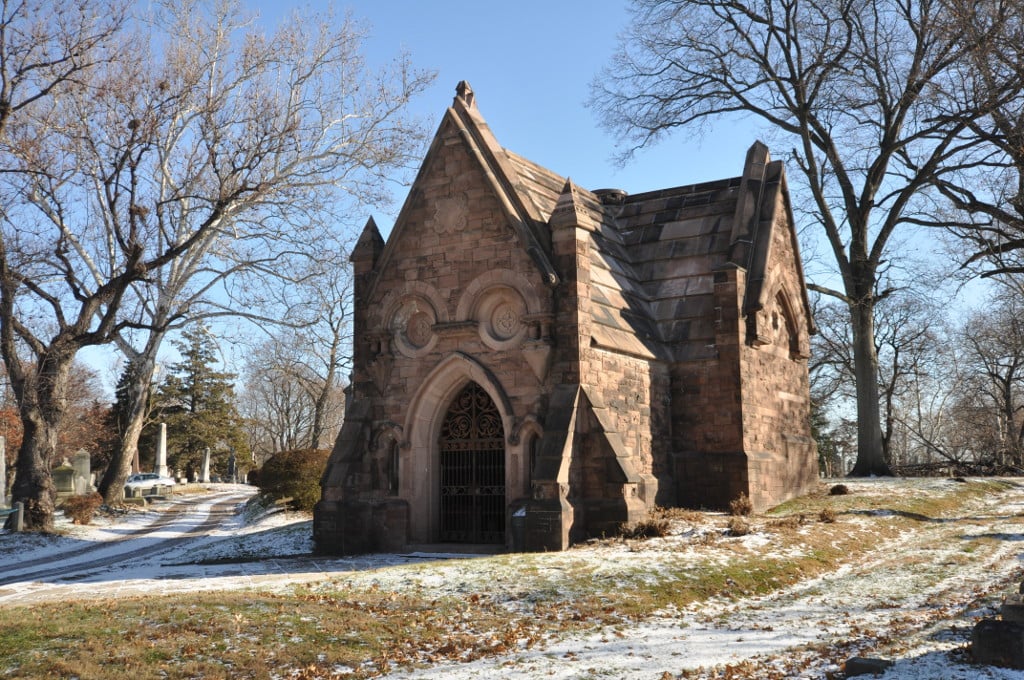
Est. 1780 · Tomb of Robert Erskine (1735-1780), manager of the Ringwood ironworks · Erskine was George Washington's first Geographer and Surveyor General, producing 275+ maps · Ringwood iron supplied Revolutionary War hardware, by tradition including Hudson River chain links · Located on the grounds of Ringwood Manor State Park, a National Historic Landmark district
Robert Erskine came to Ringwood as a Scottish engineer hired in 1771 to manage the ironmaking operations there. The Ringwood works were already an important colonial ironmaking center, and Erskine ran them through the most demanding years of the American Revolution, keeping the furnaces producing iron used for military hardware and, by tradition, links for the great chain strung across the Hudson River to block British ships.
In 1776, after Erskine designed a defensive structure for the Hudson, he drew the attention of the Continental command. George Washington appointed him the army's first Geographer and Surveyor General, a role in which Erskine and his assistants produced more than 275 maps of the theater of war. The mapmaking took him into the field in all conditions.
Erskine contracted pneumonia during a surveying expedition and died at Ringwood on October 2, 1780, at the age of forty-five. He was buried in a tomb on the manor grounds, in the old Ringwood burial ground near the main house, where his marker still stands. The estate later passed to the Hewitt and Cooper families and ultimately became Ringwood Manor State Park, preserving both the mansion and Erskine's tomb.
The grave is a genuine Revolutionary-era site. It belongs to a man whose maps helped Washington's army move through New Jersey and New York, and whose iron came out of the same hills the tomb now overlooks. The legend that grew up around the tomb is folklore; the man, his work, and his early death are documented history.
Sources
- https://en.wikipedia.org/wiki/Ringwood_Manor
- https://revolutionarywarjournal.com/best-ghost-stories-of-the-american-revolution/
- https://occult-world.com/ringwood-manor/
Apparition of Robert Erskine seen sitting on his tombLantern-carrying figure escorting travelers toward the Drink Brook bridgePale-blue lantern said to knock against his shinbone, vanishing at the bridge
The signature Ringwood legend belongs to Robert Erskine. According to the tale, his apparition has been seen in two forms. In the simpler version, the colonel is glimpsed sitting on top of his own tomb on the manor grounds. In the better-known version, his ghost takes on the role of a guide: he escorts travelers walking past late at night, leading them from the burial ground toward an aging wooden bridge at Drink Brook, about a hundred yards distant.
The detail that fixes the story in local memory is the lantern. Erskine is said to carry a pale-blue lantern that knocks and smacks against his shinbone as he walks, a small, almost mundane sound that makes the figure more unsettling than a silent specter would be. When he reaches the bridge at Drink Brook, the legend says, he simply vanishes.
The story has been retold for generations in North Jersey folklore collections and in accounts of Revolutionary-era ghost legends, and it remains attached to the Erskine tomb and the manor grounds. HauntBound presents the lantern legend as folklore. What is documented is the grave itself and the man buried in it: an ironmaster and military surveyor who died of pneumonia in 1780 and was laid to rest a short walk from the brook his ghost is said to wander.
Notable Entities
Robert Erskine