Est. 1941 · National Historic Landmark · Most Decorated American Battleship · Lead Ship of North Carolina-Class · Citizen Preservation Campaign
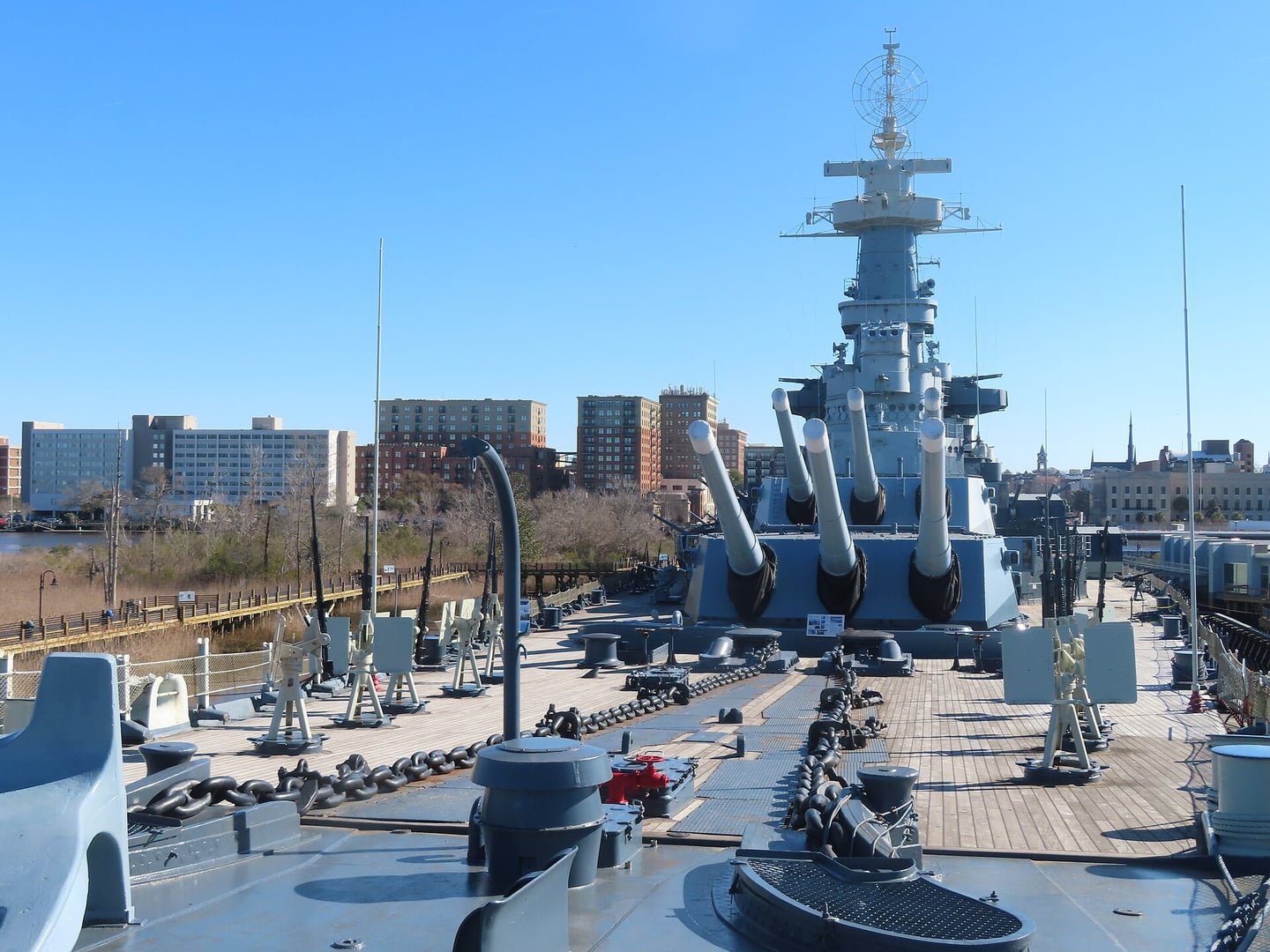
USS North Carolina (BB-55) was the first American battleship commissioned after the Washington Naval Treaty's expiration. The ship was laid down at New York Naval Shipyard in October 1937 and commissioned on April 9, 1941, the lead ship of a new class of fast battleships designed to operate with carrier task forces at speeds previously beyond standard battleship capability.
During World War II, North Carolina participated in every major Pacific Fleet campaign from the Guadalcanal landings of August 1942 through the Japanese surrender. The ship's anti-aircraft batteries shot down twenty-four enemy aircraft, and the 16-inch main batteries supported amphibious operations from the Gilbert Islands through Okinawa. North Carolina earned fifteen battle stars across the Pacific campaign, more than any other American battleship.
On September 15, 1942, a Japanese submarine torpedoed North Carolina off the Solomon Islands during operations supporting the Guadalcanal landings. The torpedo exploded in a lower-deck washroom, killing five sailors and wounding twenty-three. The torpedo damage was extensive but the ship returned to operational service within weeks. The torpedo-damage compartment is preserved as part of the current museum tour and is among the most-cited paranormal locations aboard the ship.
North Carolina was decommissioned on June 27, 1947 and held in the inactive reserve fleet at Bayonne, New Jersey through the 1950s. The Navy announced the ship's scheduled scrapping in 1960. A citizen preservation campaign led by North Carolina governor Luther H. Hodges and a statewide schoolchildren's penny drive raised the required transfer and towing costs. The battleship reached the mouth of the Cape Fear River near Southport on October 1, 1961, and was towed about 30 miles up the river to its Wilmington berth the next day, October 2, 1961. The state's World War II Memorial was dedicated in April 1962, and the ship opened to the public on October 14, 1961.
USS North Carolina is designated a National Historic Landmark and is listed on the National Register of Historic Places.
Sources
- https://battleshipnc.com/
- https://en.wikipedia.org/wiki/USS_North_Carolina_(BB-55)
- https://www.wonderfulmuseums.com/museum/battleship-north-carolina-museum/
ApparitionsPhantom voicesPhantom footstepsTouching/pushingPhantom soundsShadow figuresCold spots
USS North Carolina's paranormal record is among the most-documented of any American museum ship. The reports cluster on two principal locations: the torpedo-damage compartment, where five sailors were killed in the September 15, 1942 submarine attack, and the sick bay, which served as the primary medical facility throughout the battleship's combat service.
The torpedo-damage compartment has produced sustained reports across multiple decades. Visitors and staff describe disembodied voices, with specific recurring phrases including I'm tired and get out reported by multiple witnesses. The sound of running footsteps in the surrounding passageways has been reported during evening hours when the museum is closed to standard visitors.
The sick bay produces reports of the sound of beds creaking and shifting, loud knocks and tapping on the bulkheads, and the sensation of being touched by unseen hands. The figure of a medical officer in 1940s naval uniform has been reported in the central sick-bay passage. Paranormal-investigation groups including the SyFy Channel Ghost Hunters team have filmed in these spaces; the resulting footage and audio are widely circulated in regional paranormal media.
Additional reports cover the bridge, the engine room, the catapult deck, and the crew berthing spaces. The battleship is configured for extensive evening-program access through third-party operators including Haunted Rooms America and Ghost Hunts USA. The museum itself does not directly operate the paranormal programs but provides the access framework through which the third-party operators run their scheduled investigations.
Media Appearances
- Ghost Hunters (SyFy Channel)
- TAPS investigations