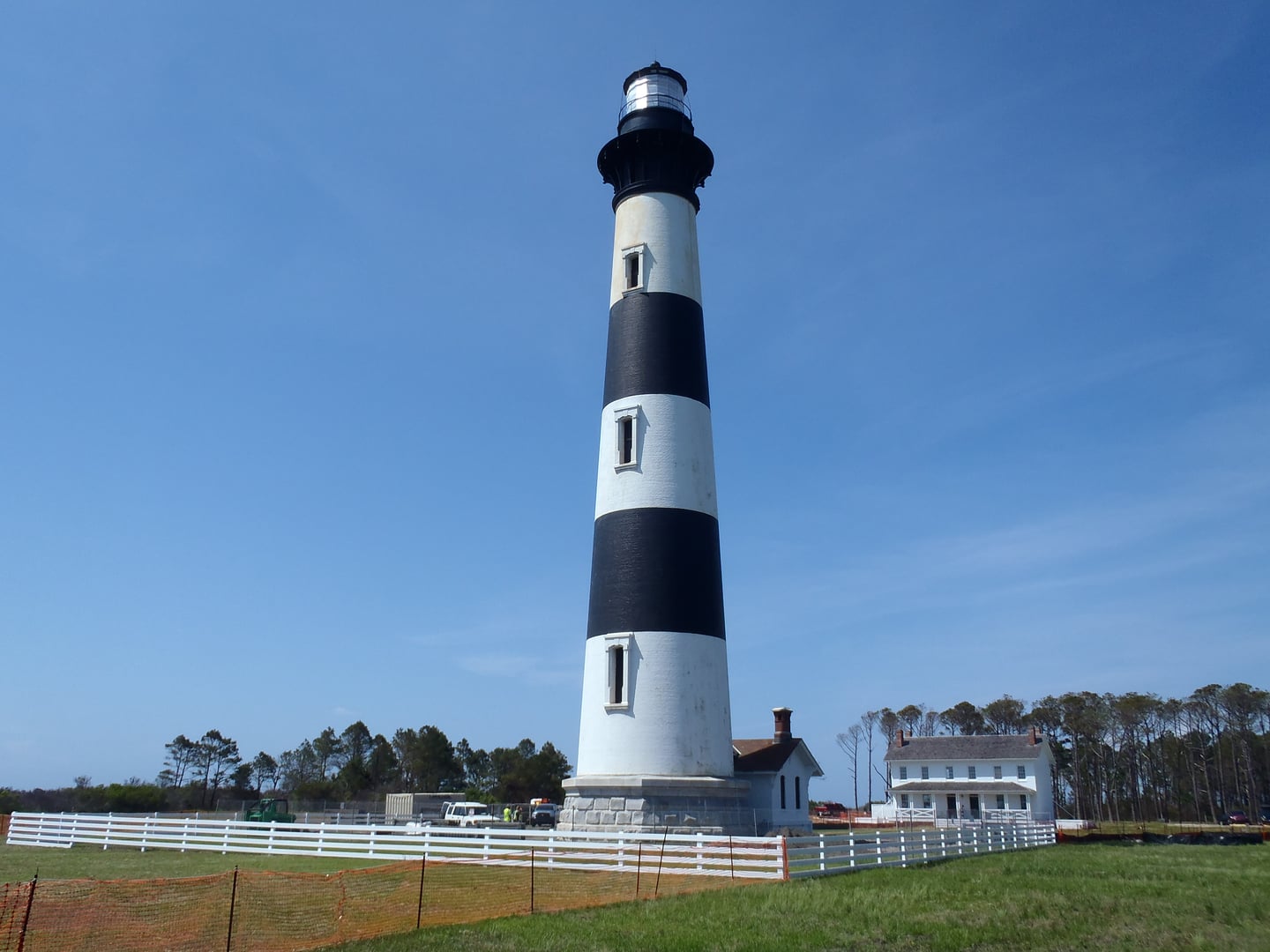
Est. 1870 · Tallest US Brick Lighthouse · Cape Hatteras National Seashore · Graveyard of the Atlantic · 1999 Structural Relocation · First-Order Fresnel Lens
Diamond Shoals extends approximately twelve miles offshore from Cape Hatteras, where the warm Gulf Stream meets the cold Labrador Current. The collision of currents and sandbars has wrecked more than 1,000 documented vessels — the highest concentration on the U.S. Atlantic coast. The waters off North Carolina earned the name Graveyard of the Atlantic by the 19th century, and Cape Hatteras has been the most consistently lethal section.
The first Cape Hatteras lighthouse, completed in 1802, was widely judged ineffective. Its light was reportedly difficult to distinguish from stars, and its location was poorly chosen. After the Civil War, Congress authorized funds for a new lighthouse in 1867. The current tower was completed and first lit in December 1870. At 210 feet from base to tip, it remains the tallest brick lighthouse in the United States. The distinctive black and white spiral stripes were painted in 1873 as a daymark distinguishing it from Bodie Island Lighthouse to the north and the Cape Lookout light to the south.
The station was served by 83 keepers across its operating history. Keeper Unaka Jennette served twenty years — the longest tenure of any keeper at Hatteras. The first-order Fresnel lens, manufactured in Paris, illuminated the tower until automation. The light flashes a 7.5-second pattern visible 20 nautical miles to sea.
By the late 20th century, the eroding shoreline had brought the surf within 120 feet of the tower foundation. After more than a decade of debate among the National Park Service, the Coast Guard, engineers, and the public, the decision was made to relocate the entire structure rather than abandon or armor it in place. International Chimney Corporation and Expert House Movers conducted the move in spring and summer 1999. The 4,800-ton tower was lifted onto hydraulic jacks, slid on steel beams along a soap-lubricated track, and successfully placed on its new foundation 2,900 feet from its original location on July 9, 1999. It remains a working Coast Guard aid to navigation.
Sources
- https://www.ncpedia.org/cape-hatteras-lighthouse
- https://en.wikipedia.org/wiki/Cape_Hatteras_Lighthouse
- https://www.outerbankslighthousesociety.org/capehatteras.html
- https://www.history.uscg.mil/Browse-by-Topic/Assets/Land/All/Article/1944529/cape-hatteras-lighthouse/
ApparitionsPhantom soundsPhantom footsteps
The lighthouse's paranormal literature circulates primarily through Outer Banks ghost-tour operators and regional folklore rather than published investigations. The most frequently cited tradition concerns a small phantom cat reportedly seen in the principal keeper's quarters — a story attributed in local tradition to a pet kept by one of the long-serving keepers. The tradition is folkloric; no specific keeper or cat is identified by name in primary documentation.
The surf line below the lighthouse's original location draws a different set of accounts. Visitors describe figures in 19th-century sailor's dress at the shoreline at dusk, particularly near the site of the USS Monitor's December 1862 foundering eighteen miles offshore. The Monitor's sinking killed sixteen crew members; the wreck site is now a National Marine Sanctuary. The shoreline accounts also reference the German U-85 and U-352 and the British steamer Mirlo (torpedoed in 1918) — vessels whose losses contributed to the high concentration of maritime tragedy in the immediate offshore waters.
Reports from within the tower itself are limited. The 257-step iron staircase and the gallery deck generate occasional accounts of unexpected sounds and the impression of being watched while alone at the top, but these reports are infrequent compared to those associated with the surrounding shoreline. The National Park Service does not include paranormal material in its interpretive content, which focuses on the engineering, maritime, and relocation history.
Notable Entities
The keeper's quarters cat