Est. 1872 · Cape Hatteras National Seashore · Graveyard of the Atlantic · First-Order Fresnel Lens · Civil War Demolition Site
The shoals along this section of the Outer Banks have wrecked an estimated 5,000 vessels since European contact, a casualty rate that prompted Congress on March 3, 1837, to appropriate $5,000 for a lighthouse near New Inlet. The first Bodie Island lighthouse, completed in 1847, was built on poor foundations and was abandoned within fifteen years. The second tower, completed in 1859 by the Lighthouse Board, was destroyed in 1861 when retreating Confederate troops dynamited it to deny its use to the Union Navy.
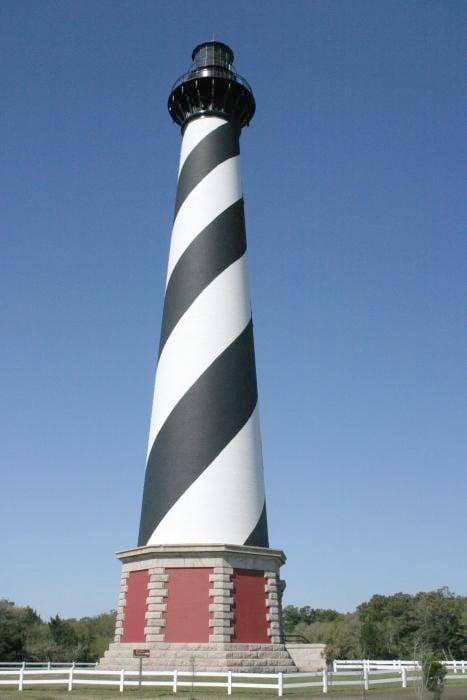
The current tower was authorized after the Civil War and completed in 1872. It stands 156 feet from base to focal plane, painted with horizontal black and white bands as a daymark distinguishing it from Cape Hatteras Lighthouse to the south. The original first-order Fresnel lens, manufactured in Paris by Henry-Lepaute, illuminated the structure until automation. The light flashes a 2.5-second on, 2.5-second off, 2.5-second on, 22.5-second off pattern visible 19 miles to sea.
The origin of the name remains debated. The Outer Banks Lighthouse Society and the National Park Service both note that the island is identified on early survey maps as Body's Island, likely after a landowning family of that name. A persistent folk etymology connects the name to the high number of bodies of drowned mariners and shipwrecked passengers washed ashore along this coast. Both readings appear in NPS interpretive material.
The lighthouse and its 1872 double keeper's quarters were transferred to the National Park Service as part of Cape Hatteras National Seashore in 1953. After a 2009-2013 restoration, the tower opened for public climbs for the first time in its history. The keeper's quarters now houses a NPS museum and bookstore.
Sources
- https://www.nps.gov/caha/planyourvisit/bils.htm
- https://en.wikipedia.org/wiki/Bodie_Island_Lighthouse
- https://www.lighthousefriends.com/light.asp?ID=357
Phantom footstepsPhantom sounds
Of the four major Outer Banks lighthouses, Bodie Island carries the least-developed paranormal literature. Most accounts circulate through Outer Banks ghost-tour operators and regional folklore rather than published investigations. The dominant traditions cluster around the original 1872 keeper's quarters, now operating as a NPS museum.
Visitors and seasonal staff have described phantom footsteps on the upper floor of the keeper's quarters when the building is otherwise empty, attributed in local tradition to the long line of resident keepers — Samuel Tillett, John B. Etheridge, William F. Hatsel, Peter G. Gallop, and others — who served the station from 1872 until the light was automated in 1932. None of these reports have been formally documented by the National Park Service.
The broader regional folklore frames the Bodie name itself. Despite the National Park Service's preferred attribution to a landowning Body family, the alternative folk etymology — that the name derives from the number of drowned bodies washing ashore along this shoreline — persists in tour-operator narratives and in published collections of Outer Banks legends. The Graveyard of the Atlantic and the wreckage of nearby vessels including the Laura A. Barnes (1921) and the USS Huron (1877, with 98 lives lost) anchor the regional sense of the coast as a site of unresolved maritime tragedy.
Without independent investigation records or attributed first-person accounts beyond ghost-tour material, the lighthouse's paranormal profile remains thin compared to better-documented Outer Banks sites.