Self-Guided Visit
Lighthouse grounds and beach walk
Visit the Cape Hatteras Light Station grounds, the keeper's quarters museum, and the beach where the Lady in White is said to walk on misty mornings.
- Duration:
- 1.5 hr
HauntBound archive · catalog record
Reported phenomena, as catalogued
+ 1 further entry on record
The Outer Banks' 1870 Sentinel and the Theodosia Burr Story
46368 Lighthouse Road, Buxton, NC 27920
Research updated May 2026
Age
All Ages
Cost
Free
Grounds are free to visit. Lighthouse climb fees apply during the climbing season, per the National Park Service.
Access
Limited Access
Sandy beach and lighthouse grounds; lighthouse climb is stairs only
Equipment
Photos OK
Est. 1870 · National Park Service Site · Cape Hatteras National Seashore · Graveyard of the Atlantic · Theodosia Burr Mystery (1812)
Cape Hatteras Lighthouse stands near Buxton on Hatteras Island, marking Diamond Shoals, where the Gulf Stream meets the cold Labrador current and where roughly 2,000 ships have been lost along the stretch of coast known as the Graveyard of the Atlantic. Alexander Hamilton, who as a 17-year-old had survived a shipboard fire off the cape, oversaw the new federal Lighthouse Establishment in 1789 and recommended a light here. Congress funded it in 1794, and a 95-foot octagonal sandstone tower went into service in 1803. Mariners complained it was too short and too dim; it was raised and fitted with a first-order Fresnel lens in 1854, and Union troops occupied the island to protect it in 1861.
Congress authorized a replacement in 1867. The present conical brick tower, built from about 1,250,000 bricks from James River kilns at a cost of $155,000, was completed in December 1870. At 198 feet it is the tallest brick lighthouse in the United States. The black and white spiral daymark was painted in June 1873. Beach erosion forced the Lighthouse Service to abandon the tower in 1936, and it stayed dark until 1950, when the Coast Guard relit it with an electric beacon. The vandalized original lens was removed in 1949 and is now displayed at the Graveyard of the Atlantic Museum in Hatteras Village.
Between June 17 and July 9, 1999, International Chimney Corp. and Expert House Movers jacked the 4,830-ton tower onto steel mats and rolled it 2,900 feet inland, restoring its original 1,500-foot distance from the sea. The light returned to service on November 13, 1999. The National Park Service manages the light station as part of Cape Hatteras National Seashore; the Coast Guard maintains the beacon. In January 2024 the park began a $19.2 million restoration by Stone and Lime Historic Restoration Services that includes a replica first-order Fresnel lens. Crews found cracked cast-iron gallery brackets in 2025, and the tower will remain closed to climbing through 2026.
Sources
Three separate traditions attach to the cape and its lighthouse, and the Dare County library's Outer Banks folklore guide traces all of them to the regional collections of Charles Harry Whedbee, Nancy Roberts, and later writers.
The most specific to the tower is the lighthouse cat. Visitors for roughly a century have described a black and white cat of about 15 pounds that approaches on the grounds or the stairs, allows itself to be petted, and disappears when someone tries to pick it up. The Outer Banks Visitors Bureau notes that reports continued after the 1999 move. The cat is usually said to have belonged to a keeper, though no keeper is named in the published versions.
The best known is the Lady in White, identified with Theodosia Burr Alston, daughter of Aaron Burr, who sailed from Georgetown, South Carolina, aboard the schooner Patriot in late December 1812 and was never seen again. Whedbee and others recorded accounts of a woman in a white gown walking the beach on misty mornings or, in the Nags Head versions, between Christmas and New Year. The tale rests on the 1869 discovery of an unsigned portrait of a young woman in a Nags Head cottage, which NCpedia describes as a legend that left historians wondering whether she reached shore or whether wreckers looted the ship. Pirate deathbed confessions printed in the 1830s were never confirmed.
The third is the Gray Man, a hazy figure seen on the dunes before a hurricane, said in local telling to be a man named Gray who drowned in a sudden storm and returns to warn islanders. The Graveyard of the Atlantic narrative, with its drowned sailors, supplies the broader backdrop. None of these accounts appears in National Park Service interpretive material, which treats the site as maritime history.
Notable Entities
Media Appearances
Visit the Cape Hatteras Light Station grounds, the keeper's quarters museum, and the beach where the Lady in White is said to walk on misty mornings.
Tour the keeper's quarters and visitor exhibits managed by the National Park Service.
Walk the grounds of America's tallest brick lighthouse — 210 feet base to tip — and visit the principal keeper's quarters museum. Exhibits cover the 1870 construction, the 1999 relocation 2,900 feet inland to escape the encroaching surf, and the long line of 83 keepers who served the station.
Some links on this page may earn HauntBound a small commission when you book, at no extra cost to you. Our editorial picks are independent. Full disclosure
Every HauntBound history is researched from documented sources. We clearly separate verified historical fact from paranormal folklore.
Free Guide
10 verified stops, rated for families, mapped in order. Free.
One email to confirm, then the guide link. Unsubscribe anytime.
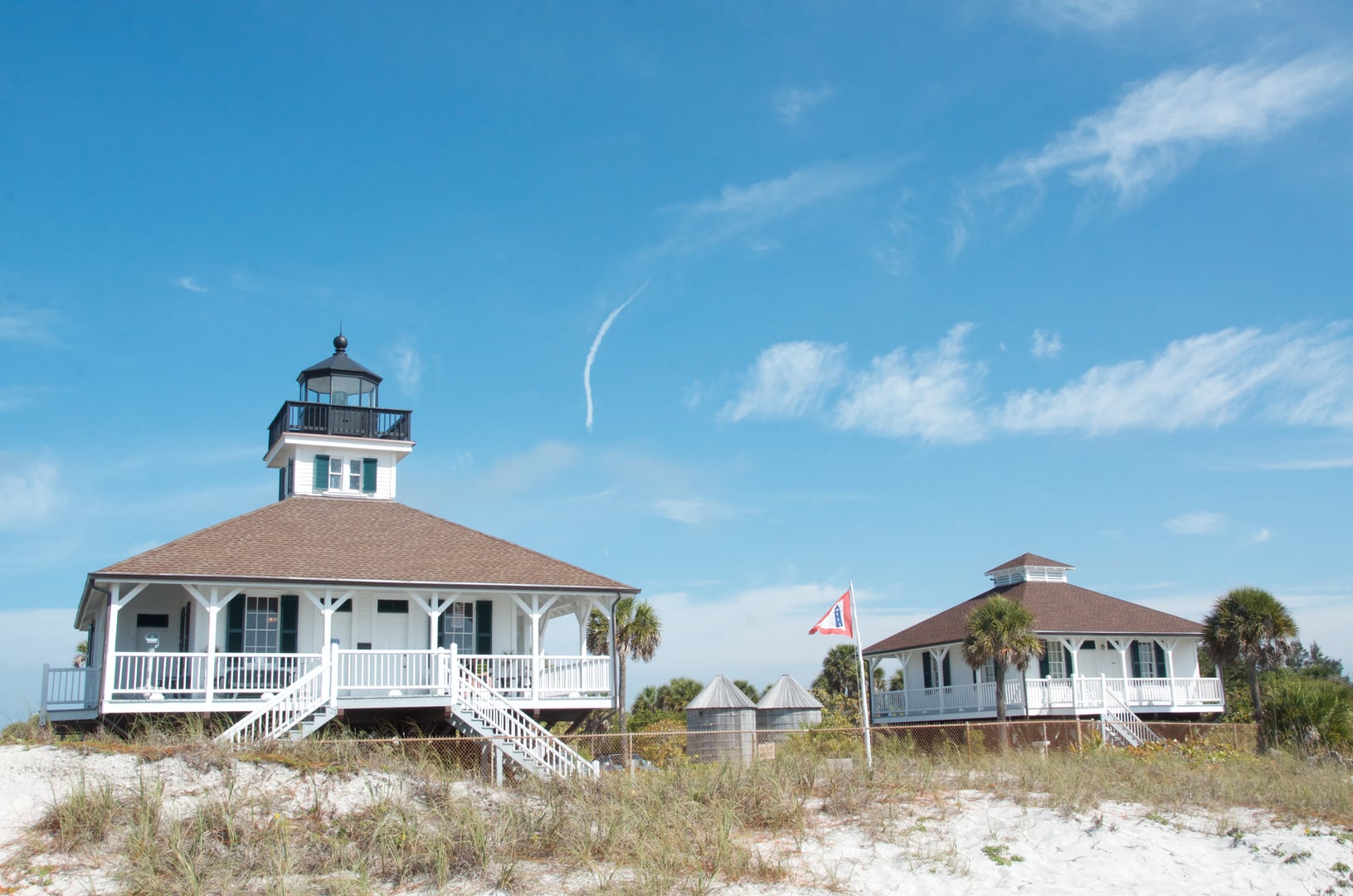
Boca Grande, FL
Port Boca Grande Lighthouse was built in 1890 at the southern tip of Gasparilla Island to mark the passage into Charlotte Harbor, a major commercial waterway serving the tarpon-fishing resort culture and phosphate shipping trade of Southwest Florida. The lighthouse was decommissioned in 1966 when a modern light took over the function, and the structure was later transferred to Florida State Parks, which restored it as a museum and active anchor of Gasparilla Island State Park.
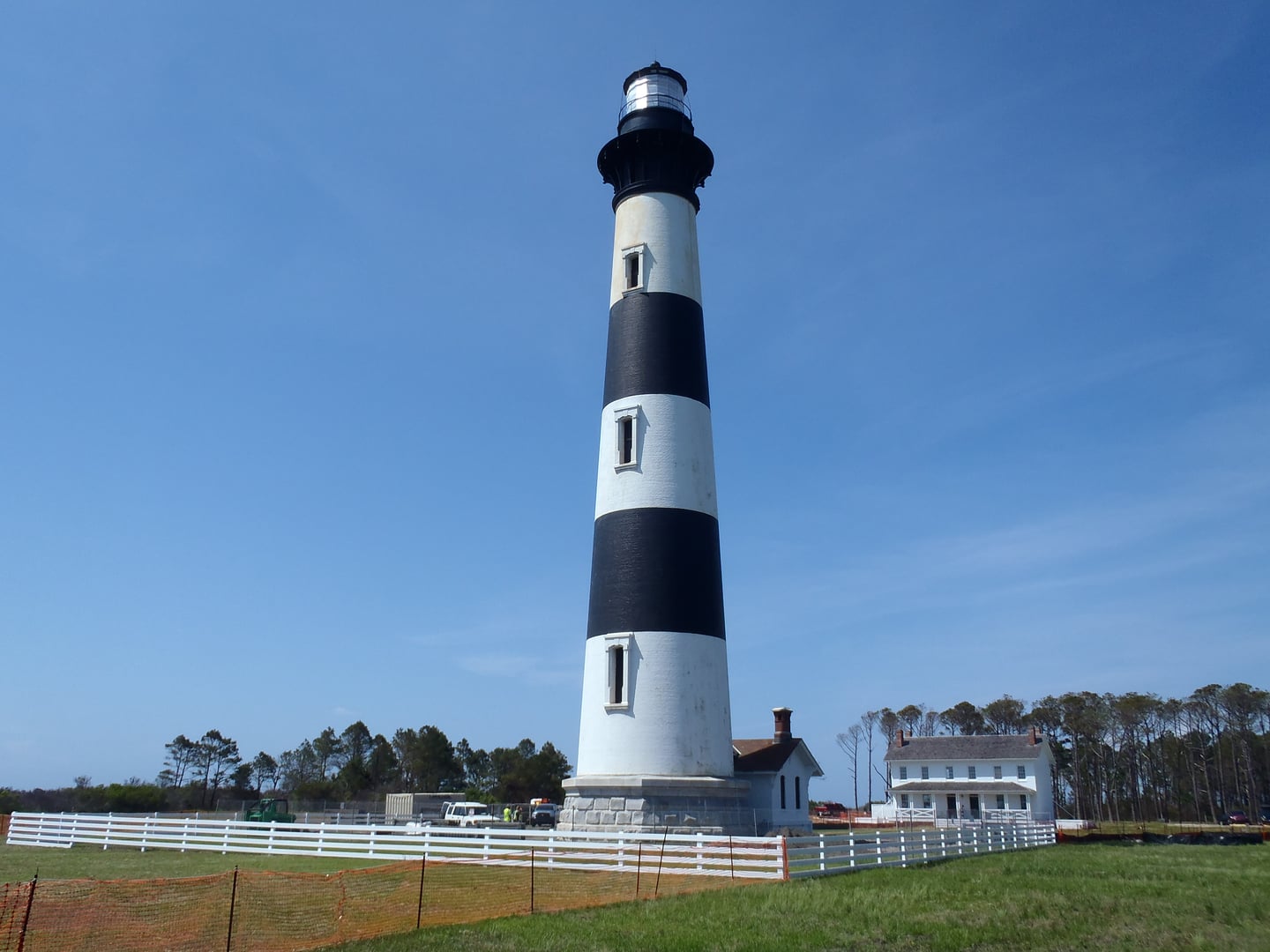
Nags Head, NC
The Bodie Island Lighthouse, built in 1872, is the third light station to stand on this stretch of the North Carolina Outer Banks. Its 156-foot tower marks one of the most treacherous sections of the Graveyard of the Atlantic between Cape Henry and Cape Hatteras.
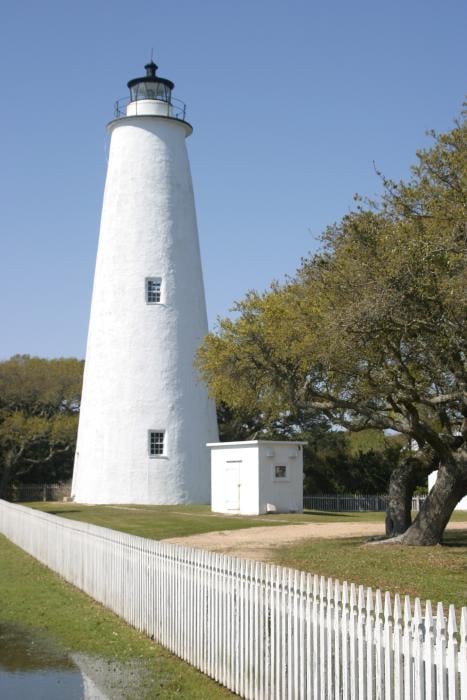
Ocracoke, NC
Ocracoke Light is the oldest operating lighthouse in North Carolina and the second-oldest operating lighthouse in the United States. Built in 1823 by Noah Porter for $11,359, the 75-foot whitewashed brick tower has guided ships through Ocracoke Inlet for over two centuries and has been administered by the Cape Hatteras National Seashore since 1951.