Est. 1852 · National Historic Landmark · Mississippi Hills National Heritage Area · Greek Revival Architecture · Enslaved-People History
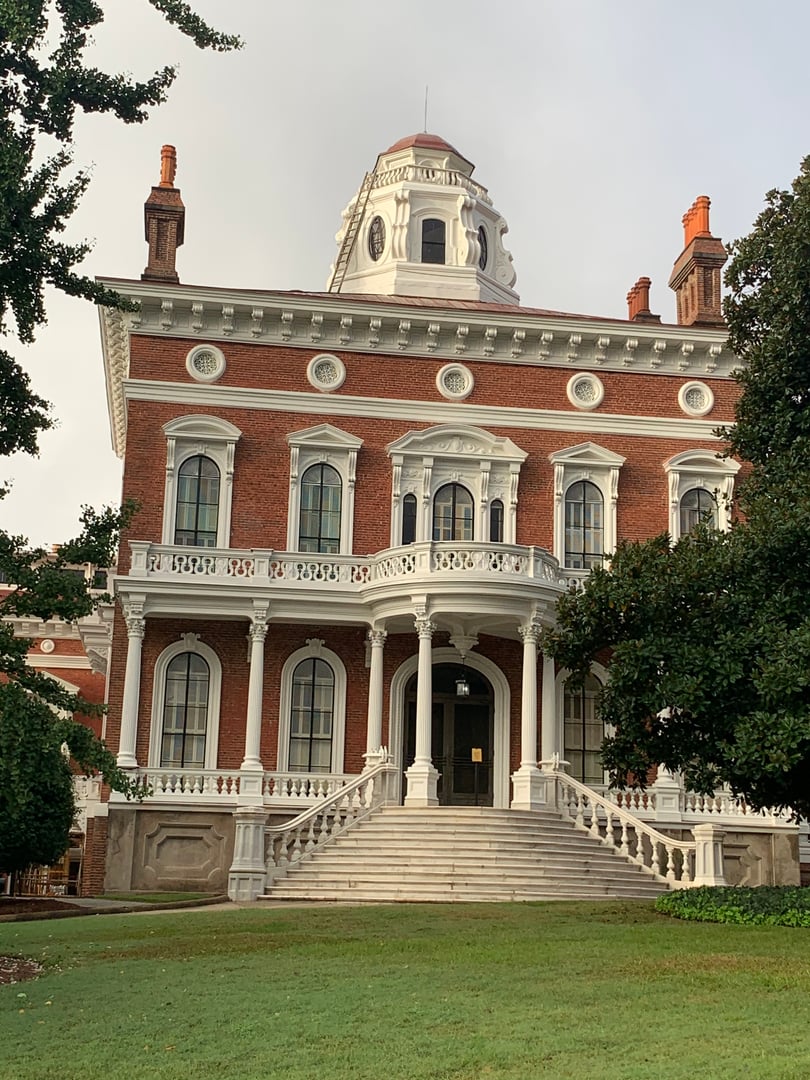
Colonel George Hampton Young, a planter and lawyer from Georgia, established the Waverley plantation in the 1830s on the Tombigbee River. The current mansion was completed in 1852, designed in a Greek Revival idiom unusual for its octagonal central rotunda and a four-story self-supporting spiral staircase rising to a domed cupola.
Like all Mississippi plantations of its scale, Waverley's operation depended on the forced labor of enslaved people. U.S. Census records from the 1850s document the enslaved population at the property; their full names and histories are partially preserved in family papers held by Mississippi State University. The site is recognized today as a designated Mississippi Hills National Heritage Area location, and its interpretation includes the enslaved community alongside the Young family narrative.
The property passed to the Youngs' children after the Civil War. The last of Colonel Young's ten children died as a bachelor in the early twentieth century, and the mansion was effectively abandoned. For roughly five decades, the house sat empty; period photographs document a Greek Revival shell with broken windows, a partially collapsed roof, and overgrown grounds.
In 1962, Robert and Donna Snow purchased the mansion and began a multi-decade restoration. They opened the house for tours and lived in the residence; the Snow family operated Waverley through 2009. After a period of closure, the property was acquired by new owners, and most recently by Charlie and Dana Stephenson, who have been undertaking further restoration. The mansion was added to the National Register of Historic Places in 1973 and designated a National Historic Landmark in 1974. Public access currently operates on a special-occasion basis rather than daily tours; spring pilgrimage weekends remain the most reliable visiting window.
Sources
- https://en.wikipedia.org/wiki/Waverley_(West_Point,_Mississippi)
- https://www.wpnet.org/waverly-mansion/
- https://mississippihills.org/directory/waverley-mansion/
- https://www.battlefields.org/visit/heritage-sites/waverley-plantation-mansion
ApparitionsPhantom voicesPhantom soundsDisembodied laughter
Robert and Donna Snow, who purchased Waverley in 1962 and restored it room by room, became the central witnesses behind the mansion's reputation. The Snows reported a young girl's voice calling for her mother on the upper floors, particularly in the rotunda. They told tour visitors and journalists that the voice was heard often enough that family members eventually stopped commenting on it.
Other accounts recorded by tour guides and visitors describe music and laughter from an unseen ballroom gathering, the silhouette of a Confederate-era figure briefly visible in interior mirrors, and a horse and rider that move through the front lawn at dusk. None of these accounts is documented in pre-1962 records; the mansion stood vacant from roughly 1913 through 1962, and the legends took shape during the Snow restoration period.
Local historians treat the stories as cultural artifact rather than verified phenomenon. The young-girl-crying account is the most consistent and longest-running report, repeated across multiple owners and decades of visitors. Whether one attributes the experience to suggestion, to the acoustic peculiarities of the four-story self-supporting staircase, or to something else, the report itself is unusually stable for an antebellum mansion narrative.
Waverley's history also includes the lives of enslaved people forced to labor on the property before 1865. Contemporary interpretive practice asks that this history be presented with archival respect; sensationalizing ghost-story narratives without that grounding misrepresents both the property and the people whose lives shaped it.
Notable Entities
The crying girl on the upper floors